How do Japanese view Mongolia?

An interesting article written by Kunio Minato (JGSS Research Center).

JGSS-2006 から見た日本におけるモンゴル国の好感度 -東アジア各国・地域との比較検討-
(日本版総合的社会調査共同研究拠点 研究論文集[9] JGSS Research Series No.6)

Abstract

Favorability of Mongolia in Japan Seen From JGSS-2006:
Comparison With East Asian Countries/Region

Relationship between Japan and Mongolia has been expanding since Mongolia abandoned its socialist system in 1990. Then, how do the Japanese feel about this “new” neighbor? And what are the factors associated with it? To answer these questions, the author examined favorability of Mongolia and made a comparative analysis with other East Asian countries and region (South Korea, North Korea, China and Taiwan), using JGSS-2006 data. The results are the following: First, favorability of Mongolia is the second highest after Taiwan. Second, amount of reading books has significant positive effect on the favorability, which might reflect the popularity of Japanese literatures featuring Mongolia or Mongolian figures. Third, males are more likely to have favorable feeling toward Mongolia than females are. Fourth, Mongolia makes favorable impression residents in especially in Kanto area. JGSS-2006 is virtually the first social survey which asks favorability of Mongolia to the Japanese, and the results of analysis shown in this
article are expected to deepen mutual understanding between Japan and Mongolia.
Posted in International Relations, Japan | Tagged | Leave a comment

Air pollution in Ulaanbaatar reaches alarming levels

An article published by Canadian and Mongolian researchers last week argues that nearly 10 percent of Ulaanbaatar city’s total mortality are attributable to outdoor air pollution. The article shows that a major source of air pollution in the city is emissions from home heating in low-income ger areas, and it urges anti-air pollution efforts to focus on those areas.

The article is downloadable from here.

Posted in Air Pollution, Environment, Health, Social Issues, Ulaanbaatar | Tagged | Leave a comment

Arriving in Ulaanbaatar (Again)

By Julian Dierkes

[This is a very belated posting of some writing I did in August]

Getting to Ulaanbaatar and then arriving in Ulaanbaatar continues to be somewhat of an adventure even when I’ve arrived on my 10th (I think) trip in the past seven years.

I flew into Tokyo, transferred from the Air Canada terminal to the JAL terminal, flew to Beijing (where personnel remains as surly as ever, though the in-terminal “hourly hotel” is a blessing on this kind of layover, then MIAT at 1h in the morning to arrive at ULN at 3h in the morning.

MIAT now hands out landing cards which is a real blessing as it avoids the mad scramble for the cards in the arrival and immigration hall.

My pick-up was not immediately in the arrivals area, perhaps because I was out so quickly with carry-on only, so I immediately noticed a line of sleek and formal-looking taxis waiting outside the front.

On the drive in, I noticed that the very colourful lights that decorated the last bit of the long road into town this past winter were now lining the road with white lights, while blue lights were draped overhead.

I was meant to stay at the Palace Hotel (which would have been new to me), but that somehow didn’t work out. Lots of construction visible even at night, including a huge apartment block just before the Peace Bridge.

Posted in Change, Tourism, Ulaanbaatar | Tagged | Leave a comment

Insights from the 2010 Mongolia Census

A preliminary summary of the 2010 Mongolia census is available online.  The census shows us some important trends in Mongolia.

Total population in Mongolian has reached 2 754 658. An estimated 100 thousand people counted as Mongolian citizens living abroad for more than six months, but it is doubtful how many percent of Mongolian citizens studying or working abroad were able to register or be counted.

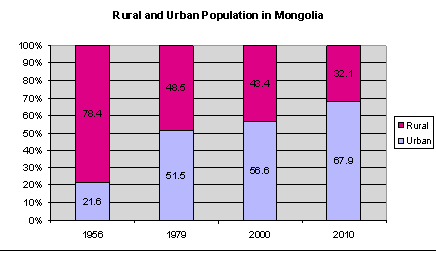
Migration to urban areas is on rise. In 2000, 56.6 percent of the population were living in Ulaanbaatar, aimag centers, and towns. Now, that is 67.9.  Only from the second half of the twentieth century, Mongolia has seen rapid urbanization. Urban population was only 21.6% in 1956, but it doubled within next two decades and reached 51.5% in 1979. There have significant urban to rural migration in the country in the early 1990s due to the privatization of socialist farms and cooperatives. But we see substantial growth of urban population over the past decade. We are in the second wave of rural to urban migration in Mongolia.

Data source: www.toollogo2010.mn


to be continued.

Posted in Demography, Population, Social Issues, Society and Culture | Tagged | Leave a comment

Anti-Chinese Attitudes in Post-Communist Mongolia

Anti-Chinese attitudes are luring our interest – so we are attempting to explain this unique phenomenon on Mongolian example. Here is my thesis abstract:

This thesis examines “anti” attitudes in general and anti-Chinese attitudes in Mongolia in particular, to answer the puzzle: Why do anti-Chinese attitudes in Mongolia still persist after both nations have enjoyed friendly, neighborly state-to-state relations for more than two decades? The argument is made that anti-Chinese attitudes in Mongolia are persistent because of lingering impacts of artificially-consolidated negative schemas about China, Chinese people, and their culture from the 1960s-1980s. Mongolian political elites at that time institutionalized anti-Chinese attitudes, introducing only negative schemas, while blocking all other sources for positive or neutral schemas about China. Nevertheless, Mongolian political elites’ attitudes toward China became noticeably positive since mid-2000 due to increased interactions, information, and the changing economic reality despite of the fact that unfavorable views of China and the anti-Chinese attitudes have still dominated the media, blogosphere, and public discourses. The main reason for the gap between attitudes of the political elites and the public can be explained by a reluctance of the political elites and intellectuals to de-construct the past schemas because of its diacritic purpose to differentiate Mongolian identity in addition to material realities. This thesis also contends that anti-Chinese attitudes in Mongolia are a variant of a global anti-Chinese phenomenon. The “anti” attitudes are explained by three main reasons: a power imbalance, a backlash against economic activities, and conflicting identities. In this regard, the Mongolian case study is an excellent entry point to understand the causes and consequences of anti-Chinese attitudes in the small, developing, democratic Chinese neighbors. This thesis uses analytical approaches for a similar phenomenon, anti-Americanism, and extensively uses the notion of schema, as developed by Katzenstein and Keohane (2007) in their conceptualization of anti-Americanisms.

Posted in China, Nationalism, Social Issues, Society and Culture | Tagged | 2 Comments