Changes in Ulaanbaatar’s Cityscape

By Julian Dierkes

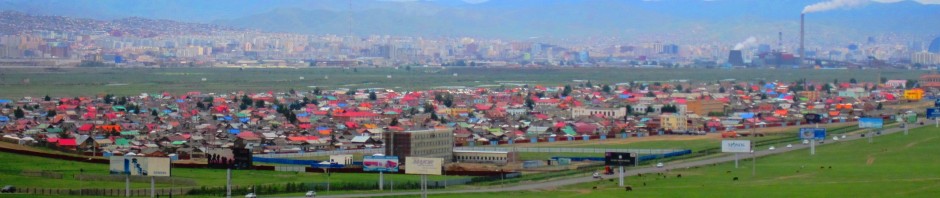
One of the delights of returning to a city on a regular basis but at somewhat lengthy intervals (I’ve been traveling to Ulaanbaatar once or twice a year for the past seven years) is that gives the observer an opportunity to notice changes in the cityscape.

There was lots to notice on my most recent, August 2011, visit.

To anyone who is familiar with the (East) German Ampelmännchen it might not come as a surprise that the intersection at the SW corner of Sukhbaatar Sq now boasts traffic lights with an archer, wrestler, and horseback rider as the traffic light symbols. Terrific!

Not only have the traffic lights been changed, but some of the one-way rules on the W side of the square have also changed and traffic seems to be flowing a bit smoother now. Hard to tell as it was still summer and thus a lot of Ulaanbaatar residents in the countryside, but traffic seemed marginally lighter than during my last visit in January 2011.

The other most significant traffic and building project is probably the additional bridge over the Tuul which should ease N-S traffic a bit.

I used to think that Mongolia was where Hyundai Accents went to die, but they are not as dominant in traffic as they used to be. Generally, a greater mix of cars around. Some of the city buses are now a mobile WiFi hot spot.

More and more (small) parks seem to be appearing in downtown Ulaanbaatar. The park in front of the Central Tower looks quite manicured, including a water feature, at least in summer. Likewise the centre of the street leading straight North for the State Department Store has received a facelift and now looks quite attractive.

With some small parks springing up, fancy buildings are not far behind. The new MPP headquarters looks bombastic and almost finished. The DP will surely follow suite and construction is already under way on its sight next to the state opera, overlooking Sukhbaatar Sq.

Posted in Change, Ulaanbaatar | Tagged | 1 Comment

Mongolia Connected

According to the 2010 Mongolia Census, 30.6% of Mongolians (six years old and older) use the Internet. The level of Internet usage is higher in Ulaanbaatar (49.3%) and some urban centers, such as Erdenet (36.5%) and Darkhan (34.4%). A wide digital gap appears to exist particularly between Mongolia’s far western provinces and Ulaanbaatar as only about 10% of far western residents use the Internet. The usage of internet is urban-centric, but it is growing and diversifying.

Nowadays, some cellphone network operators provide inexpensive access to Internet (at least using messenger and email services) in Mongolia. The usage of cellphones is increasing dramatically. 74% of Mongolians (including children) and 86.9% of the residents of Ulaanbaatar have at least one cellphone. Two years ago, one could find a “street-phone” or a portable telephone, which all small kiosks and street vendors had everywhere in Ulaanbaatar. Now, they have disappeared.

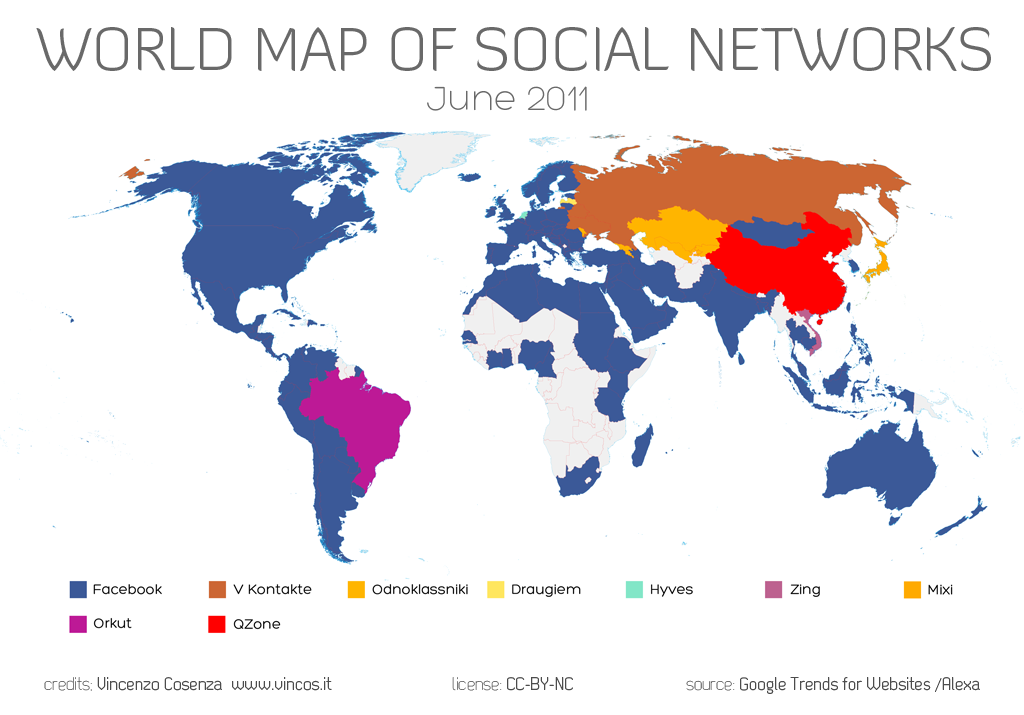
Obviously, the increasing usage of Internet and cell phones has many important implications for everyday life, politics, and business. Broadly, it makes a landlocked country “land-linked,” and its people more connected. The map that you see below shows an interesting pattern. It obviously shows the expansion of Facebook, but it in part shows a difference between Mongolia and its immediate neighbors.

World Map of Social Networks

Posted in Population, Society and Culture, Ulaanbaatar | Tagged | Leave a comment

All is well in Mongolia?

By Julian Dierkes

After the recent flurry of reporting (Economist I, Economist II, National Post, Globe & Mail, The Northern Miner, The Financial Times, The Australian, on the electionineering sparring match between some Mongolian MPs and, who?, Ivanhoe?, the current government? China? some writers (Peter Koven for the National Post, Brenda Mouw for the Globe & Mail) are now giving the all clear because the Government of Mongolia has released a joint statement with Ivanhoe and Rio Tinto reaffirming support for the 2009 Investment Agreement.

This “all clear” is appropriate, but also comes a bit too quickly in my view.

Yes, All Clear!

Yes, negotiations over the Investment Agreement are not being reopened, but that’s not much of a surprise. A succession of governments in Mongolia have fought for and supported a comprehensive agreement with the foreign investors who are making development of the OT project possible in a way that would not be imaginable through domestic efforts alone (technological as well as financial hurdles). I emphasize governments to mean the executive, i.e. the president and cabinet, not members of the Ikh Khural.

Because there was a petition and it was addressed (though I wonder what exactly any discussions may have consisted of other than recognizing that IVN and RT responded, “No way are we re-negotiating at this point!”), this should quell some of the agitation among MPs.

Namely, if my analyses are right that a) this is primarily an election issues, and b) we will not see the emergence of a stable anti- or pro-mining political movement, then this means that there should be no formal attempts to revisit this issue, at least until this current government including its coalition arrangement fall, or the election, possibly even the presidential election in 2013.

Hang on a Second!

The underlying issue hasn’t gone away and we’re likely to see agitation on this issue – namely how to structure resource development so that it satisfies social demands for equitable and sustainable development – for years to come. We saw lots of discussions, including some grandstanding and nationalism, but also some very reasonable attempts to come to sensible solutions, for the five years leading up to the OT IA. It is therefore not at all surprising to see that these discussions are continuing and not terribly insightful to predict that they will continue.

What is less fortunate in this entire situation is that politicians’ attempts to initiate such discussions are frequently not channeled into a careful consideration of underlying issues involved, prompting much more long-term thinking and deeper analysis, but instead that the past two weeks clearly point to electoral positioning. Some of the people involved appear to be prioritizing personal political ambitions over national development goals which may OR MAY NOT best be served by attracting foreign investors to develop mineral deposits.

Musings that destabilize the investment climate and, possibly, Mongolia’s international positions for the sole benefit of possible electoral gain are certainly not a way to move a careful analysis of the issues facing Mongolia forward.

Other Immediate Implications

Perhaps the start and stop of re-negotiations cleared the air a little bit, but it’s hard not to think that the recent turmoil will have an impact on further negotiations regarding Tavan Tolgoi, the large coal project that the government wants to subcontract to international mining companies.

Posted in International Agreements, JD Mining Governance, Mining, Oyu Tolgoi, Politics, Research on Mongolia | Tagged | 1 Comment

Consensus on OT?

Mongolia’s President, Prime Minister, and Parliament Speaker want progress in OT, not delay.

Today, PM S. Batbold, Parliament Speaker D. Demberel and some members of parliament and cabinet members met with the President Ts. Elbegdorj to discuss current debates over the OT Agreement and the Election Law. President Ts. Elbegdorj backs the Government on OT. According to News.mn, the President stated that recent debates over OT Agreement need to stop, and Mongolia needs to exploit OT and get more investment as quickly as possible. Earlier this week at the opening of the Ikh Khural, the Speaker D. Demberel also urged progress in OT. During the meeting the PM S. Batbold said that the Government of Mongolia, Ivenhoe Mines and Rio Tinto are preparing a joint statement on OT. Tomorrow, PM S. Batbold will respond to the petition sent from 20 MPs last month.

Posted in Mining, Politics | Tagged | Leave a comment

No Stable Anti-Mining Coalition

By Julian Dierkes

Today, I published an Asia Pacific Memo that argued that no stable anti-mining coalition has coalesced in Mongolia to support or advance the recent petition asking the government to open negotiations with Oyu Tolgoi to increase the government ownership stake. Likewise, I don’t foresee a pro-mining party emerging any time soon.

Below, I offer an expanded version of this Memo:

Next week, German Chancellor Angela Merkel is scheduled to address the Mongolian parliament.  With this visit, Chancellor Merkel may hope to escape some of the turbulence of the current European debt crisis, but this visit will come in the middle of a mining policy tumult as Mongolian politicians are gearing up for a summer 2012 election. 20 MPs recently petitioned the government to re-visit an Investment Agreement signed with Ivanhoe Mines and Rio Tinto covering the giant Oyu Tolgoi project in 2009. This sent the shares of Ivanhoe and Mongolia’s credibility as a resource investment destination momentarily tumbling. Now, the speaker of the Mongolian parliament – who sets the legislative agenda – has lent his support to calls for a renegotiation of the Investment Agreement. Despite these voices, no enduring anti-mining coalition is behind this petition, nor has an anti-mining or pro-mining, single issue party emerged.

Mongolia has moved beyond the status of a “recent democracy” over twenty years after the gentle demise of state socialism through popular agitation. While Mongolian democracy has faced procedural and substantive changes, repeated peaceful changes of government and broad participation of the citizenry in politics  have established the rule of the people for the people firmly.

This puts Mongolia in noticeable contrast with the authoritarian post-Soviet republics of Central Asia where natural resources have also come to form the basis of economic development.

For the past five years and likely into the foreseeable future, Mongolian politics have revolved around the development of the Oyu Tolgoi copper and gold project in the South Gobi. When the mine goes into production (perhaps in 2013), it will dwarf all other single economic activities, contributing perhaps one third of GDP and will continue to do so even if the best-intentioned efforts at diversification succeed. The future of Mongolia’s GDP thus depends on this project to a great extend. However, many Mongolians also contend that the future of Gross National Happiness may depend on the participation – as owners – of the Mongolian people in this development project.

The negotiations between Ivanhoe Mines and the Mongolian government, later joined by Ivanhoe investor Rio Tinto, were a slow-moving roller coaster with numerous twists, turns, and dips largely created by the public musings of Mongolian politicians. Some of these musings led to a one-third ownership stake of the government in the Oyu Tolgoi project, bought with money borrowed from Ivanhoe Mines. While many had hoped that the conclusion of an agreement would lead to the stability favoured by international investors, the current turmoil has dashed these hopes.

But are current debates an indication of a long-term risk? Curiously no anti-mining party has emerged. Instead, individual politicians have created turmoil and continue to do so now. Noticeably these individual politicians are never members of the executive. While some politicians have railed against the Investment Agreement covering Oyu Tolgoi for years, they have not attempted to rally around this issue to form a single-issue party.

Of course, single-issue parties are not uncommon. Consider the Bloc Québécois in Canada or the anti-nuclear German Green Party of the early 1980s. So why no such single-issue grouping in Mongolia when the issue – Oyu Tolgoi – is arguably THE central issue facing Mongolians?

Two dynamics prevent the emergence of such a movement: 1. Corruption and patronage, and 2. The uncertainty about their opposition or support among even ardent proponents.

Mongolian politics revolve around patronage. That is politicians build their electoral strength relying on the positions and funding that they can offer to supporters once elected. Corruption can play an important role in shoring up such support by making greater financial means for such efforts available. Since patronage appointments are only available to members of the government or at least of parliament. There are thus significant incentives to individual politicians to be a member of a ruling coalition or of the government. These incentives have stabilized a grand coalition for some years, despite the Mongolian People’s Party’s majority of seats, by offering an incentive to Democratic Party officials to participate in a coalition.

Secondly, the strong populist ethic in Mongolian politics and especially its election campaigns has prevented politicians (and thus parties) to stake out strong substantive positions, lest they be identified to closely with this position and risk the wrath of the electorate should this position turn out to loose or fall out of favour. This has also stabilized the government coalition in that neither participating party wanted to risk being seen as the sole proponent of the OT Investment Agreement. While Mongolian politicians are commitment-shy on the Investment Agreement, they are not at all shy about sharing their musings on this issue very publicly, often via Twitter these days, with little regard to the state of mind of investors who interpret these musings to place Mongolia among investment-friendly and hostile economies.

Unless these underlying dynamics change – and the current turmoil if anything suggests that they will not leading up to next summer’s election – no stable anti-mining coalition, nor a forceful pro-mining grouping will emerge. If you are interested in following this story over coming years or, worse, if you are financially invested, buckle your seat belts! Mongolian politicians are going to continue to muse about the best way for the Mongolian people to participate in their mining boom and the options they will be considering will frequently be misidentified as resource nationalism.

P.S. (Feb 2013):
The absence of an anti-mining movement continues through 2012 and into 2013 despite simplistic cries of “resource nationalism” by foreign investors that are echoed by some writers. See:

Posted in Asia Pacific Memo, Democracy, International Agreements, JD Mining Governance, Mining, Oyu Tolgoi, Party Politics, Politics, Research on Mongolia | Tagged | 3 Comments

OT: In Danger of Becoming A Hostage in Domestic Politics, Again

In 2005, Ivanhoe’s Robert Friedland’s infamous statement about the huge profits to be made in Mongolia at an investor conference in Florida delayed his deal with the Government of Mongolia over one of the biggest copper deposits in the world, Oyu Tolgoi (OT).

Like many other democracies, political parties and politicians attempt to build up their profiles for upcoming elections in Mongolia – they often attempt to distinguish themselves from the ruling government.  The next parliamentary election is scheduled in June, 2012.  Following this logic, 20 members of the Mongolian Parliament issued a petition to the Prime Minister to demand the implementation of the parliamentary resolution that allowed the government to conclude the stability agreement with Ivanhoe and Rio Tinto. [Unuudur Newspaper, September 28, 2011]

However, Rio Tinto’s country director and chief executive Cameron McRae’s statement in the Australian on September 12, 2011 provided a golden opportunity for Mongolian parliamentarians to rally publicly.  Although the piece was originally titled “Rio Tinto Warns Mongolian Politicians Not To Be Greedy,” it seems that the newspaper then reworded the title as “Warning on Mongolia’s Minerals Regimes” as the investors demanded corrections. The original title can be found in several Mongolian blogs, for example, Business Mongolia.

Following this news article, several parliamentarians representing the 20 Mongolian MPs, who issued a petition to the Prime Minister, made statements that Cameron McRae intervened in an internal matter (politics of sovereign nations, rights of Mongolian parliamentarians) and even threatened  OT to disclose any hidden deals with other Mongolian politicians.

In response to MPs call, A. Munkhbat, an OT Vice President, denied Mr. McRae’s statement and stressed that the journalist of the Australian acknowledged his mistake of disseminating wrong information at a press conference on September 29, 2011. [OT Media Release, September 29, 2011].

If one ignores this bickering, the Mongolian government is in negotiation with  Rio Tinto and Ivanhoe  following the petitions of the 20 parliamentarians and directives of the Standing Committee of Foreign Affairs and Security of the Parliament, according to Minister of Mineral Resources, Zorigt [Press Release, Government of Mongolia, September 21, 2011].   And, Ivanhoe and Rio Tinto expressed their unwillingness to re-negotiate  the terms of the 2009 agreement.

Obviously, the Prime Minister would respond to the petition of the 20 members after their negotiation with the Rio Tinto and Ivanhoe.  But, Mongolian politicians and the media apparently over-reacted to a presumed news item in the Australian – which almost made  local politics global and OT a hostage of domestic politics as in the past – when Friedland’s casual comments in Florida resonated in Mongolian politics.


Posted in Mining, Oyu Tolgoi, Politics | Tagged | 4 Comments

MPs Petition to Renegotiate OT Agreement

By Julian Dierkes

Over the last several days (late Sept. 2011) there have been quite a number of articles in the press outside of Mongolia about a petition that was submitted to the Prime Minister of Mongolia by 20 MPs demanding a renegotiation of the Oyu Tolgoi investment agreement and more specifically demanding that the government pursue a 50% ownership stake. Part of the quick press coverage may have been brought about by the swift reaction from Rio Tinto and Ivanhoe.

Below we provide a rough translation of the original petition (by Byambajav D, edited by J Dierkes) as found on the personal blog of MP N Batbayar “A Petition Relating to the Oyu Tolgoi Deposit Issue Forwarded to the Prime Minister” [Accessed on September 28, 2011] Any annotations that we’ve added appear in [square brackets].

To the Prime Minister of Mongolia S. Batbold

On the Enforcement of the Ikh Khural’s Decision

Based on article 41.1 of the Constitution of Mongolia, the undersigned members of parliament are sending you this petition.

According to the article 29.4 of the Mineral Law, the Ikh Khural provided the Government of Mongolia the authority to negotiate the Oyu Tolgoi Investment Agreement and to conclude the agreement under the following terms and conditions:

  1. The minimum share of the state ownership of the Oyu Tolgoi deposit should be 34 percent;
  2. To permit the Government of Mongolia (S. Bayar [prime minister at the time of the conclusion of the agreement]) to conclude the the Oyu Tolgoi Investment Agreement in accordance with Mongolian legislation and […] guidance and recommendations approved by the Ikh Khural [see original Ikh Khural resolution made available by Business Mongolia;
  3. To obligate the Government of Mongolia (S. Bayar) to renegotiate the agreement and increase the state share of the Oyu Tolgoi ownership to no less than 50 percent after the first investment is paid-off.

However, the agreement that the government concluded did not fulfill the terms and conditions of the 57th decree [the terms listed above] of the Ikh Khural. Even though some members of parliament have repeatedly demanded that the government make amendments to the agreement in accordance with national interests, the decree has not been enforced until present and whether it will be enforced is not clear.

Thus, we demand that the 57th decree of the State Great Khural on the Oyu Tolgoi Investment Agreement should be enforced and results should be reported to the parliament by October 1, 2011.

If our demand is not fulfilled by this date, we will take all possible measures within our legal authority to conform the agreement to Mongolia’s national interest.

Sincerely,

The members of the State Great Khural who supported this demand:

Mongolian People’s Party

Ts. Davaasuren, B. Bat-Erdene, Ts. Batbayar, D. Baldan-Ochir, S. Byambatsogt, Sh. Saikhansambuu, D. Ochirbat, D. Terbishdagva

Democratic Party

N. Batbayar, D. Gankhuyag, S. Erdene, R. Amarjargal [prime minister 1999-2000], G. Bayarsaikhan, Z. Enkhbold, L. Gantumur, Kh. Temuujin, Ts. Sedvaanchig

Civic Will – Green Party

D. Enkhbat

Independent Members

Z. Altai, Ts. Shinebayar

[Party affiliations added in translation for clarity]

Some points to note about the petition:

  • none of the undersigned are members of cabinet. This makes a sense as the petition is directed at cabinet. It thus does not appear to be the case that Min of Mineral Resources, Zorigt, signed the petition.
  • a subgroup of the undersigned presented the petition at a press conference and seemed to be the initiators of the petition
  • some of the MPs who joined the petition were a surprise in that they had not previously been very vocal in opposing OT or the OT investment agreement: Enkhbat (Civic Will Party), Temuujin and Gantumur (both emerging leaders in the DP)
  • some of the “usual suspects” who have been vocal in their opposition in the past: Batbayar, Enkhbold, Bat-Erdene

A Mongolian securities firm (Frontier Securities) has provided a summary of the open letter to Rio Tinto written by the signatories of the parliamentary petition on their “Daily Strategy Notes” (thanks to Trish Saywell of the Northern Miner for pointing me in this direction).

In the brief analysis of the letter, the “chief investment strategist” for Frontier adds some other aspects to the categorization of signatories that we’ve provided above. I would largely agree with his conclusion that is important to view the petition and subsequent ‘campaign’ in the context of the upcoming parliamentary election and “primarily aimed to destabilizing political status quo and break up the Coalition Government as well as based on desire to project patriotic image to electorate”.

Posted in Foreign Investment, International Agreements, JD Mining Governance, Mining, Oyu Tolgoi, Politics, Research on Mongolia | Tagged | 5 Comments

Resources Available to Mongolian MPs

By Julian Dierkes

Parliaments around the world differ significantly as to the resources that they make available to individual MPs to support their parliamentary work, but also to serve their constituencies.

In Mongolia, the situation is as follows:

For the 4 years of their term of office, MPs receive an annual allowance of 1 billion MNT (C$820,000 (Sept 2011)) to spend on local development projects from the state budget. Projects can be development related projects, infrastructure development or sometimes an allowance to vulnerable groups within the constituency.

This allowance has increased significantly over the past decade: 2000 = 10 million MNT, then 100 million MNT, 500 million MNT in 2008 and 2009, and now 1 billion MNT per year since 2010.

In addition, MPs receive an allocation of 480.000 MNT (C$400 Sept 2011) for information and advertisement work for their constituency from the secretariat office of the Ikh Khural.

Each MP has three assistants and one adviser. One of the assistants is devoted to serve constituents.

Posted in Governance, JD Democratization, Law, Party Politics, Politics | Tagged | Leave a comment

The Legislative Process in Mongolia

By Julian Dierkes

[Byambajav Dalaibuyan, Naranzul Bayasgalan, and Mendee Jargalsaikhan all contributed to this post.]

The Ikh Khural (parliament) is the sole legislative body.

The President, the Government (usually the Prime Minister or a Deputy Prime Minister, but also Ministers who are MPs) and individual members of the Ikh Khural have the right to propose legislation.

Drafting of Laws

Within the government, the Ministry of Justice and Home Affairs is responsible for drafting laws in collaboration with the relevant Ministry for a specific proposal of a law. The Ministry of Justice and Home Affairs collaborates with the ministry or ministries that cover portfolios that are potentially relevant to a draft law.

Even if a law is proposed by the President or an individual member of the Ikh Khural, the
Ministry of Justice and Home Affairs forms a working group to draft the law to be submitted to parliament. These working groups may solicit input from stakeholders (private, public, NGO).

Draft laws come in three varieties: a new law, an amendment of an existing law, a rewriting of an existing law.

Proposed Laws in Parliament

When a law is proposed to parliament (by the President, the government or an individual member), the person proposing the law must provide specific information improves the existing body of laws, citing the specific impact this law would have on all interested parties.

Once a law has been proposed formally to the Ikh Khural, the Speaker assigns this proposal to one of seven standing committees: security and foreign policy, environment  and rural development, social policy, state organization, budgetary issues, legal issues, economic issues. Articles 19-25 of the Law of the Mongolian Parliament delineate the portfolios of these committees and their subcommittees and any ad hoc committees.

The 2006 Act on the State Great Khural Procedure suggests that if a draft law concerns public interest it should be discussed by a general session of the Ikh Khural. Furthermore, the Act opened up the possibility to publicize drafts in daily newspapers. After studying public comments, the relevant standing committee may organize hearings to involve testimony or statements from stakeholders and experts, though this is rarely done in practice.

Following any hearings or deliberations, the relevant standing committee will vote on whether to recommend a proposed law (as proposed, without amendments or changes) to be discussed by a plenary session of the Ikh Khural. If such a discussion is recommended, the standing committee designates one of its members to present the committee’s conclusions in this plenary session.

This recommendation is issued to the Speaker of the Ikh Khural who adds discussion of the draft law in a plenary session to parliament’s agenda. Discussions are prioritized by the Speaker in consultation with party leaders and individual members. The President and Prime Minister make announcements of their priorities that are taken into consideration by the Speaker in scheduling discussion at the opening of the parliamentary session in spring and fall.

In the plenary session, a proposed law is introduced by the sponsoring member who is then questioned by members of the Ikh Khural. Next, the Standing Committee reports on its deliberations in less than 15 minutes. Stakeholders may also be invited to speak on the proposed law. Finally, the law goes to a plenary vote. If the law passes without opposition, it is submitted for a final reading. If the law passes with substantial opposition, this opposition is documented.

In the preparation for final reading of the law, amendments can be offered, before it is transferred back to the relevant standing committee. Following its further deliberation, the standing committee passes the proposed law back to the original sponsor to be introduced in a final reading.

If the law is approved in final reading by a simple majority of the Members present, it is subsequently promulgated and published, unless vetoed by the President. The veto can be overridden by a ⅔ parliamentary majority.

If a draft law is not approved, it can be referred back to committee to prepare further readings of the law. These readings can span legislative sessions.

Sources
Posted in Constitution, Democracy, Governance, JD Democratization, Law, Politics | Tagged | 3 Comments

Asia Pacific Memo on the Impact of the Xinhai Revolution on Mongolia

My colleague, Tsering Shakya, wrote an Asia Pacific Memo today that points out that the end of the Qing Empire enabled parallel but different processes of political and social development in Tibet and Mongolia.

In every conversation about the parallel declarations of independence by Tibet and Mongolia, as well as the fascinating links between the two, including personnel overlaps, I continue to learn much that’s curious, fascinating, and enlightening from Dr. Shakya.

Posted in Asia Pacific Memo, China, Mongolia and ... | Tagged | Leave a comment

Canada-Mongolia Roundtable

On Friday, September 9, the biennial Canada-Mongolia roundtable is meeting in Ottawa. The MNG delegation is led by D Zorigt, the Minister of Mineral Resources and Energy.

The roundtable had originally been scheduled for earlier this summer, but the fuel crisis  prevented Min. Zorigt’s participation at that time.

A whole range of topics including bilateral aid, military relations, economic relations, environment, public service reform etc. will be discussed. A Foreign Investment Promotion and Protection Agreement is also still under discussion, see DFAIT’s website on such negotiations.

The wide range of topics to be discussed as well as the broad participation by many Canadian federal departments and agencies hints at the greater importance that Mongolia is acquiring in Canadian foreign policy (thinking).  Hopefully, these meetings might be extended to include academics and other interested parties in the future as well.

Posted in Canada, International Relations | Tagged | 2 Comments

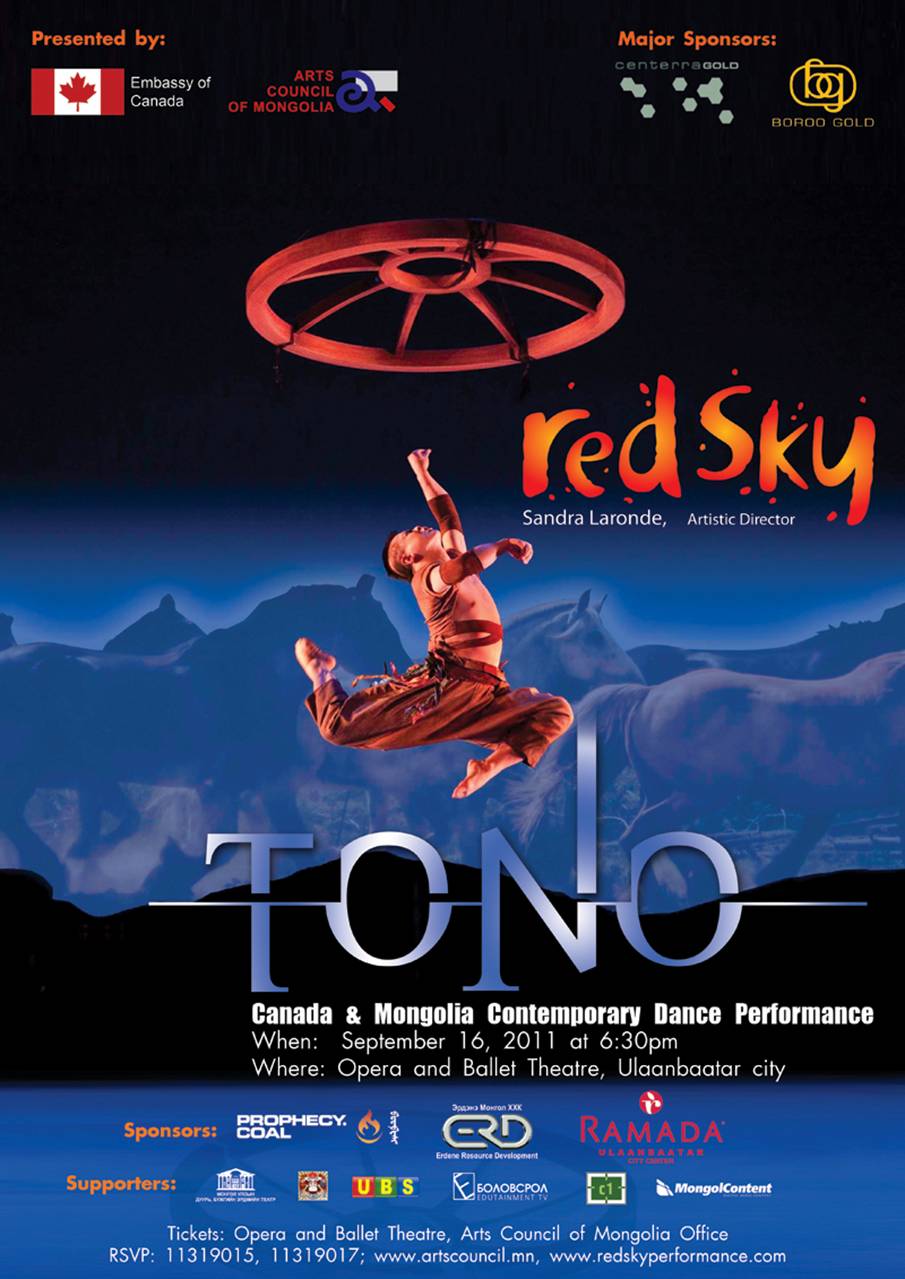
Tono Contemporary Dance

Red Sky’s “Tono” is (finally) coming to Mongolia: Sept 16 at 18:30h in the Opera.


Posted in Canada, Tourism | Tagged | Leave a comment

Mongolia: A Sultanistic Democracy?

By Julian Dierkes

In a late Aug 2011 column for the International Herald Tribune which was also published by the Globe & Mail, Chrystia Freeland of Reuters, wrote about arguments that some of the regimes that are currently crumbling in the Arab world should be categorized as “sultanistic”. She’s referring to a term as used by Jack Goldstone of George Mason Univ. “Sultanistic dictatorships” are focused entirely on the preservation of the power of the “Sultan”, devoid of any motivating ideology or drive. The argument thus goes that dictators like Moammar Qaddafi focus on the maintenance of their power through divide-and-conquer tactics using military might and trusted lieutenants. Their demise is sped up by the lack of a unifying or motivating ideology and various (elite) groups supporting the sultan this quickly abandon him (usually) as power dynamics seem to shift.

In Mongolia, the term “oligarchy” has been used more and more frequently in the past two to three years. The first person I heard use this term in the Mongolian context is Bat-Uul, prominent democracy activist since the early democratic movement and still an important power broker in the Democratic Party. The term is clearly borrowed from the Russian context where it refers to the few individuals who became massively wealthy in the turmoil of the privatization of state assets and through their proximity to political decision-makers. Not all of the “oligarchs” have been able to maintain their closeness to politicians, but they certainly seem to be a force in Russia.

While there are by now many rich people in Ulaanbaatar and many of them obviously maintain close relations with people in political power or wield political power themselves, this term of “oligarch” has not struck me as particularly useful in the Mongolian context. For one, while corruption may certainly have played an important role, it is not the chaos of relatively unstructured and unsupervised privatization that has built the wealth of some of Mongolia’s wealthiest. On the other hand, their wealth often is derived from areas that are quite central to the Mongolian economy, including significant shareholdings in the mining sector.

Yet, I see corruption as one of the root evils that threatens the existence of Mongolian democracy in the long term, not the presence of oligarchs.

As I contemplate long-term scenarios for Mongolian political development, it is clear to me that there is some significant risk of a descent into some kind of popularist authoritarianism (as seen in several of the -stans). The current incarnation of party politics also seems prone to sultanistic tendencies, i.e. an exclusive focus on the preservation of power, rather than a vehicle for democratic decision-making. The lack of a political, ideological and policy profile of any of the Mongolian parties (past and present since the early 1990s) is one of the great laments about political development there, and this lack has made some unfortunate aspects of Mongolian politics relatively prominent.

Of course, the focus on electoral politics is one of the aspects of diverse parties in developed and generally-assumed-to-be mature democracies, like Tony Blair’s and Gerhard Schröder’s Third Way, or Stephen Harper’s electoral strategies and courting of ethnic minorities in contemporary Canada. Nothing unique to Mongolia in this scenario. However, one significant difference: true and tested constitutional and electoral structures with significant distribution of power to different institutions. By contrast, Mongolia’s politicians keep tinkering with some of the foundations of their democracy (witness the recent debates about proportional representation in the Ikh Khural), and with the exact balance of power between the president and parliament/the prime minister (although the current Elbegdorj-Batbold cohabitation seems fairly quiet in this regard). It seems like a charismatic populist would be able to exploit parties’ and individual politicians’ sultanistic tendencies to establish him/herself as an authoritarian figure of some kind.

Posted in Democracy, JD Democratization, Politics | Tagged | 1 Comment

Bill Rafoss: Mongolia Looks to Change Electoral System

Bill Rafoss recently (August 11, 2011) wrote an article for the Saskatoon Star Phoenix. Bill has shared the article with me and I reproduce it (with Bill’s permission) below as well.

Bill Rafoss in Mongolia 2011

Bill Rafoss is a Sessional Lecturer at the University of Saskatchewan teaching in Canadian Politics. He went to Mongolia as an election observer in the 2009 presidential election and again this summer to research post-election violence.

Canada remains one of the last major western countries to operate its electoral system on the ‘first past the post’ system. Three of Canada’s provinces have considered changes to that system, to date unsuccessfully. Mongolia too is considering changes to its electoral system, moving from the first past the post system to one that includes proportional representation. The results of that debate could change the complexion of the Mongolian Parliament or Great State Khural next year.

Mongolia is a parliamentary republic that has been dominated by a two-party system since it severed its ties with the former Soviet Union in 1992. The Mongolia People’s Party (MPP), formerly the Mongolia People’s Revolutionary Party (MPRP), has been the natural governing party since 1992, but recently the opposition Democratic Party has been challenging the MPP for government.

In the last Parliamentary election in 2008, the MPRP won the most seats in parliament to the dissatisfaction of many urban Mongolians. Rioting broke out in the capital, Ulaanbaatar, following the vote and five people were killed in protests with the police. A Presidential election occurred in 2009 and the Democratic candidate won the Presidency. This sets the stage for a showdown in the next parliamentary election in 2012.

There are two other parties in the Mongolian khural: the Green Party and the Civil Will Party. These smaller parties, joined by other parliamentarians and civil society members, have been calling for electoral reform as a means of making parliament more inclusive. Many see parliament as an ‘old boys club’ fashioned for wealthy men. The leader of the Civil Will Party, Madam S. Oyun, has been an out-spoken critic of the first past the post system. She would like to see Mongolia move to a pure proportional representation system. Under such a system, her party’s 11% vote would translate into approximately the same number of seats and this might give her Green-Civil Will coalition greater bargaining power in Parliament, to the extent that they could even hold the balance of power. This could assist them greatly in forcing swifter action by the government on issues like unemployment and poverty as well as pollution in the capital city. Currently, some 30% of Mongolia’s population live below the poverty level.

A Parliamentary Committee has been struck to recommend changes to the electoral process. There is some urgency to this committee’s work if Mongolia is to avoid the violence that marked the 2008 election. However, the Committee itself has been unable to reach consensus on a new approach. Larger, national parties tend to favour first past the post since it affords them the best chance of achieving a majority government. The MPP in particular, sensing that it has the most to lose in a PR system, has rejected PR for all 76 members of parliament. The latest proposal on the table is to move to a 38/38 formula, where half of the MP’s are elected at the local level, as we do in Canada, with the other half elected through proportional representation from party lists of candidates. In other countries that use proportional representation, these lists tend to field a more diversified group of candidates than the FPTP system.

A decision on changing the electoral process must be made by December 31st this year if the process is to change for the parliamentary election next year. A decision to change to the 38/38 formula could result in a more diversified parliament, where more voices are represented and likely more women are elected. If there is no change, the two party system will continue to dominate Mongolia, with the only question remaining which party will hold power.

Mongolia has recently signed an agreement with Canada to modernize its civil service. Canada would do well in return to watch how Mongolia moves toward a more inclusive parliament, as it may wish to consider such changes in the future.

Posted in Party Politics, Politics | 1 Comment

Economy, Security and Democracy – China, Russia, and US

A few days back, Stephen Noerper wrote a commentary – capturing a historic little known visit by the Vice President Biden.

But, I like to rewind it a few months back.  A number of visits by Mongolian officials to its neighbors and third neighbors reciprocated in a very short period.  This was not a case before.  Reciprocation for high-level visits to India, China, US, South Korea, and now Finland as well as Germany is happening just in one year.  Maybe Mongolian diplomats are working so hard, or there is some special interest – attracting Mongolian friends in shorter period.  Mongolian tabloids are linking all these high-level visits with the country’s natural resources, investment in infrastructure, and even not-so-clear nuclear waste repository talks.  These puzzles probably need to be re-visited – What attracts series of high-level visits?  All wants to visit Mongolia while it is a summer there, maybe, – In fact, three high-level persons from US, China, and South Korea landed in the Chinggis Khaan airport in a same day.

In June, 2011, we also observed another interesting dynamics of Mongolian foreign policy.   Mongolia secured over 10 agreements with China and declared strategic partnership.  Almost at the same time, Mongolian President assured that Mongolians miss Russians in his speech in Moscow while Russia was still hardheaded in settling fates of joint ventures in Mongolia in order strike a deal in Mongolian mining exploitation.  In contrast, Mongolian President visited the US military hospital in Washington to express his sympathy for the US military personnel. This was surprised and touched Biden and many other Americans.  Mongolians bought Boeing and requested support for Mongolia’s lead on democratization.  A quick observation is a small nation could play diplomacy with big powers, but it is difficult, and costly, which we start seen from last summer as Mongolia starts receiving bids  from them in the largest choking coal deposit.  Another look, China offers money, Russia tries to make a deal using its old legacy, and US admired Mongolian democracy.  Mongolia looks China for economic support, Russia for security, and US for democracy. Is it representing changes in major powers’ capability and interests.  They all want to be major powers, reality is changing dramatically. Will these three converge or diverge?

Posted in China, Foreign Policy, International Relations, Politics, Russia, United States | Tagged | Leave a comment