More Details on Election Procedures

The polling stations will be open from 7 to 20h on June 28. Since the voting is happening using voting machines that tabulate votes as voters feed them into the machine, the count should be very quick after the polling stations are closed. The voting machines are set up to report results immediately to the general election commission, rather than any kind of tabulation by the local election officials intervening in the reporting.

This reporting structure suggests that barring any major mishaps or immediate challenges, preliminary results can be expected very quickly after polls close, but certainly on Thursday evening.

There does seem to be some dissatisfaction with the information about the election that is being distributed by the General Election Commission. However, flyers have been distributed to (Ulaanbaatar town centre) households that show samples of the ballot. At least the flyer that was delivered to the apartment we’re staying in was specific to the Sukhbaatar electoral district (#26).

On the national ballot, voters here in Sukhbaatar-Ulaanbaatar would mark two names (but organized by party) in the top section that casts their vote in the first-past-the-post riding election, and then mark a single vote for the part in the bottom section to cast their vote for nation-wide proportional representation party votes. For Ulaanbaatar voters, they would have a second page to cast their vote in the Ulaanbaatar city parliament elections on the same system, though with single-member districts. Note that the city election is being held in parallel with the national election for the first time.

Note that most electoral districts send two members to parliament (1 Arkhangai, 2 Bayan-Ulgii, 3 Bayankhongor, 7 Dornod, 9 Uvurkhangai, 11 Selenge, 13 Uvs, 14 Orkhon, 15 Darkhan-Uul,16 Khentii, 17 Tuv, 18 Khuvsgul, 19 Zavkhan, 20 Khovd, 22 Ulaanbaatar – Bayangol, 24 Ulaanbaatar – Khan-Uul, Bagakhangai, Baganuur, 25 Ulaanbaatar – Chingeltei, 26 Ulaanbaatar – Sukhbaatar), though there are six single-member districts(4 Bulgan, 5 Govi-Altai, 6 Govisumber and Dornogovi, 8 Dubdgovi, 10 Umnugovi, 12 Sukhbaatar), and two three-member districts (21 Ulaanbaatar – Songinokhairkhan, 23 Ulaanbaatar – Bayanzurkh).

The ballots themselves look like Scantron sheets where voters are required to fill in bubbles to mark their vote. In the polling stations, voters will register, receive their ballot, mark the ballot behind a privacy screen, feed this ballot through the counting machine, insert the paper ballot into a ballot box and exit the voting area, presumably being recorded as having voted, though whether this is by marking identification papers or fingernails or through some other method, I have not found out.

Posted in Elections, Ikh Khural 2012, JD Democratization, Party Politics, Politics | Tagged | 2 Comments

Campaign Workers

As in previous elections, political parties once again seem to be hiring large numbers of students to work as campaign workers. Typically, these campaign workers travel in groups close to a campaign event, dressed in some kind of slogan-bedecked shirt to hand out campaign literature. While the going rate in 2008 was ₮5,000, the current rate appears to be ₮10,000 per day (approx. C$8). In the above picture, students seemed to be coming from/going to an MPP event focused on youth.


Posted in Elections, Ikh Khural 2012, Mongolian People's Party, Politics | Tagged , | Leave a comment

Took a while ’til my penny dropped: political vanity phone numbers

When I looked at the MPP campaign poster and their “voters, phone us with your concerns” hotline earlier today, I noticed that the phone number was 1921 harking back to the revolution as a nice touch.

DP Campaign Donation Poster
Not to be outdone in that regard, guess what the DP hotline’s number is? 1206. Ah yes, never a good Mongolian public appeal without some reference to Chinggis Khan hidden somewhere in the rhetoric.

Both big parties are thus clearly harking back to glorious times in the nation’s imagined history and doing so by using a vanity phone number. Oddly, especially the level of Twitter activity among Mongolian politicians, very few of the campaign ads mention URLs, FB or twitter accounts.

Posted in Democratic Party, Elections, Ikh Khural 2012, Mongolian People's Party, Party Politics, Politics | Tagged , | Leave a comment

First Look at Campaign-Smothered Ulaanbaatar

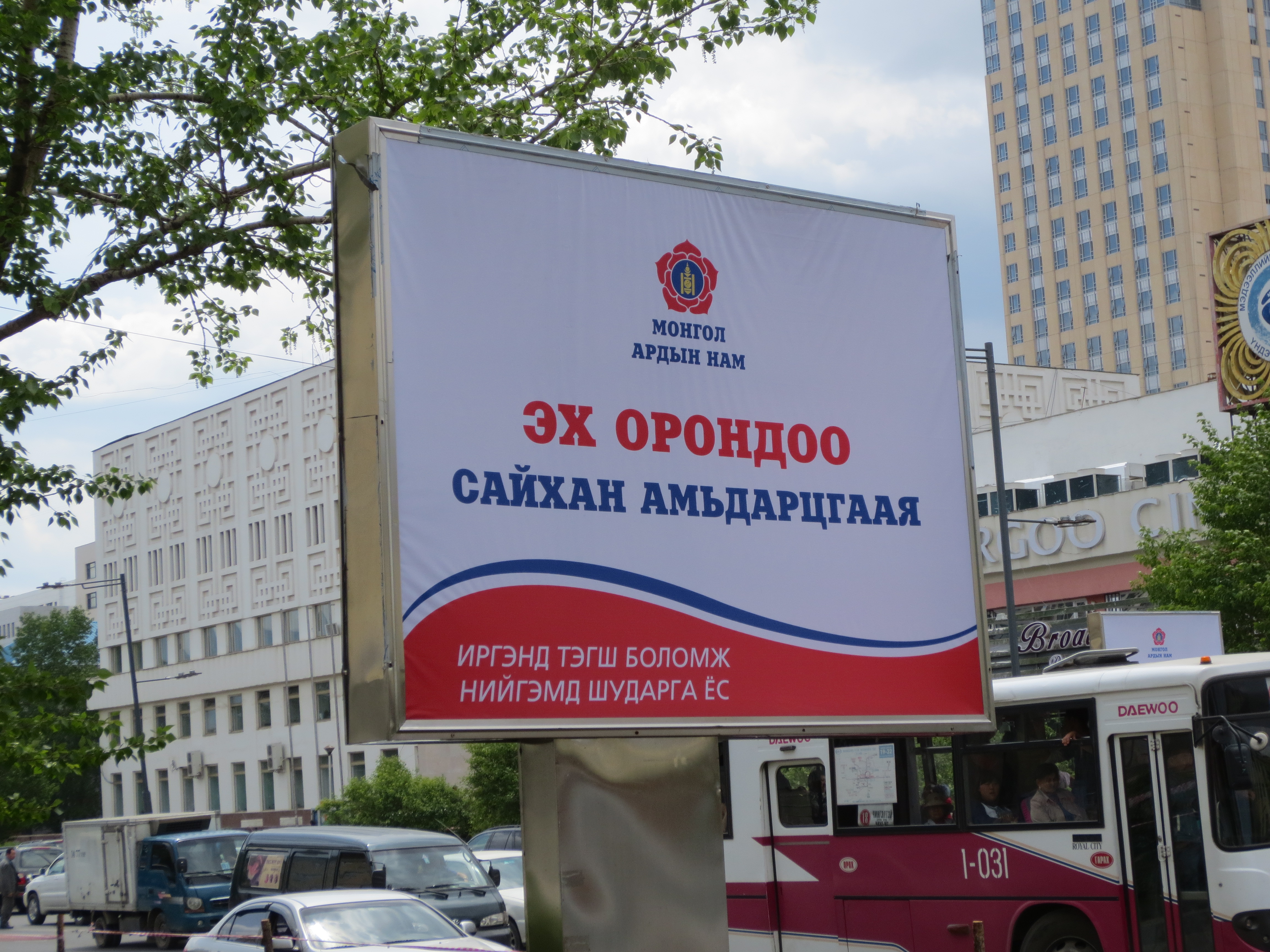
As you arrive at Chinggis Khan airport, the first campaign poster is visible right outside the airport premises. On the long drive into town, posters from the two largest parties, DP and MPP, dominate all the billboards, though most of them show the candidates in the local majoritarian district (District 21 for the West of Ulaanbaatar), rather than the party per se. This changes as you get into the centre of town where some of the smaller parties also have set up campaign posters.

Just to get a sense of the intensity of advertising using billboards and posters in the town centre, we counted all the posters we saw along a 2km stretch of Peace Avenue (the main East-West axis in downtown Ulaanbaatar) from the State Department Store to the State University of Education. It is probably safe to assume that this would be the most expensive stretch of outdoor advertising available in the country.

Banners are posted on existing billboard/poster structures, i.e. billboards that are set up for commercial advertising, but have been taken over virtually entirely (at least in the city centre) by political ads. They are a mix of street-level, roadside poster frames that house posters approximately 1 * 0.4m, and much larger billboards that are on billboard structures above pedestrians’ heads (perhaps 2 * 3m). There are also some rare other shapes, including some very large billboards right by Sukhbaatar Square.

On the 2km stretch we counted the following number of variably-sized posters:

  • MPP 89
  • DP 24
  • CWGP 23
  • Independent 2
  • MPRP 1
  • “Citizens’ Labour Party” (их нам)

These are individual billboards most of which would be facing in two directions, but we have only counted these two-faced billboards as one in the above count.

Note that these are a mix of posters for the parliamentary election as well as the Ulaanbaatar city election.

Clearly, and this confirms a casual impression from driving into town, the MPP is investing a lot into outdoor physical advertising and is dominant in terms of the number of posters. A bit surprising, perhaps, is the much smaller number of DP posters and the virtual absence of the MPRP.

Posters are a mix of pictures of candidates with very little policy or platform information, and party posters that typically reproduce one of two central slogans for the party.

Posted in Democratic Party, Elections, Ikh Khural 2012, Mongolian People's Party, Party Politics, Politics | Tagged , | 6 Comments

Sant Maral’s Politbarometer June 2012

The Sant Maral Foundation under L Sumati is the only credible polling that happens with any regularity in Mongolia. They have now released their second Politbarometer this year two weeks before the election following earlier poll results in April. Below are some of the highlights with a brief discussion.

Party Votes

Of valid answers to the question, “Which party would you vote for?”, the results were as follows with the April numbers in parentheses:

  • DP: 42% (33%)
  • MPP: 28% (32%)
  • CWGP: 3% (4%)
  • MPRP: 24% (12%)
  • Others: 3% (19%)

Clearly, some very important movement in these numbers. The current numbers have the DP far ahead of the MPP. A 42% share in the proportional representation would translate into 12 seats of so from the party list. To secure a parliamentary majority (39 seats), the DP would thus have to win 27 of the 48 majoritarian ridings. While this still seems like a tall order, it is also a distinct possibility. Note as well that the non-Ulaanbaatar results are drawing on polling in four aimags only (Sukhbaatar, Arkhangai, Selenge, and Hovd), so inference to national vote a bit shaky.

In an earlier post, I had offered the following two scenarios as the most likely outcome:

A. slight DP plurality (30-35 seats), but not enough to form government with CWGP. Result: DP-led coalition with MPP, PM = Altankhuyag

B. Strong DP: DP with a significant plurality (35-37 seats), but no majority, CWGP as expected. Result DP-CWGP coalition, PM= Altankhuyag

Given the current poll results, those two still seem like the most likely result, although scenario D with a DP majority would probably move up to C displacing a MPP plurality which now seems almost out of reach. Recall, however, that the poll only reflects the popularity of parties, not that of individual politicians running in majoritarian districts where 48 of the 76 seats in parliament will be decided.

Of course, my earlier speculation had completely discounted the possibility of a significant MPRP surge, or had at least relegated this to the sixth position among likely scenarios. The Politbarometer results suggest that such a surge is more likely than I had originally thought, but that it might still lead to a DP government. Even if the MPRP result were to be on par with the MPP and lead to around 7 seats in the new Ikh Khural, the MPP might still end up with a significantly larger party faction in parliament based on members elected directly in their ridings.

The analysis of voter movements suggests that the MPRP gain comes largely at the expense of the MPP.

Since Sant Maral offers separate answers for Ulaanbaatar vs. elsewhere in the country, that both large parties as well as the MPRP have more support outside of UB, while CWGP is the only party with stronger support in the city.

Corruption

The rise in the support for the MPRP must be linked to the arrest of frm President Enkhbayar and the support that he has gained through portraying himself as a political martyr in this process and/or an indication of the success of populist appeals to the electorate.

However, the Politbarometer numbers do not indicate the increased importance of corruption as an issue that I was expecting from the very public back-and-forth in the Enkhbayar case. In April as well as in the current Politbarometer, corruption was ranked 5th among socio-political or economic problems by voters, though its rating increased relative to a drop in importance attached to the two top issues, unemployment and standard of living/poverty/income. Also, 5th was a “move up” for corruption for its 7th position in May 2011.

The MPP is seen as the least competent in addressing corruption between DP, MPP, and MPRP. Unfortunately, as I assume anti-corruption to be one of the central tenets of the CWGP campaign, they were not included in this question.

Trust

As some commentators have raised questions about the fate of Mongolian democracy through this election, trust in government institutions is an important question in my eyes. Here, Sant Maral asks, “How do you approve or disapprove the following statement: ‘In principal you can trust that the government is doing the right things for citizens’?”

Adding “fully approve” and “rather approve” together, we get a level of trust in government of 57% and of distrust (“rather disapprove” and “fully disapprove”) of 37%. This compares to 50% and 45% in April, respectively.

If the Enkhbayar case were the only imaginable impact on trust in government over this three-month period, we’d have to conclude that the prosecution of the former president seems to have raised levels of trust, but surely there are many other factors at play as well.

Individual Politicians

To get a sense of the popularity of individual politicians, Sant Maral asks “Whom of the prominent persons in the country would you like to name; who, in your opinion, should play an important role in politics?” Respondents are not prompted with a list of names and can name up to three.

Some big changes in the results here. While Enkhbayar was ranked second in this question in April with 17% hoping for a prominent role for him, he has lept to first place in response to this question in June with 22.5%. As this parallels the rise of the share of the MPRP in party preferences, the MPRP’s fate – not surprisingly – seems very closely linked to perceptions of the former president.

Current president Elbegdorj also made slight gains while the biggest loss of support came for union leader Ganbaatar who is running as an independent in the election, but whose support dropped from 26% to 14.5%.

PM Batbold’s popularity has been relatively stable at 11% (12% in April).

CWGP’s Oyun has dropped out of the listing of 10 most frequently-mentioned individuals in the June figures, as has Battulga, seen as a potential challenger to Altankhuyag for the leadership of the DP.

Note that the results on individual politicians may have been biased somewhat by the sampling for the Politbarometer which was limited to Sukhbaatar, Arkhangai, Selenge, and Hovd aimags outside of Ulaanbaatar. For example, Ulaan and Zorigt are from Sukhbaatar, Udval and N Batbayar (DP) are from Arkhangai, and Bayartsogt is from Selenge which may explain their high individual ranking, rather than some kind of national prominence.
Posted in Democracy, Democratic Party, Elections, Ikh Khural 2012, JD Democratization, Mongolian People's Party, Party Politics, Politics | Tagged | 9 Comments

What am I looking for in election?

As I am about to leave for Ulaanbaatar, I’m thinking about what sort of things I’ll be looking for in following the campaign in the city, and hopefully a little bit in the countryside as well.

Corruption

I have previously written that the on-going Enkhbayar saga may promote a more public and frank discussion of corruption in this campaign. Since many Mongolians seem to think of most incumbents as being variously corrupt, particularly members of parliament, I do not necessarily expect these incumbents to voluntarily take on the topic in their campaign events. To the extent that such events allow for some direct interaction with voters, I do expect individual voters to raise this issue in questions.

However, most campaigning that I saw for the 2008 parliamentary election was relatively passive as far as individual voters were concerned with party-organized rallies much more common than direct interaction between candidates and citizens.

Among the parties, I imagine that Civil Will-Green Party is the most likely to emphasize corruption or, perhaps more accurately, anti-corruption. One of my questions in visiting CWGP events will therefore be how central anti-corruption will be to their campaign. Clearly, their campaign will be different from 2008 in that proportional representation offers them a much better chance at significant representation in parliament, beyond their current two members, even though one of these MPs, Enkhbat, has chosen not to run again. If anti-corruption does play a central role in the CWGP campaign, then I will interpret their result as a proxy for the extent to which corruption has become a topic of major concern for voters.

Populism

What about the MPRP? I imagine that their electoral support would be split into two categories. On the one hand, traditionalists, particularly in the countryside who will go with the true-and-tested MPRP brand “because they always have”. On the other hand, the MPRP also has some potential to garner support of protest voters and those who are looking for a more forceful voice for populist concerns especially regarding the distribution of revenues derived from the mining boom. I don’t think that the MPRP has much ideological credibility rooted in the original MPRP’s state-socialist past when it comes to redistribution of wealth, especially since Enkhbayar’s corruption trial is unlikely to portray him as a poor fighter for common Mongolians. However, partly because of the perceived (and irregular in some aspects) persecution of Enkhbayar, the MPRP might well emerge as a bit of an anti-big-party vote. In MPRP campaign activities I am therefore looking for populist appeals aimed at the MPP and DP, as well as a relatively unrealistic and simplistic stance vis-a-vis mining revenues. If these turn out to be prominent themes for the MPRP, I will interpret their vote share as a bit of an indication of the rise/decline/fate of populism.

Voter Participation

What about voter participation? This has steadily declined from 95% (1992) to 76% (2008). This trend may continue, though perhaps the simpler voting format (unlike the multi-member multi-vote set-up in 2008) and the information efforts of the General Election Commission may make voters’ options clear enough that no one would stay away because of a lack of understanding.

It is still a little unclear (perhaps only to me) how the new biometric identification cards will have an impact on turnout. One of the challenges in 2008 and also in the presidential election in 2009 was voters who had moved, but failed to register their move with the authorities. I am not sure whether the identification cards will make it easier for local officials to let cases like that vote and thus raise the turn-out. Given these factors, I would expect turnout in the 70s% with the low 70s suggested some disappointment in democratic governance, perhaps, while the high 70s suggesting a more engaged electorate.

In its June 14 Politbarometer, Sant Maral reported that 82% of Mongolians expressed their intention to vote. That would be a terrific turnout, of course.

Posted in Corruption, Elections, Governance, Ikh Khural 2012, Inequality, JD Democratization, Oyu Tolgoi, Party Politics, Populism | Tagged | 7 Comments

Exit Poll of Diaspora Voters

Some Mongolians living abroad have organized an exit poll of others living abroad as they cast their votes.

The results of this exit poll are reported on D Sainbayar‘s blog in Mongolian. Thanks to Sainbayar for allowing me to post this English summary.

Here are the highlights:
Voters were asked whether they were willing to participate in an exit poll in front of Mongolian embassies in London, Seoul, Tokyo and Washington DC, as well as the San Francisco consulate. Those who were were then asked to report the vote they cast.

Of the total of 711 voters in these locations, 249 participated in the poll.

These 249 voters cast their votes as follows:

  • DP: 44%
  • MPP: 25%
  • CWGP: 13%
  • MPRP: 12%
  • Other 6%

The results are broadly similar across the different locations in that there is no difference in the ranking of parties except for CWGP and MPRP. Voters in Seoul gave the DP the fewest votes (38%) and Washington the most (54%) representing a notable variation. The MPP finished strongest among voters in London (35%) and weakest in Washington (16%), the CWGP strongest in Washington (16%) and weakest in Seoul (11%), and the MPRP strongest in Tokyo (16%) and weakest in London (8%).

My Comments:

Obviously, the methodology (no sampling frame of any kind) doesn’t allow for any inference to the larger population of Mongolians living abroad, nor to the Mongolian electorate.

The result here is perhaps a bit stronger for the DP then what I might expect in the general election as an overall share of the vote 44% could translate into a majority for the DP depending on results in majoritarian ridings.

I would have also expected Civil Will-Green Party to do even better than 13% given its focus on urban professionals and its anti-corruption stance. I would have thought that these positions would have particular appeal among Mongolians living abroad, though perhaps these groups are more heterogeneous that I assume.


Posted in Diaspora, Elections, Ikh Khural 2012, JD Democratization, Party Politics, Politics | Tagged | Leave a comment

First-Ever Diaspora Voting

Mongolians abroad voted for the first time since 1990. After the democratic revolution, Mongolians began to enjoy their freedom to choose places abroad to live, work, and study without any party guidance and surveillance. Mongolian communities have established themselves in Europe (particularly, Germany, the UK, and France), Asia (South Korea and Japan), and North America (the US and Canada) – where Mongolians were not allowed to visit during the Cold War. The 2010 Census counted 107 140 Mongolians living abroad and many of them work to support their families in Mongolia. Despite this economic link, which also contributes to the national economy through remittances especially at times of economic hardships, diaspora communities have never enjoyed the right to vote.

Out of 80 000 eligible voters, 4 320 registered for the election, and 2 779 participated in the first diaspora voting on 10 June 2012. According to the General Election Commission, these votes will be counted on the Election Day, June 28, 2012. There were no irregularities reported and Mongolian Embassies and Consular Offices organized elections.

There are some concerns about diaspora voting. The foremost is insufficient turn-out for registration and voting, but there are several understandable causes. First, the decision about diaspora voting was made in December 2011 – causing financial and administrative hurdles in the organization of the vote.

Because these plans were not reflected in annual budgetary process, there were no additions funds for embassies and consular offices to reach out to Mongolians in their area of responsibilities. The joint administrative regulations of the Foreign Ministry and General Election Committee came out in April after much consultations.

Another concern is people’s civic will to participate in the election, which probably requires more careful study and polling. Finally, geographic, financial, and work-related matters easily discouraged voters who were required to vote in person at an embassy or consular office.

But, if we see this in an optimistic way, Mongolians are learning and improving democratic governance. Hopefully, the process around the diaspora vote was indeed a good lesson for parliamentarians who approved the law without much thinking about logistics, bureaucrats at the General Election Commission and Foreign Ministry, diplomats at the embassies who organized jointly, and voters who gained their political rights. Now the question is how to improve this in a transparent and accountable way. This time Mongolians abroad only voted for political parties (they only participated in the proportional voting part), but they were not allowed to participate in the majoritarian part, where voters elect MPs for their ridings. partWould the next attempt include over 1 000 military personnel serving in hot spots? Could online voting be a solution? Then, Mongolia can offer this lesson for others.

Relatedly, the protection of Mongolian nationals abroad is declared one of the key national security concerns in the revised National Security Concept and is also highlighted in the Foreign Policy Concept in 2011. In the last few years, the public is increasingly pushing the Ministry of Foreign Affairs and its diplomatic posts to protect rights of Mongolian nationals abroad. (during the tsunami, Mongolia evacuated its citizens from Japan by organizing several flights from Japan). Similarly, the embassies are increasingly playing noticeable roles during crisis abroad.

Posted in Democracy, Diaspora, Elections, Ikh Khural 2012 | Tagged | 1 Comment

Mobilizing against Dispossession: Gold Mining and a Local Resistance Movement in Mongolia

Dalaibuyan Byambajav. 2012. “Mobilizing against Dispossession : Gold Mining and a Local Resistance Movement in Mongolia” Journal of the Center for Northern Humanities, 5: 13-32.

Civil society scholars and practitioners have long been curious about the mechanisms that enable ordinary people to take collective action in conditions that normally would present little opportunity of emergence and sustenance, be it local or global. It was the same kind of intellectual curiosity that led this research to examine a local resistance movement in rural Mongolia, which emerged in response to the threats imposed by gold mining.

With its coverage of extensive surface and expansion into new territories, gold mining activities across the Mongolian countryside since the late 1990s have presented a significant challenge to the livelihood of Mongolian herders. Mining expansion has threatened the environmental, material, and cultural bases of the livelihood of herders (Tumenbayar 2002; High 2008; Dierkes, in press). Local herders in Mongolia, whose living environment has been affected by mining activities, have rarely complied with such disturbances without opposition. Local resistance movements emerged in response to mining-related environmental problems and livelihood risks since the early 2000s in Mongolia presented in part a societal defensive reaction to the destructive mining activities.

However, the majority of the local resistance movements have not been able to produce sustained collective action or community-based struggles. Even though, both academic and popular writing about mining, mobile pastoralism, and environmental management in Mongolia have discussed the role of local resistance movements, there is a lack of understanding of the actual staging ground of local collective action. What are the contradictory trends that facilitate or undermine local resistance movements? What forms of organization and collective action repertoires are available to local citizens in Mongolia?

Download the full version of this article PDF

Abstract in Japanese

2005年,モンゴルのアルハンガイ県ツェンヘル郡において,牧畜民による金鉱山開発計 画反対運動が発生した。そこでは,採掘予定地域の牧畜民が3 カ月にわたり道路封鎖などの 抗議を行った。この抗議行動は,モンゴルで1990年代に始まった急速な金鉱山開発によっ て引き起こされた環境問題や土地などの生活資源の収奪をめぐる反対運動の事例である。本 稿は社会運動論を用いてこの反対運動の動員力の展開要因を考察した。主な知見は次のとお りである。①地域牧畜民と都市部の市民組織が連携して行ったその反対運動の発生と動員に は,都市部を拠点とする「同郷会」という組織が大きな役割を果たした。同会は,同郡内で の反対運動に対する行政や鉱山開発会社による阻止・妨害行為を乗り越える重要な基盤とな った。②牧畜民動員のため,インフォーマルな「牧畜民協力グループ」や,社会主義時代に 用いられた「行動記録簿」などの社会・文化資源の利用が有効であった。

Dierkes, Julian. ed. in press (2012). Change in Democratic Mongolia: Social Relations, Health, Mobile Pastoralism and Mining, Leiden: Brill.

High, Mette M. 2008 “Dangerous Fortunes: Wealth and Patriarchy in the MongolianInformal Gold Mining Economy.” PhD Diss., Cambridge University

Tumenbayar, N. 2002 “Herders’ Property Rights vs. Mining in Mongolia.” Paper presented at Seminar on Environmental Conflict Resolution, Brown University.

Posted in Civil Society, Environment, Environment, Environmental Movements, Mining, Mining, Research on Mongolia, River Movements, Society and Culture | Tagged | Leave a comment

Early Ideas and Reflections on the Atmosphere Surrounding the 2012 Elections

I have been in Ulaanbaatar for about 3 weeks now and from some informal conversations with teachers, past advisors, and friends I have come up with some general, almost anecdotal, observations. While these are not through in depth study or surveys, I have relied on several Mongolian-language news articles in addition to other more casual conversations.

1.     The Mongolian People’s Party is in a bit of an identity crisis. The change in name from the Mongolian People’s Revolutionary Party (Монгол Ардын Хувсгалт Нам) to the Mongolian Peoples Party (Монгол Ардын Нам) is just one example of how the MPP is increasingly torn between tradition and reform. Just after the official candidates were announced, but before they were required to register in their respective voting districts, PM Batbold wished his party good luck, stressing two things in particular. Firstly, that this is a party with certain traditions and that they would stand by those traditions. Secondly, that despite this strong connection to heritage and tradition, the MPP was also a new party with new ideas and new policies to put forward.

I can’t help but recall the old nickname that the MPP had, back when it was still the MPRP: Ах Нам (The Big-Brother Party). This was the traditional party that led Mongolia for over 60 years, this age and experience made them not only trustworthy but inherently respectable as the elders of the nation. Today’s MPP has to appeal to two very different electorates: the older supporters who will stand by their party based on tradition and perhaps some idealized, nostalgic memory of the old-communist system; and, Mongolia’s younger voters, who are going to look for a fresh political agenda to support their interests. It seems to me that these two groups have interests that are not easy to effectively co-address. Still, the MPP recognizes that it must begin to appeal to the new demographic reality of the country. Another side of this uncomfortable position between tradition and reform is apparent in the creation of a new political party, using the MPP’s old name: The Mongolian People’s Revolutionary Party, originally lead by Enkhbayar, but now focusing on some other, less scandalized politicians in coalition with the Mongolian National Democratic Party (МYАН: Монгол Үндесний Арчилсан Нам). Indeed, the MPRP-MCDP coalition’s slogan, Шударга ес (with possible translations being justice, fairness, and loyalty), challenges the MPP’s claim to tradition.

As a more general note, I will say that in the center of the city the MPP seems to dominate the skyline, with far more campaign posters, billboards, and banners; however, as you leave the center of the city, they are casually overtaken by the DP. One Mongolian friend mentioned that this was because the center of the city has historically been strongly democratic and the periphery more MPP-leaning, so the more materials the weaker the party is in that section of town. This is a casual observation, but useful when trying to get a more general feel of the election.


 2.     Support for Enkhbayar in Ulaanbaatar is limited, despite disproportionate international concern. I personally have yet to talk to a single Mongolian, who is unhappy with the arrest of N. Enkhbayar.  Of course, this is not based on wide surveys and all my friends are definitely DP-leaning. It is, however, imperative that we wait until the results of a fair trail to make the final judgment. Indeed, politicians as rich as Enkhbayar and his family rarely are very clean. However due to an excellently managed and funded PR campaign (Хар PR, depending on who you talk to) Enkhbayar has managed to convince an international audience that his arrest is completely politically motivated and that it is a sign of the crumbling of Mongolian democracy. I argue otherwise. Instead, I say that the ability to pass an Anti-Corruption Law and organize an Anti-Corruption Agency capable of going after the usually untouchable ex-politicians is a sign that Mongolia’s democracy has never been so strong. In this way, I find this issue to be ultimately up to the Mongolian people and am disturbed by the international press and Senator Dianne Feinstein’s support for such an unpopular politician.


 3.     Ultimately, elections everywhere are about legitimacy. Mongolia’s political legitimacy will be largely based on how the government manages Mongolia’s unprecedented growth and whether everyone will be able to enjoy the benefits of this growth. In reality, any government, whether democracy, or autocracy, or authoritarian must be able to deliver “the goods”. China’s Communist Party’s legitimacy is wrapped up in it ability to develop and lead the country; Putin’s support network is based on a huge increase in the quality of life across Russia and simply being better than his predecessor, Yeltsin.

Yet, democracies have the additional concern of making sure that they can address almost every concern their constituency might have. Keeping this in mind, Mongolian political legitimacy will be based not only on developing the country, but also whether or not the government can manage the growth in a way that benefits as many Mongolian’s as possible. In the city elections, for example, major voter concerns are going to be air quality, the beautification of the city, traffic/infrastructure, and the ger districts. In the national elections, more general concerns will probably dominate the political agenda, with mining policy a likely key factor. A look at the main political slogans also revels some interesting insights. Both main parties are using a slogan that revels that they see their own legitimacy being tied to the quality of life of its population. The Democratic Party’s Хүн шиг амьдаръя, Улс шиг хөгжье (Live like a person, Develop like a country) and the MPP’s Эх орондоо сайхан амьдарцгаая, are very similar. The campaign might come down to which party is seen as more capable of spreading the country’s new found wealth across the populace.


4.     This election still has some logistical concerns to overcome and the combination with city elections might prove problematic. The decision to combine the City of Ulaanbaatar elections with the national Ikh Khural elections remains unclear to me at this time. I am not sure exactly how this is suppose to simplify or improve the electoral process at all, indeed, it seems an unnecessary complication. Additionally, I wonder if it doesn’t complicate the campaigning process. For example, the current mayor of UB is quite popular, even with voters that are do not usually support his MPP party. One has to wonder if this might affect swing voters’ decisions on whether to offer more support to MPP outside of the city elections, in a show of support for Munkhbayar. It will be interesting to see how it ultimately plays out. Continuing concerns about voter registration and the disbursement of new ID-cards also complicate the process.


Posted in Air Pollution, Corruption, Elections, Ikh Khural 2012, Inequality, Mining, Mongolian People's Party, Policy, Politics | Tagged | 1 Comment

Asia Pacific Memo 161: Bumpy Roads, but Heading in the Right Direction

A condensed version of this post was published as Asia Pacific Memo #161 on June 7, 2012.

Mongolian summary:
Монгол дахь авилгал, шүүх засаглалын бие даасан байдлын талаар гадаадын судлаачид цэц булаалдаж, янз бүрийн таамаглал дэвшүүлж байгаа хэдий ч, ардчилсан тогтолцоог бэхжүүлэх чиглэлээр тодорхой ахиц гарч байгааг анзаарахгүй өнгөрч боломгүй.  Ялангуяа, сонгуулийн хуулийн шинэчлэлт, ашиг сонирхолын зөрчлийг зохицуулах тухай хуулийг мөрдөх талаар Сонгуулийн ерөнхий хорооноос гаргаж байгаа хүчин чармайлт нь бага ч болтугай итгэл үнэмшил төрүүлж байна.

Elections not only determine the fate of governments, but they are also potential milestones in democratic development. With the closing of election registration on June 6, 2012, the campaign for the Mongolian national parliament (Улсын Их Хурал) opens officially. Because of the arrest of N Enkhbayar, former prime minister, chairman of the Ikh Khural and president, a number of observers (Jonathan Manthorpe in the Vancouver Sun, Morris Rossabi in East Asia Forum), have voiced pessimism about the fate of Mongolian democracy. To the contrary, the upcoming election promises to be more carefully organized and transparent, and public discussions of corruption may well strengthen democracy further.

For years, most Mongolians have assumed that their political leaders are corrupt. This has been reflected in anecdotal discussions as well as in survey data and the resulting low ranking in Transparency International ratings. This perception of endemic corruption has cast a dark cloud over Mongolia’s potential for economic and political development. Yet, corruption has not been a serious topic of public discussions or election campaigns in the past.

The arrest of Enkhbayar and several provincial governors this Spring not only hints at the manipulation of public perceptions by all actors involved, but makes corruption one of the main issues on which this election will turn. The veracity of particular allegations against individuals will have to be determined by the courts. In the meantime, the General Election Commission has rejected Enkhbayar’s nomination as a candidate. But the mere fact of public attention to corruption increases the potential for more transparent governance and provides a deterrent.

Mongolian election laws assign significant authority over the organization of the election to the General Election Commission.  The Commission has adopted electronic voting, and has been much stricter in its enforcement of registration requirements for voters as well as candidates, and has placed a new emphasis on conflict-of-interest concerns.

Canadian company Dominion Voting Systems is providing electronic voting machines to be used in the election. 1,839,984 eligible voters will receive biometric identification cards that will be used to verify their residence. The two large, two smaller, and several minor political parties contesting in the election have been required to submit their platforms and to nominate candidates for new proportional representation party lists and majoritarian electoral ridings.

In addition to a 20% female candidate requirement, candidates cannot be active public servants. Candidates also have to comply with stricter conflict-of-interest declarations that include information on family members and business interests. Three current MPs from different parties had thus been initially rejected by the Electoral Commission because of irregularities in their income reports.

The separation between elected officials and public servants has been enforced on the basis of recent legislative changes.

The Election Commission is implementing some innovations such as the opportunities for Mongolians living abroad to vote, though this has been hampered by a requirement for in-person appearances at embassies abroad limiting the number of voters to 2,500 out of over 105,000 Mongolians living abroad. For the first time, not just international organizations, but domestic civil society is also being invited to monitor the election, partly in a bid to stave off the political violence that followed the 2008 parliamentary election.

The road to a further institutionalization of democracy and thus a stable political context for economic development is a bumpy one for Mongolia. With limited policy-making capacity, the government is called upon to address numerous challenges. However, democratic legitimacy may be the firmest ground for that road to be built on and the preparations for the upcoming election are pointing in the right direction.

Posted in Asia Pacific Memo, Civil Society, Corruption, Democracy, Elections, Governance, Ikh Khural 2012, Law, Party Politics, Politics, Populism, Public Service | Tagged , | Leave a comment

The Mongolian Public Service

The Mongolian public service has been criticized by political parties, businesses, and the public for being ineffective, unaccountable, and nontransparent. There are some signs of improvement, but discussions often lead to suspicions of superficiality and conspiracy. What’s wrong with the Mongolian Public Service? Why do people express doubts in reform efforts?

The authority of the General Election Commission has increased than previous elections, and made decisions strictly under the revised election law and new conflict of interest law. Now the election will be organized at all levels by public servants as opposed to a mix of party officials and public servants, especially in the counting of votes. Candidates must prove their resignation from the public service six months prior to election, if they have served in the government, as well as disclose their political and business involvements in the last ten years. The courts and the police has to provide clearances. Political parties are required to explain the sources of their funding, but only for the year prior to the election.

The Mongolian Civil Service Commission seems to increase autonomy and to emphasize transparency and merit-based hiring in contrast to its heavily politicized past. These are all good developments. Mongolia has improved its law, regulations, and standards concerning the public service for several times. On  paper, Mongolia now has an ideal legislative framework. However, there are three specific spoilers – political parties, business entrepreneurs, and local lobbying – that delaying ‘tipping points’ for enforcement of this fine legal framework.

When either of the two major political parties has achieved a parliamentary majority (DP in 1996, MPRP in 2000), each attempted to assert their influence at all level of central and provincial governments. The politicized hiring and firing devastated transitional bureaucratic institutions. Political parties even managed to take over key ministries and agencies in charge of privatization, foreign assistance, tenders, mining as well as state-owned enterprises (Erdenet copper plant, railway, airlines). Later, this party-led competition spread into judicial and law enforcement agencies – perhaps either to provide safe havens or marginalize political opponents. Today, political parties need to eliminate their postings of party-affiliated officials in the public service. And, public servants either at national government or local offices at the provinces and counties need to demonstrate their non-partisanship.

The second spoiler are business entrepreneurs. Similarly to many other post-communist states, Mongolia produced winners and losers first, from privatization, second, government tenders, and then mining projects. To gain power and authority (to protect their business interests or accumulate resources), numerous business entrepreneurs have joined political parties or run independently to the parliamentary election as well as local elections. Even today, a clear half of the candidates of any party have business entrepreneurs’ backgrounds or some connections with business. The new law on conflict of interests and attempts of the anti-corruption agency discourage many to openly express their business interests, but still could not prevent them from being offered public service positions.

Finally, local lobbying groups have a very negative impact on public services. The lobbying groups, often called ‘nutagyin zuvlul’ (Local Homeland Councils), now play a detrimental role in parliamentary as well as local elections. Local Homeland Councils were created in the early 1990s to maintain rural and urban links and to generate supports for provinces and counties. Each council consists of and is run by influential and famous people who originated from that locality. Although their main goal is to generate support at the government and capital regions for their local provinces and counties, they are gateways for politicians and business people enter into national and local politics and business. All 21 provinces have their own lobbying councils. Negatively, these lobbying groups attempt to support their natives to gain higher positions in the government services.

To enforce Mongolia’s fine public service laws and standards, influences of political parties, business entrepreneurs, and local lobbying groups must be eradicated. This needs strong political will from each party by removing party-affiliated personnel first, from the judiciary, law enforcement and auditing agencies,then, ministries and agencies, and finally, from the state-owned enterprises. Otherwise, laws will remain on the paper and parties will use the state institutions for revenge, intimidation, and opportunities, surely in rotations.

Posted in Democracy, Governance, Party Politics, Politics, Public Service | Tagged | 1 Comment

Early Speculation about Likely Election Outcomes

[The notes below are based on conversations I’ve been having with Byambajav Dalaibuyan, Mendee Jargalsaikhan and Tsogtbaatar Byambaa. All foolish conclusions are mine, of course.]

This seems to be the most likely overall scenario for the election at this point, i.e. before the election campaign officially commences:

  • losses for the Mongolian People’s Party (MPP), primarily to the Mongolian People’s Revolutionary Party (MPRP);
  • gains for the Democratic Party (DP), primarily at the expense of the MPP;
  • 5-10 seats for MPRP;
  • 3-6 seats for Civil Will Green Party (CWGP).

[Note that this discounts the possibility of independent candidates winning seats, as Mendee has pointed out to me.]

BUT, obviously there is lots of room for developments to interfere with those guesses. My eye right now is on corruption and the extent to which this becomes a more general topic of discussion. The DP is pushing hard on corruption, mostly by going after Enkhbayar, while the MPP is trying to stay aloof. Either or both of these strategies might backfire, I think, and the CWGP probably has the most to gain by more discussion of corruption.

Scenarios in Order of Likelihood

A. slight DP plurality (30-35 seats), but not enough to form government with CWGP. Result: DP-led coalition with MPP, PM = Altankhuyag

B. Strong DP: DP with a significant plurality (35-37 seats), but no majority, CWGP as expected. Result DP-CWGP coalition, PM= Altankhuyag

C. A variation: slight MPP plurality (reverse DP and MPP numbers). Result: MPP-led coalition, PM = Batbold

D. DP majority: obviously, the DP would govern if it can win 38+ seats. PM = Altankhuyag.

E. Strong MPP: MPP with a significant plurality (35-37 seats), but no majority, CWGP/MPRP as expected. Result MPP-led coalition with DP, PM = Batbold. However, this might be one of the scenarios where Batbold would be tempted to talk to the MPRP about a coalition, especially if the MPRP result is weak (<7).

F. MPRP surge: If the MPRP surges (12+ seats) this surge could come at expense of either DP or MPRP, almost certainly implies a DP-MPP coalition.

G. CWGP surge: If the CWGP surges on the back of discussions of corruption (10+ seats, my student, Naranzul becomes an MP), this could, again, be at the expense of either or both MPP and DP, but this might make a DP-CWGP coalition more likely, with a more prominent role for CWGP/Oyun

H. Disputed election: Either because the results end up very close or because of (alleged or real) irregularities in the voting or counting process, the election results may be disputed, leading to some period of a continuation of the current government on a caretaker basis.

What all of these scenarios have in common is the basic conclusion that as of July there may be a different PM, but overall policies are not likely to change much. Whatever coalition ends up governing will face a stronger and, in the case of the MPRP, more vocal and more vocally populist opposition.

Caveats:

  • Enkhbat’s announcement that he’s not running for re-election has cast a bit of a shadow over the CWGP
  • The rank ordering of the scenarios currently depends mostly on the success of the two large parties. Their outlook might shift significantly in the course of the campaign.
  • There is some internal opposition to Batbold and Altankhuyag with Khurelsukh and Battulga, respectively, waiting in the wings [point emphasized by Tsogtbaatar]
Posted in Democratic Party, Elections, Ikh Khural 2012, JD Democratization, Mongolian People's Party, Tsogtbaatar Byambaa | Tagged , , | 4 Comments

Interesting Mining Project out of Vancouver aimed at Domestic Consumption not China

As Ivanhoe Mines/Robert Friedland is slowly pushed out of Mongolia, the commercial relationship between Canada and Mongolia is likely to shrink.

Apart from the Ivanhoe satellites, South Gobi and Entrée Gold, a number of other projects are pushing forward, though many at exploration stages, see listing of non-Mongolian mining companies operating in Mongolia.

One of the Vancouver-based projects that fascinates me is Prophecy Coal’s proposed power plant to be built at its Chandgana coal deposit. Prophecy has just announced that they have signed a “covenant” with the Mongolian Energy Authority and this seems to be a further step in moving this project to reality.

What I find particularly interesting about this project is that it is explicitly not aimed at exporting raw materials to China. While the economic lure of such exports has powered the Mongolian resource boom for some years (and may loom to doom Mongolia to a slowdown if Chinese consumption is indeed slowing down) it has also been at the root of some of the resentment of Chinese commercial dominance in Mongolia that may be at the root of popular anti-Chinese attitudes and also part of the explanation for a recently passed law that sets up a government (bureaucratic or parliamentary depending on size of investment) review of foreign investment.

By contrast, the Prophecy Chandgana project, if it comes to pass as currently envisioned, would fuel a power plant that would feed electricity into Mongolia’s domestic grid. Power needs are significant for industrial and mining activities in Mongolia, but the need for additional power sources away from Ulaanbaatar has become ever greater with the heavier pollution that every winter seems to bring. FDI aimed at domestic consumption, even if it is commodity consumption in the form of electricity, is what makes this project unusual in my eyes.

Posted in Air Pollution, Foreign Investment, Mining | Tagged | Leave a comment

Mongolian People’s Party Candidates

* marks incumbents, (F) designates female candidates.

Candidates by proportional list:

  1. S Batbold, Prime Minister (M) *
  2. U Khurelsukh, Secretary General of MPP (M)
  3. D Demberel, Speaker of Ikh Khural (M) *
  4. U Enkhtuvshin (M) *
  5. D Lundeejantsan (M) *
  6. Ts Nyamdorj, Justice and Internal Affairs Minister (M) *
  7. N Enkhbold (M) *
  8. Ya Sodbaatar, Secretary of MPP (M)
  9. J Enkhbayar, Defense Minister (M) *
  10. D Sarangerel, Secretary of MPP (F)
  11. D Oyun-Erdene, Head of Youth organization of MPP (M)
  12. Ts Garamjav, Deputy Minister of Energy and Mineral (F)
  13. J Sukhbaatar (M) *
  14. B Undarmaa, Deputy Minister of Education, Culture and Science  (F)
  15. E Munkh-Ochir (M) *
  16. B Dolgor, Advisor of Prime Minister  (F)
  17. J Tsolmon, Deputy Minister of Health  (F)
  18. B Batstsetseg (F)
  19. Kh Badelkhan  (M) *
  20. V Udval, Deputy Minister of Justice and Internal Affairs (F)
  21. D Enkhchineg (F)
  22. J Saule, Deputy Minister of Agriculture and Light Industry (F)
  23. G Munkhtsetseg, Head of Mongolian Writers Union (F)
  24. D Enkhchimeg, Director of Petrovis company  (F)
  25. Sh Radnaased, Advisor to the Secretary General of MPP (M)
  26. Ts Tsengel (M) *
  27. D Dondog (M) *
  28. P Bayanmunkh (M)

Candidates by majoritarian constituencies:
1. Arkhangai-             J Munkhbat (M), B Baatarbileg (M)

2. Bayan-Ulgii-          Kh Jekei (M), A Telekhan (M)

3. Bayankhongor-     G Zandanshatar (M) *, M Bilegt (F)

4. Bulgan-                   Yo Otgonbayar (M) *

5. Govi-Altai-              Ts Dashdorj (M) *

6. Govisumber and Dornogovi-          Ts Anandbazar (M)

7. Dornod-                  N Nomtoibayar (M), D Odbayar (M)*

8. Dubdgovi-               B Amarsanaa (M)

9. Uvurkhangai-         L Chinzorig (M), B Tumurkhuu (M)

10. Umnugovi-            Kh Badamsuren (M)

11. Selenge-                J Erdenebat (M), S Gerelmaa (F)

12. Sukhbaatar-           R Bud (M)*

13. Uvs-                      Ch Khurelbaatar (M) *, B Choijilsuren (M) *

14. Orkhon-                 O Sodbileg (M), D Damba-Ochir (M) *

15. Darkhan-Uul-        D Khayankhyarvaa (M) *, J Sukhbaatar (M) *

16. Khentii-                 B Bat-Erdene (M) *, N Ganbyamba (M) *

17. Tuv-                       M Enkhbold (M) *, S Batbold (M) *

18. Khuvsgul-             L Enkh-Amgalan (M), B Munkhbaatar (M)

19. Zavkhan-               D Oyunkhorol (F)*, D Baldan-Ochir (M)

20.Khovd-                   S Byambatsogt (M) *, G Nyamdavaa (M)

ULAANBAATAR

21. Songinokhairkhan-  D Sumiyabazar (M), D Tumengerel (M), G Tenger (M)

22. Bayangol-              Ts Munkh-Orgil (M) *, L Amgalan (F)

23. Bayanzurkh-          D Arvin (F) *, B Batzorig (M), B Munkhbaatar (M)

24. Khan-Uul, Bagakhangai, Baganuur-         Ts Batbayar (M) *, B Lkhagvajav (M)

25. Chingeltei-              D Ochirbat (M) *, D Zorigt (M) *

26. Sukhbaatar-           Ch Gankhuyag (M), G Tsogzolmaa (F)

Posted in Elections, Ikh Khural 2012, JD Democratization, Mongolian People's Party, Party Politics, Politics | Tagged | Leave a comment