Z Enkhbold, Chairman, Great State Khural to Visit Vancouver

University of British ColumbiaCelebrating 40 Years of Diplomatic Relations between Canada and Mongolia
Institute of Asian Research
Program on Inner Asia

Celebrating 40 Years of Diplomatic Relations between Canada and Mongolia

“Current Developments in Mongolia”

Thursday, March 28, 2013, 17h
UBC Robson Square, Room C400
800 Robson St
Downtown Vancouver

His Excellency

Zandaakhuu ENKHBOLD

Chairman, State Great Khural of Mongolia

Introduced by
Anna Biolik
Former Canadian Ambassador to Mongolia

Panel Discussion

Opening remarks on current developments regarding:

The event is free and open to the public, but we ask that you register your intention to attend at http://bit.ly/mongoliamarch28

Posted in Events, Politics, Research on Mongolia | Tagged | 1 Comment

Book Chapter: Finding the Buddha Hidden Below the Sand

Buddha Hidden Below the Sand: Youth, Identity and Narrative in the Revival of Mongolian Buddhism

Matthew King in J. Dierkes, ed. Change in Democratic Mongolia – Social Relations, Health, Mobile Pastoralism, and Mining Leiden: Brill.

Here, Matthew King reports on his on-going research that expands on this chapter:

Brill: Change in Democratic MongoliaSince exploring the Buddhist revivalist movements of contemporary Mongolia several years ago (in research that went into my chapter in Change in Democratic Mongolia), I have been focusing primarily on finishing my doctoral work at the University of Toronto. In many ways my doctoral project grew out of the research that went into that chapter, and some of the conversations that happened at the original conference at UBC. If nothing else, in my contribution I hoped to show just contested and multi-vocalic the ‘revival’ of Mongolia’s Buddhism today truly is. I was trying (as best I could at the time as a recently graduated MA student!) to show how the appeals for a timeless, ‘Mongol’ Buddhist identity were couched so completely in the rhetoric and ideology of the post-socialist period. I hoped to highlight what I felt was our scholarly challenge to account for the broader socio-cultural context within which the multiple Buddhist revivalist movements of contemporary Mongolia operate. I was pre-occupied then (as I am now!) with how Mongolian Buddhist revivalists drew so deeply from rhetorical strategies and educational initiatives of what was often identified as the primary threats to their tradition; “Westernization’, ‘secularism’, ‘capitalism’, and ‘Christianity’ being only a few examples. I was interested in exploring urban, middle-class youth as a particularly contentious site of these negotiations; a position that the young people at the ‘Buddhism for Young’ people camp I visited were certainly well aware.

My doctoral research examines the life and historiography of the previous Zava Damdin (whose incarnation ran the Buddhist camp I explored in this chapter), a prolific scholastic figure in the post-Qing and early socialist periods in Mongolia who was deeply embedded himself in the rather cosmopolitan, revolutionary milieu of Ikh Khüree (contemporary Ulaanbaatar). Indeed, many of the themes I began to touch upon in my chapter in the Change in Democratic Mongolia have become central pre-occupations in my doctoral research: for instance, how were extended appeals to the past by threatened Buddhist monastics framed by, and syncretic expressions of, the rhetorical and interpretative resources of antagonistic forces in Mongolian society at the time (for instance, epistemic violence associated with empiricism and hardline expressions of socialism)? How can we think holistically about the social scene of Buddhist historiography at this time (and other times besides)? These questions remain as exciting (and largely unresolved, admittedly!) today as I finish my doctoral dissertation as they did several years ago when this Brill volume began to come together.

Even though my research is now primarily historical, I have been lucky enough to return to Mongolia many times in the last few years, and have continued to write on the Buddhist revival movement. The Gobi monastic network community I described in the Change in Democratic Mongolia volume have gone through many changes. Soon after the visit described in my chapter, Zava Rinpoche was told to undertake a four-year meditation retreat by his centenarian lama, Guru Deva Rinpoche. Zava Damdin dutifully spent over four years in a small, fenced-off yurt doing his practice next to his monastery. While in retreat, Guru Deva Rinpoche died, and many of the young monks who had staffed the ‘Buddhism for Young People’ camp (who were now teenagers largely left to their own devices with their teacher and disciplinarian in an extended retreat), left the monastery. As of last summer, there was just three or four monks still in residence. Now out of retreat, Zava Damdin is a celebrity in Mongolia: his intense religious discipline has given him uncommon spiritual qualifications in Mongolia, even if his staunch nationalism and particular brand of charisma continue to position him in opposition to more mainstream, Tibetan affiliated, monasteries and Buddhist prelates. Despite a depleted monastic population, buildings continue to be erected at his Gobi desert facility, and Zava Damdin is a regular conversation topic on Mongolian nightly news and talk shows. His role in the Mongolian re-imagining of its past and present is far from over, and far from predictable.

Apart from this, I would say that in general most of the trends I endeavored to describe in my contribution to Change in Democratic Mongolia remain true today, and are all deserving of more sustained study. A particular demographic of urban youth continue to act as contentious sites for imagining Mongolia and Mongolia-ness (both a timeless entity and a nation profoundly challenged by the socio-economic challenges of the post-socialist period). The varieties of intruding discursive resources associated with the post-socialist period (environmentalism, religious multiplicity, global capitalism, a secular public sphere, etc.) continue to define (and be defined in turn by) the way that these ever-evolving qualities of Mongolia’s ‘timeless’ Buddhist identities are imagined. One important change that I noticed while on a research trip this past summer (2012) was a rather xenophobic turn in Mongolia politics. On the one had, this is manifested as an attempt to gain more control over the assets and foreign activity associated with the lucrative mining industry. It also is being expressed by changing visa requirements, a move that has effectively expelled Christian missionaries from Mongolia today. It also has a rather more nefarious expression in the growth of a self-styled ‘nazi’ movement, birthed in the slums of Ulaanbaatar by some of the hundreds of thousands of alienated Mongols whose have little share in the rapid growth of Mongolia’s economy, and who have sold their herds to move to the city. Just how the more radical nationalisms of groups such as these ‘nazis’, and the growing disparity between the rich and poor in contemporary Mongolia more generally, inform new Buddhist appeals and new historical imaginings is an open question.

Posted in Book: Change in Democratic Mongolia, Civil Society, Environmental Movements, Nationalism, Religion, Research on Mongolia, Social Movements, Society and Culture | Tagged | 1 Comment

Democratization and Foreign Policy

This is a small summary of the findings from my M.A. Thesis, completed in December 2012. I argued that Mongolia’s successful democratization allows the country leverage in deepening its relationship with the United States and Europe. This furthers the US and EU’s democratization agenda, while simultaneously adding weight to Mongolia’s “Third Neighbor Policy”.


Mongolia’s Credentials

The expression “not all that glitters is gold” is perhaps best rephrased for our purposes as “not all that democratizes will become a democracy”. When Mongolia became an official democracy, no one was sure how a small state with less than 3 million people would manage to produce a real democracy in-between the authoritarian PRC and the uncertain democratization of the newly established Russian Federation.[1] However, all available indicators support that it accomplished just that.

Mongolia’s democratic transition was largely based on domestic political will. Real democratization ultimately is an “exercise in national political self-determination.[2] True democratization has to be domestically driven otherwise it will lack legitimacy.[3] Mongolia was ranked at 6.23 by Democracy Index 2011[4], 6.36 in 2010 [5], 6.6 in 2008 ,[6] and 6.6 and 2006 ,[7] on a 10 point scale, meaning that it has been consistently ranked as a “flawed democracy”, which while admitting its problems, firmly ranks Mongolia as a democracy above hybrid and authoritarian regimes. Freedom House has ranked Mongolia as “free” for all available years (2002-2012).[8]  Although Mongolia is still a developing democracy, it is hard to argue that it is not a functioning one. Signs of increased civil society engagement and contested election results are actually a sign of a thriving democratic system, where the ability to change the status quo is recognized and a number of political parties are competing against each other.

U.S. and E.U. support to Mongolian Democracy

High profile visits are an important indication of bilateral ties and entail some level of prestige and significance to relationships between nations. Between the U.S. and Mongolia, several high-profile visits have highlighted the slowly deepening relationship between these two distant countries, often making explicit mention to Mongolia’s democratic status (see Table 1 for a list of the most prominent visits).

Table 1: High-Profile Visits

To Mongolia To the United States of America
2005: Rep. Dennis Hastert 1991: President Ochirbat
2005: President George Bush 2001: Prime Minister Enkhbayar
2011: Vice-President Joe Biden 2004: President Bagabandi
2012: Secretary of State Hilary Clinton 2011: President Elbegdorj

Outside of high-profile diplomacy, the U.S. has also signaled its support for Mongolia and the value it places on Mongolian democracy in a number of other statements and institutional mechanisms. The U.S.-Mongolia Friendship Caucus seeks to educate and inform U.S. politicians on Mongolia, focusing on Mongolia’s political system and the reform process.[9] The International Republican Institute (IRI) began working in Mongolia in 1992, working explicitly to support democratic governance and institutional development.[10] In 2010, the U.S. Embassy hosted events celebrating the 20th anniversary of Mongolia’s “decision for democracy”, during which then-Ambassador Addleton identified democracy as one of five pillars of U.S.-Mongolian relations.[11] In July 2011, Mongolia was granted Presidency of the Community of Democracies, and will host a meeting of the organization in 2013.[12] The organization makes clear reference to Mongolia as an example of successful democratization and simultaneous political and economic transitions.[13]

The United States recognizes that Mongolia is an important partner as it continues to shift its diplomatic focus to the Asia-Pacific. Mongolia is a U.S./international successful story for democratization and has been held up as a model of Asian democratization, in particular.[14] The U.S. has stated that its goals in Mongolia are not geostrategic in nature, and that the U.S. is, instead, focused on helping develop “a base of democracy” in Mongolia.[15] Mongolian democracy contributes to the country’s stability in an area defined by such authoritarian powers as Russia and China.[16] The United States sees its own security as dependent on the domestic political stability of other states, and sees Mongolia’s democratic system as a potential balancing force against authoritarianism in the region.

Mongolia’s proven commitment to democracy is also in line with E.U. global goals, particularly as they concern Central Asia.[17] Mongolia’s accession to the Organization for Security and Co-operation (OSCE) in Europe on November 22, 2012 is a clear indication that Europe and Mongolia are coming closer together on a number of issues. As the official announcement was being made, the OSCE Secretary General noted that Mongolia’s participation would allow the organization to better tackle transnational issues, while Mongolia stood to benefit from the OSCE’s expertise in democratic transitions.[18] These shared values are defined as respect for human rights, democracy, and the rule of law.[19] The Partnership and Cooperation Agreements also explicitly support democratic development.[20] The U.S. responded to this announcement in a similar fashion, citing the accession as an indicator of Mongolia’s importance to the democratic community as an example of a successful transition from communism to democracy.[21] A number of European development projects in Mongolia are handled directly by the European Institute for Democracy and Human Rights, which aims to encourage democratic institutional reform and support for human rights, specifically regarding the rights of inmates and sexual minorities.[22] Furthermore, Germany’s Konrad-Adenauer-Stiftung (KAS) political foundation has taken an active role in supporting Mongolia’s democratization through seminar trainings and programs to strengthen decentralization efforts.[23] Europe began developing relations with democratic Mongolia at a slower pace than the United States, but the proximity of Eastern Europe to Eurasia and a shared history between Mongolia and many Eastern European nations under the Soviet Union sets the groundwork for more multifaceted relations in the future.

Results

Mongolian democracy stands out in stark contrast to it neighbors, Russia and China, as well as across the larger post-communist world, such as the Central Asian authoritarian states Kazakhstan, Uzbekistan, and Turkmenistan.[24] Despite all its “robustness/rowdiness”, the Mongolian political system is clearly democratic. A perfect democracy where all citizens have an equal say and where the government is equally responsive to all its citizens’ demands does not exist.[25] From Hilary Clinton’s statement in Ulaanbaatar in support of democratization, it can be observed that Mongolia is becoming one of the poster countries for democracy and the rewards, stability, and development benefits that are associated with this political system. Mongolia can be held against claims that democracy is not for Asia. This is by no means meant to suggest that Mongolia’s own motivation in democratizing was to attract “Western” favor; rather, the point is that once democratized, the benefits to the Mongolian state and population were international as well domestic.

At the same time, Mongolia has been able to actively leverage its democratic credentials as part of its efforts to adapt to the post-communist international system and fulfill its “third neighbor policy.” Mongolia’s Concept of Foreign Policy states that the country’s foreign policy is guided by international norms such as respect for human rights and freedoms.[26] The Concept of National Security of Mongolia identifies the country’s democratic government as key to the state’s continued security in the sectors of civil rights and information security.[27] Furthermore, Mongolia’s democratic government distinguishes it a region defined by Russia, China, and the Central Asian states.

Does democracy matter? It seems that democracy is a potential tool that Mongolia can and has used to increase its attractiveness as a partner for U.S., E.U., and potentially other leading democracies. Attracting this interest is a key factor in Mongolia’s foreign policy, since it allows Mongolia to command a larger number of “third neighbors” as a counterbalance to Russian and especially Chinese influence. It is crucial that Mongolia implements a strong policy of diversification. Indeed, as a small state between giants, it knows only too well that over dependence on any one power will not afford it the sovereignty and autonomous decision-making power that it needs to survive as an independent state. If Mongolia’s democratization was not a factor and the country’s natural resources, growing economy, and/or strategic location were the only factors influencing relations with the U.S. and E.U., we might still expect some diplomatic gestures (Kazakhstan and Uzbekistan are also OSCE participating states). However, we would not see the level of high profile visits, the institutional support, or rhetorical references to Mongolia as a responsible stakeholder. We would also see more emphasis on economic ties and perhaps stronger military relations.


[Summaries of other key sections of the thesis are available at http://www.miliatematters.com/blog.html and the whole thesis is available at https://circle.ubc.ca/handle/2429/43714 ]


[1] Fish, M.Steven. “The Inner Asian Anomaly: Mongolia’s Democratization in Comparative Perspective.” Communist and Post-Communist Studies 34, no. 3 (September 2001). P. 323

[2] Burnell, From Assistance to Appraising, p. 414

[3] Ibid., p. 421

[4] Democracy Index 2011

[5] Democracy Index 2010

[6] Democracy Index 2008

[7] Democracy Index 2006

[8] Freedom House, 2002-2012

[9]  As reported by the Embassy of Mongolia in the United States of American: http://www.mongolianembassy.us/mongolia_and_usa/us_mongolia_friendship_caucus.php. (Accessed on December 4, 2012). The other four focuses were development assistance, commercial, security, and people-to-people relations.

[10] As reported on IRI’s official website: http://www.iri.org/countries-and-programs/asia/mongolia (Accessed on December 4, 2012).

[11] “Ambassador Addelton’s Remarks at the Asia Society Breakfast: Warm Relations in a Cold Place: The United States and Mongolia,” Embassy of the United States in Ulaanbaatar, Mongolia, June 14, 2011. http://mongolia.usembassy.gov/speeches_061411.html (Accessed on December 4, 2012).

[12] The White House, U.S.-Mongolia Joint Statement

[13] See the Community of Democracies official website: http://community-democracies.org/index.php?option=com_content&view=article&id=2&Itemid=3

[14] Noerper, Ten Things We Get from Mongolia. p. 1

[15] Narangoa, Preventative Diplomacy, p. 373

[16] Wachman, NBR, p. 5

[17] Ibid.

[18] “Secretary General welomes Mongolia to OSCE, stresses added value to security community,” OSCE News (November 22, 2012). (Accessed on December 4, 2012).

[19] Statement by High Representative Catherine Ashton Following the Legislative Elections in Mongolia on 28 June 2012, 2012.

[20] European Initiative for Democracy and Human Rights

[21] “U.S. Envoy on Mongolia as OSCE Participating State,” IIP Digital (November 22, 2012). http://iipdigital.usembassy.gov/st/english/texttrans/2012/11/20121123139050.html#axzz2E82SDh1V (Accessed on December 4, 2012).

[22]  “EU supports Mongolia’s Technical and Vocational Education and Training (TVET) sector with 7 mln euro project,” Delegation of European Union to Mongolia, May 31, 2012. http://eeas.europa.eu/delegations/mongolia/press_corner/all_news/news/2012/20120531_01_en.htm (Accessed on December 4, 2012).

[23] For more information on KAS, please see: http://www.kas.de/mongolei/en/ (Accessed on December 4, 2012).

[24] As rated by Democracy Index

[25] Epstein, Democracy Promotion, p. 11

[26] Concept of Foreign Policy, Section II, Article 8

[27] The Concept of National Security of Mongolia, Section IV

Posted in Democracy, Foreign Policy, International Relations, Mongolia and ..., Politics, Research on Mongolia, United States | Tagged | Leave a comment

Foreign Investment to Mongolia: Restrictions, China, and Comparisons with Canada II

This is an update on an earlier post as well as an extended version of an argument that has now been published in English through East Asia Forum and the UB Post, and in Mongolian in Unuudur:

There has been a recent flurry of writing on foreign investment in Mongolia in English-language media, from newspaper accounts to more scholarly arguments from think tanks and the like. To my mind, many of these writings have taken the perspective of a foreign investor, rather than the perspective of Mongolian policy-makers or any Mongolian, really.

Since the Chalco bid for South Gobi Resources prompted the passage of a Foreign Investment Law by the Mongolian parliament in May I’ve been struck by some of the parallels between this law and its counterpart in Canada. Below I examine these parallels and Mongolian policy regarding foreign investors in light of the recent decision by the Canadian government to approve two bids by state-owned companies for companies in the Canadian oil & gas sector.

Similarities and Differences between the Mongolian and Canadian Foreign Investment Law

Before I turn to developments in Mongolia, a quick note on the parallels between the Canadian and Mongolia Foreign Investment Law. This is relevant as Canada is not only an established mining jurisdiction, but has been identified in Mongolia as a potential model for regulatory decisions about the extractive industry.

The greatest similarity obviously is the fact that such a law exists and that this law demands a government review of investments in certain industries triggered by thresholds of the financial volume of these transactions.

The Canadian government recently reviewed the bids of two Asian state-owned companies for Canadian companies. Chinese CNOOC bid for Nexen, a company active in the oil sands, and Malaysian Petrobas planned to purchase Progress, a natural gas company. These bids were approved on December 7 after months of delays and active debate in the media and among policy-makers.

With their approval the government announced that in the future bids from state-owned enterprises (SOEs) would only be approved under “exceptional circumstances” and that bids exceeding $330mil from SOEs would require review, while private bids would only be scrutinized if they surpassed $1bil. The argument that the government presented for the restrictions on SOEs focused on the fear that such bids would put an important sector of the Canadian economy that was emerging in a free market context under more or less direct control of a foreign government. Memorably, Prime Minister Harper argued that, “When we say that Canada is open for business, we do not mean that Canada is for sale to foreign governments.” While the government denied that this was a response specific to Chinese investments, clearly the decision was made in a context of expectations of increasing investments from China.

The Mongolian law has also made an explicit distinction between private and SOE bids. It outlines sectors that it applies to (the resource sector is included, naturally) and thresholds at which different kinds of reviews are triggered. A large bid by a foreign investor or any bid by an SOE would thus trigger a review by parliament.

One of the differences between the Canadian and Mongolian context is that decisions on FDI in Canada come in the context of a stable regulatory regime that offers predictability and the attempt to balance investors’ expectations with Canadians’ needs. Stability in the regulatory regime has not been the strong suite of Mongolian mining regulation.

So, this is where the parallels clearly end. Yes, similar principles, but a very different application thereof.

Mongolia as a Cautionary Tale?

Some observers have recently portrayed Mongolia as a “cautionary tale” (Stephens & Krusekopf) when it comes to the encouragement of foreign investment.

Resource nationalism has been one of the themes that non-Mongolian writings about the Mongolian context have focused on, particularly in attempts to understand the detention/holding of Sarah Armstrong, an Australian lawyer for South Gobi Resources for two months until just before Christmas 2012. Resource nationalism is generally equated with some evil movement aimed at nationalization of resource assets.

In Mongolia this claim is most commonly linked to the demand by some parliamentarians and parts of civil society that the Investment Agreement for the Oyu Tolgoi mine, jointly owned between Rio Tinto and the Mongolian government, should be revisited.

But one observer’s resource nationalism is another person’s attempt to preserve the resource wealth of a country and to reap its benefits for current and future generations. The former is a foreign investor, while the latter is a Mongolian.

I would be the first to agree that the process by which Mongolian policy-makers have arrived at some decisions has not been ideal (in the sense of a careful decision that is based on a thorough and dispassionate analysis of available information) – in fact, this process has been awful at times, including the unproductive broad calls for renegotiation without acknowledgement that such renegotiations require the agreement of both parties  – but I cannot fault Mongolians or their leaders for their desire to get this decision “right” and their fears of getting it “wrong”.

Striking the appropriate balance between material needs, social aspirations, environmental and cultural protection, and, yes, financial rewards for investors, is not an easy decision. Jurisdictions that have had decades to arrive at appropriate mechanisms for this decision are still struggling with these issues.

Yes, there clearly is a kneejerk nationalism present in Mongolia and the Mongolian parliament that ignores the fact that ownership of mineral resources does not necessarily automatically mean profit from these resources without the skills, technologies and capital to develop them

Yes, there also is a deep-seated ambivalence about Chinese investments in Mongolia. This ambivalence includes fairly rational fears of economic dominance, but also elements of anti-Chinese sentiments.

Such attitudes are often mobilized at election time in a populist attempt to garner votes. This clearly happened in June 2012 when the Mongolian People’s Revolutionary Party under now-imprisoned former president N Enkhbayar made fairly simplistic noises about resource ownership and continues to make such noises now that the MPRP is (still) a part of the governing coalition.

Do these sentiments combine to be an ideology of resource nationalism? Not in my mind, or at least not for a majority of the population of policy-makers.

Some observers have claimed that Mongolia is limiting its economic opportunities by discouraging foreign investment and especially investment from China.

There is no doubt that there is some uncertainty around the regulatory regime for the extractive industry in Mongolia. Surely, this has also scared off some investors. But have enough investors been scared to have an impact on Mongolia? Is the OT mine not such a gigantic project in a resource-hungry world that scaring off some investors might not have a negative impact?

Sure, there is a line where all investors might be scared, but I do not think that Mongolia has come close to that line. Witness the Chinggis Bond sale in late November, raising $1.5b, but attracting orders for ten times that amount. Mongolia with its BB- S&P rating is paying 5 1/8% on these bonds, but that is cheaper credit than Italy has been able to get recently, so not too many bond investors seem scared off. In the end, there are so many investors in the world who have read the news that Mongolia was the fastest growing economy in 2011 and who want to participate in this presumed bonanza (this also in part explains the flurry of recent articles), that there does not seem to be a shortage of investors, even without any large-scale Chinese investment.

Given the Economist’s recent prediction that Mongolia will be the fastest growing economy in the world again in 2013, many investors will continue to look but also press for opportunities to participate in this growth. Given growth of 17.3% in 2011 and another double-digit year in 2012, this implies that the Mongolian economy will have grown by roughly half in three years by the end of this year. With Oyu Tolgoi entering production, the economy will begin to shift from construction to production (copper).

Yet, other than foreign mining companies active in Mongolia (really, only Rio Tinto and some juniors), there are few opportunities for investments that would offer participation in this growth. The very low capitalization/volume of trade of the domestic stock market doesn’t make this a viable option for anyone other than the most dedicated. The privatization of government holdings in sectors other than mining has also been sidelined by the attention paid to the extractive sector.

Some have argued that the Foreign Investment Law has led to a chill in FDI to Mongolia since its passage in May. Part of that slowdown is rooted in uncertainty surrounding the triggers for a review of foreign investments particularly as they are linked to SOE bids for investment. But if a country is so dependent on mining for its future, is a slowdown not a reasonable cost to pay for a more careful (if not always carefully executed, and sometimes even recklessly so) deliberation?

After all, the natural resources in question are unlikely to vanish in Mongolia (or in Canada) and nor is demand for them, at least in the near or medium-term future.

Of course, I can only speak in hypotheticals when it comes to considering the impact of legislative changes on investment volume.

It is important to note, however, that foreign direct investment seems to be somewhat of an example of herd behaviour, especially in the mining industry. The perception of political risk might thus be more important in some circumstances than the actual risk. This is certainly more the case for a place like Mongolia where much of the information (including this discussion) is about perception rather than a measured empirical reality and where information about the country is still relatively limited internationally.

Conclusions

Canada and Mongolia are not alone in the world in wrestling with the appropriate regulation of the natural resource sector. While Canada has a long-established resource sector and its provinces have developed regulatory practices over many years, the need and scope for regulation in Mongolia is much more urgent and larger given the sudden nature of the expansion of its mining industry.

The greatest hurdle to the development of a successful regulatory regime (i.e. one that makes the greatest possible benefit to all Mongolians possible while minimizing social convulsions and environmental impacts associated with rapid development) are the selfish actions of leaders. Mongolian decision-makers must surely be aware of the responsibility that they are carrying for ALL Mongolians, not just for themselves and their immediate social circles. Beyond this hurdle of corruption, the next challenge is an on-going lack of policy-analysis and policy-making capacity and the resources to develop such capacity more fully within Mongolia. As the demands for policy-making are accelerating with the impact of a mining boom on all areas of government activities and social relations, this will be what might hold Mongolia back, not a lack of foreign investment.

When members of the mining industry in advanced industrialized countries complain about governance and regulatory uncertainty in places like Mongolia, they would do well to note shared challenges and some of the parallels in the solutions that policy-makers hit upon.

There ARE lessons in the current discussions for Mongolia, to be sure. An awareness of the perception of regulatory initiatives abroad is surely useful to build up. Mongolian policy-makers might also put themselves in the shoes of the next generation of Mongolians when it comes to investments. If the current generation succeeds in building (financially) sustainable success in the current boom times to carry them through leaner years that will certainly come, then this success might well include some version of a sovereign wealth fund. Such a fund would seek to diversify its holdings internationally and would be regarded as an SOE in some jurisdictions. If Mongolian policy excludes some forms of such investments now, policy-makers should not be surprised if they will be excluded in the future.

References

Dierkes, Julian. “Mongolia’s ‘third neighbour’ policy and its impact on foreign investment”. East Asia Forum, Feb 15, 2011

Li, Justin. “Chinese investment in Mongolia: An uneasy courtship between Goliath and David”. East Asia Forum, Feb 2, 2011

Li, Justin. “Chinese investment in Mongolia: A sequel”. East Asia Forum, Feb 22 2011

McNamara, William. “Boom in Mongolia Deflates After Deal That Started It Is Threatened”. New York Times, Dec 10, 2012

Miller, J. Berkshire. “Mongolia’s Economic Challenge”. The Diplomat, December 8, 2012

Stephens, Hugh and Charles Krusekopf. “Feeding the Hungry Dragon: Canada, Mongolia and China’s Resource Strategy” (PDF). Canadian Defense and International Affairs Institute, November 2012

Wee, Denise. 2012. “Mongolia Attracts Twice Its GDP for Debut Bond”. FinanceAsia, November 30, 2012

Posted in Business, Canada, Corruption, Economics, Foreign Investment, Foreign Policy, Governance, International Relations, JD Mining Governance, Mining, Mongolia and ..., Oyu Tolgoi, Policy | Tagged | 1 Comment

Mongolia Jumps to Higher Category in Freedom House Political Rights

By Julian Dierkes

Mongolia has always been evaluated as “free” by the Freedom House Freedom in the World report.

[Disclosure: I acted as a consultant to Freedom House on the report.]

With a focus on political rights and civil liberties, this status has acknowledged Mongolia’s democratization all along.

Now, the rating for Mongolian political rights has been upgraded from 2 to 1 on a seven-point scale (“Countries and territories with a rating of 1 enjoy a wide range of political rights, including free and fair elections.”), even though this has no impact on the overall “free” evaluation.

As the Freedom House report specifies, this change in score is largely motivated by the 2012 parliamentary election where registration and polling procedures have been upgraded significantly. “Among the [Asia-Pacific’s] notable improvements, Mongolia conducted parliamentary elections that were deemed more competitive and fair than in the past.” (http://www.freedomhouse.org/sites/default/files/FIW%202013%20Booklet%20-%20for%20Web.pdf, p. 9) Further details will come when the Mongolia country report is released.

While this change in the score is obviously entirely symbolic, it’s significant in the year that Mongolia will be hosting and chairing a major meeting of the Community of Democracies.

Comparison

Other free countries that are judged 1 on political rights and 2 on civil rights like Mongolia are: Belize, Croatia, Ghana, Grenada, Hungary, Israel, Japan, Mauritius, Panama, South Korea, Taiwan.

Some scores in Mongolia’s neighbourhood:

Cambodia PR 6 CR 5 = not free, China 7 6 = not free, Japan 1 2 = free, Kazakhstan 6 5 = not free (downward trend), Kyrgyzstan 5 5 = partly free, North Korea 7 7 = not free, Russia 6 5 = not free, South Korea 1 2 = free, Taiwan 1 2 = free, Tajikistan 6 6 = not free (downward trend), Turkmenistan 7 7 = not free, Uzbekistan 7 7 = not free

Methods

The Freedom House in the World Report draws on expert opinions in evaluating countries, rather than surveys or other indices. It is thus formally independent of the many global indices that I have listed for Mongolia as a “scorecard“, but it is also self-avowedly more subjective. The narrative report that accompanies the scores does spell out the context in which any changes to scores have been made.

More on methodology.

Posted in Civil Society, Corruption, Democracy, Education, Elections, Gender, Global Indices, Governance, Inequality, JD Democratization, Media and Press, Party Politics, Social Movements | Tagged | Leave a comment

Mongolia Moves up in WorldBank Ease of Doing Business Ranking

Mongolia is continuing its positive run in world indices and rankings with the release of the WorldBank’s “Ease of Doing Business” ranking, moving from 88 to 76.

This comes on the heels of an Economist prediction that Mongolia’s economy will have the fastest growing GDP again in 2013.

In November, Mongolia moved up 26 spots in Transparency International’s Corruption Perception Index. Next up: Freedom House’s “Freedom in the World Index” on January 16.

Now, Mongolia in the “Ease of Doing Business” ranking.

Mongolia is ranked 76th now, compared to its 2012 ranking of 88.

The rise appears to be mainly driven by a huge jump in the ranking of the ease of starting a business in Mongolia which is now ranked at 39th in this category. Credit is also seen to be more easily available (jump of 14 ranks) while the other subindicators are roughly stable.

Business regulation in general and in the specific areas covered by the Easy of Doing Business ranking is not a topic that I follow in any specific detail beyond more macro questions of mining policy and mining regulation, so I can’t offer any specific insights on what might be driving this rise in rankings.

Mongolia’s lowest ranking comes in the “trading across borders” category. This “measures the time and cost (excluding tariffs) associated with exporting and importing a standardized cargo of goods by sea transport”. I suspect that Mongolia is hurt by its landlocked status in this regard. When looking at the ranking on this factor alone, of the bottom 25 countries 18 are landlocked (Laos, Ethiopia, Zimbabwe, Malawi, Azerbaijan, Nepal, Bhutan, Burkina Faso, Kyrgyzstan, Mongolia, Niger, Burundi, Afghanistan, Chad, Central African Republic, Kazakhstan, Tajikistan, Uzbekistan). It thus seems that there’s very little that policy in Mongolia might address to effect this ranking.

Comparisons

The “Doing Business” allows for the easy comparison of countries included in the ranking. In the “lower middle income” category, Mongolia ranks 7th, behind Georgia , Armenia, some Pacific Islands, and Ghana.

Among small population countries, Mongolia comes in 25th.

In the East Asia & Pacific category, Mongolia is ranked 9th behind Singapore, Hong Kong, Malaysia, Taiwan, Thailand, Samoa, Fiji and Tonga.

There’s no post-state socialist category, but the countries ranked ahead of Mongolia in this grouping would be Georgia (9th overall), Estonia (21), Macedonia (23), Latvia (25), Lithuania (27), Armenia (32), Slovenia (35), Slovakia (46), Kazakhstan (49), Montenegro (51), Hungary (54), Poland (55), Belarus (58), Czech republic (65), Azerbaijan (67), Kyrgyzstan (70), Romania (72).

Methods

The index is constructed out of 10 sub-rankings of 185 economies. The overall index is the simple average of percentile rankings in the 10 sub-rankings.

The sub-rankings focus on:

  1. starting a business
  2. dealing with construction permits
  3. getting electricity
  4. registering property
  5. getting credit
  6. protecting investors
  7. paying taxes
  8. trading across borders
  9. enforcing contracts
  10. resolving insolvency

For an explanation of the methodology see the “Doing Business” website.

Posted in Business, Policy | Tagged | 1 Comment

Mongolia Focus This Year

By Julian Dierkes

It’s been a big year for us at Mongolia Focus as well.

Parliamentary Election

To our surprise we suddenly held a near-monopoly on political analysis around the time of the parliamentary election. There were very few international journalists in Mongolia for the campaign and international organizations scaled back their election observation as well. Serving as election observers, we were able to approach politicians, campaign officials, and voters to ask them about the election campaign.

Highlights of our blogging during the election season:

Mongolia Today Authors

Writing on Mongolia Today regularly appears to be good for graduate students’ careers, or so I will claim. All three of my fellow regular authors this year handed in major research reports and moved one step further along their academic training and careers:

  • Byamba handed in and defended his doctoral dissertation in Sociology at the University of Hokkaido
  • Mendee handed in his MA thesis and is moving on to the PhD in Political Science at the University of British Columbia
  • Brandon handed in his MA thesis in Asia Pacific Policy Studies at the University of British Columbia and this will hopefully be a springboard for a PhD in Political Science, most likely somewhere in the U.S.

Congratulations to all three! They have been an integral part of the Mongolia Today project and continue to subscribe insights and fascinating topics of discussion on contemporary Mongolia

Other Publications/Channels on Contemporary Mongolia

For research on Mongolia at the University of British Columbia it was a big year as a volume based on a 2008 conference held at UBC was published this summer (Change in Democratic Mongolia).

Does Anyone Read our Blog?

Oh, but do they ever!

Since we started blogging in summer of 2011, nearly 18,000 unique visitors have come to our site for nearly 30,000 visits. The huge majority of these visits has come this year (16,000+).

Most readers access the site from Mongolia, followed by the U.S., Canada, Japan, the UK, Australia, China, Germany, Hong Kong, and South Korea.

On average, readers have looked at 2 pages. That means that in 2012, nearly 45,000 unique pages on our blog have been viewed. Two thirds of traffic arrives via search engines while there have also been referrals, especially from Twitter and Facebook.

I (Julian Dierkes) seem to have increasingly built an audience for my tweets, particularly focused on Mongolia, though I sprinkle Japan tweets into the stream as well. For example, a tweet about my Dec 30 wrap-up of international perceptions of Mongolia (“In 2012 #Mongolia made news with fastest-growing economy (+17.5% GDP in 2011)”) was re-tweeted nine times within six hours of the original post, potentially reaching around 30,000 followers.

Our listing of non-Mongolian mining companies active in Mongolia gets a lot of visits. Of the categories we’ve written about, coverage of the parliamentary election has been most popular. The most popular single post was a simple announcement of the date that election was set for.

Also, especially in the latter half of the year, we ‘ve been gratified that we’re receiving more and more feedback from Mongolians who are reading the blog posts regularly.

Some of this feedback is coming in response to tweets about posts, some of it by email or by word of (virtual) mouth. It’s great to learn that it is decision-makers and ordinary folk alike who are looking to our blog as a source of information for developments in contemporary Mongolia.

Posted in Reflection, Research on Mongolia, Social Media | Tagged | 2 Comments

Mongolia this Year

It’s been quite a year for Mongolia in that the rest of the world paid some attention to Mongolia, at least in punctuated bursts…

Mongolia in the News

Rapid Growth

The news item that probably attracted most international attention was the fact that Mongolia’s economy was the fastest-growing economy in 2011. This halo lasted all year in attracting visits by foreign journalists who produced relatively repetitive stories on the extent to which the Mongolian economy centres on Oyu Tolgoi and the controversies that this engenders.

Enkhbayar

The other story that made it onto the international news radar was the arrest, prosecution and sentencing of N Enkhbayar, former speaker of parliament, prime minister and president. The arrest came under somewhat theatrical circumstances in April and led first to Enkhbayar being barred from running for parliament and then to his initial sentencing in August before his sentence was commuted to 2 1/2 years in December.

Most of the international attention seemed to be rooted in a PR campaign that Enkhbayar and/or his supporters ran in various countries. This led to statements of support for Enkhbayar by US Senator Diane Feinstein, for example, and to a whole series of rather vacuuous blog posts by a political strategist/blogger named Doug Schoen who seemed to have a very rudimentary understanding of Mongolia and reproduced the line that was pushed in PR materials sent out by the Enkhbayar camp. Regardless of the silly notion that Enkhbayar’s trial would be the end of Mongolian democracy, democratic governance seemed to pull through just fine and emerged significantly strengthened from the June parliamentary elections.

DP Political Dominance

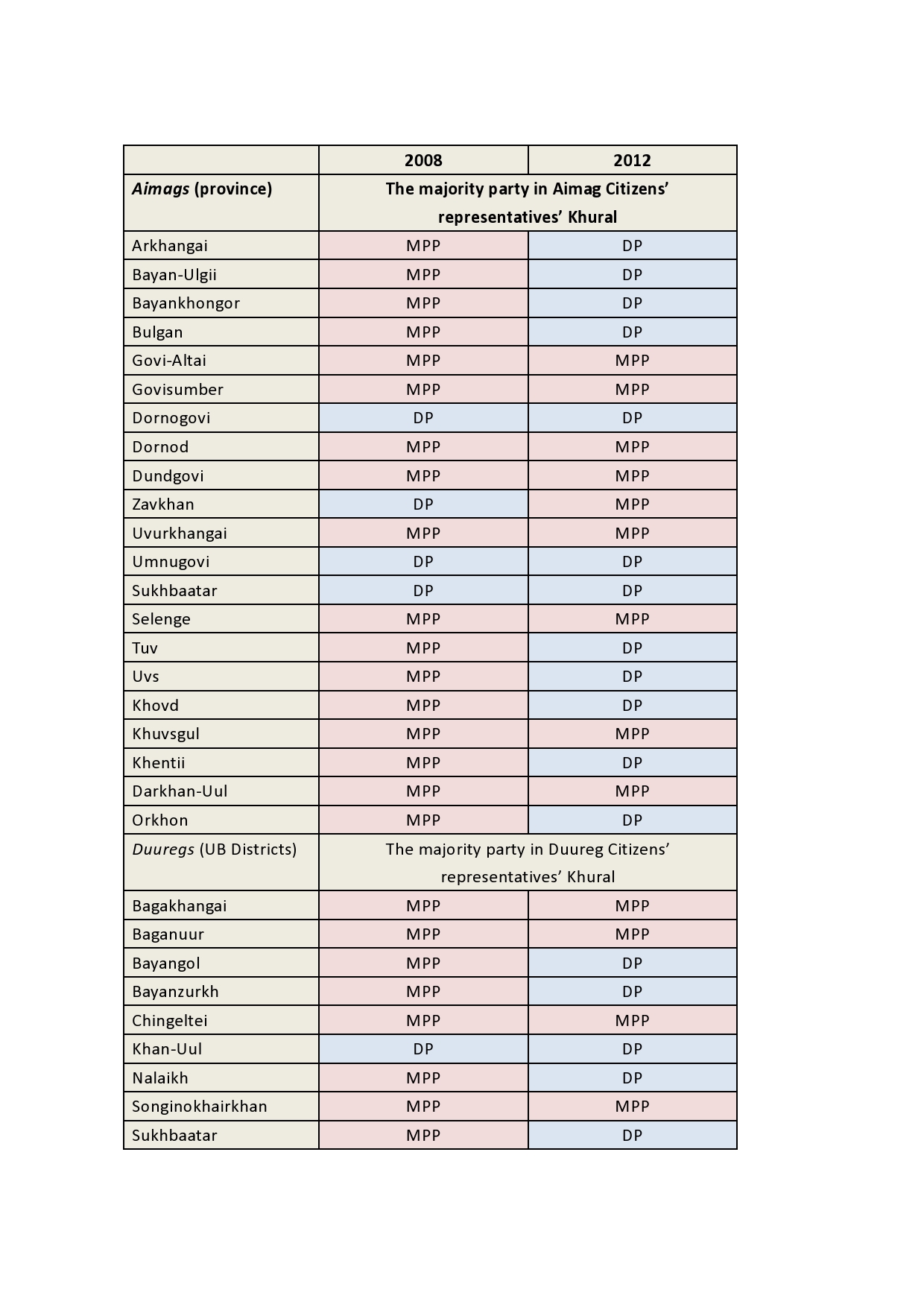
This election was also the first step in what may shape up to be a period of dominance over Mongolian politics by the DP. Having won a plurality of seats in parliament in June as well as the mayoral election in Ulaanbaatar, DP candidates did well in the local elections in November as well, winning a number of provincial khural majorities and thus governor positions.

While the presidential election is still more than six months away, Elbegdorj’s chances at re-election currently would look very strong, assuming that the DP holds together with the same unity that characterize the parliamentary campaign in June. If Elbegdorj were to be re-elected this would cement DP dominance further until the next parliamentary election in 2016, again assuming that internal rivalries don’t break out.

Other Coverage

Unfortunately, these domestic political dynamics were largely ignored by the international press, perhaps because journalists were so busy focusing on stories about various decommissioned UK ambulances who annually trek to Ulaanbaatar claiming 82% of international news coverage (my unscientific impression of coverage). At least we made it through a year of no stories (at least none that I recall) on kids living in sewers in Ulaanbaatar and Mongolian neo-Nazis. We almost made it through the year of the 850th anniversary of Chinggis Khan’s birth without any attention paid to this, but then Newsweek followed through with a story reporting on the “hunt” for Chinggis Khan’s tomb.

International Relations in 2012

Of greater significance for real rather than legendary international relations were three events this year. In May, the Mongolian parliament passed a Foreign Investment Law that is still causing ripples half a year later. In the Fall, Mongolia’s nuclear weapons-free status was finally formally recognized by the UN Security Council and in November Mongolia joined the Organization for Security and Co-operation (OSCE) as the first member from Asia (beyond the former Soviet republics of the Caucasus and Central Asia at least).

Other events that were noticed around the world were the November meeting of Japanese and North Korean negotiators in Ulaanbaatar and the massively oversubscribed sale of Chinggis Bonds (Mongolian sovereign debt).

Intensified Efforts against Corruption and Pollution

The Mongolian government has become more active during this year in two areas that hold importance consequences for the long-term future of the country: corruption and pollution.

The Enkhbayar trial is only the most prominent indicator of a seemingly intensified effort to curb corruption. A series of legislative efforts have clarified matters around an understanding of corruption and conflict of interest so that the prosecution of corrupt practices has become possible and some deterrent is being established. That does not mean by any stretch that corruption has been curbed, nor that the current DP government is free from it, but corrupt practices are being discussed in public more concretely and allegations are moving from the realm of conspiracy theories to criminal investigations.

After years of lamenting the horrific air pollution in Ulaanbaatar in the winter, there also seem to be some concrete steps to address this pollution, at least where it is coupled with traffic congestion. Less effort seems to be devoted to air pollution from coal stoves, though some pilot projects providing cleaner-burning fuels and stoves are in process.

Olympics

Finally, Mongolia’s success at the London Olympics winning five medals was drowned out somewhat by the absence of a single gold medal despite great efforts by athletes, especially in judo.

Outlook to 2013

The two political events that are most clearly on the horizon for 2013 are the presidential election and Mongolia’s continued presidency of the Community of Democracies.

On the economic front, Mongolia is likely to record strong growth for 2012 again, especially with the slight re-bounding of coal sales in the latter half of the year.

If any decisions related to Tavan Tolgoi are made this year (unlikely before the presidential election, somewhat less unlikely in the Fall) this will certainly garner attention, as would any more concrete attempts to renegotiate the Oyu Tolgoi IA.

Posted in Democracy, Elections, Foreign Investment, Foreign Policy, Ikh Khural 2012, Local Elections 2012, Media and Press, Nationalism, Oyu Tolgoi, Politics, Publications, Research on Mongolia, Social Media | Tagged | 2 Comments

Small Power

My thesis- written under the direction of Drs. Julian Dierkes and Brian Job- has been officially accepted by UBC, marking the completion of my M.A. Asia Pacific Policy Studies. I have included the abstract and link below, and in the coming weeks, I will add a post or two summarizing the Mongolia-specific sections for your reference.

Small Power: Mongolia’s Democratization and Foreign Policy Objectives

Small states are in a unique position, where they cannot hope to meet their foreign policy and security objectives through hard power. Rather, small states must balance against large neighbors via more subtle and nuanced ways. Through a critique of soft power, the author presents a new analytical framework for understanding small power and new criteria for defining “smallness” in today’s international system. Small power attempts to explain small state foreign policy decision-making and the role that “attractiveness” plays in their relations with larger states. One potential source of small power– democratic governance- is explored through a detailed look at the Mongolian model of democratization as a foreign policy tool in its “third neighbor policy”. Successful democratic transitions in small states can attract more security related, economic, and institutional support from leading democratic countries than their smallsize might initially suggest.

Posted in Democracy, Foreign Policy, International Relations, Mongolia and ..., United States | Tagged | 1 Comment

The Citizens’ Hall and Homeland Councils

Just adding a part of my thesis that focuses on the Citizens’ Hall and Homeland Councils.  And, still wondering how political parties’ emerging interests in local politics will impact the most powerful local network, Homeland Councils.

The citizens’ halls and the homeland councils provide interesting insights. The citizens’ halls demonstrate how a new democracy localizes ideas found in other democracies, while the homeland councils are examples of how informal networks of previous regimes have been transformed into the most influential formal network between urban and rural societies. The former plays a constructive role in civil society development, but the latter plays both positive and negative roles.

The first citizens’ hall (irgenii tanhim) was established in 2009 at the Government House.[i] Its main purpose is to provide citizens and civil society organizations an opportunity to participate in the law-making process.  It was initiated by current President Elbegdorj and his advisors based on examples from developed democracies.  The German Embassy, TAF and OSI provided technical assistance.[ii]  In the past three years, the citizens’ hall at the Government House was used to discuss draft legislation, amendments and the state budget, to debate over policies (e.g., city development, taxation, food security), to conduct hearings, and to hold an annual ‘town hall’ meeting with the president. The citizens’ hall at the Government House is administrated by the Presidential Office. The Presidential Office sets agendas, recieves public recommendations, administers the debates and hearings[1], and reports outcomes to the public.  The citizens’ hall uses all types of social media (website, Facebook, twitter) and broadcasts major debates.  Events are usually attended by parliament members, government officials and experts.  By January 2012, 15 out of 21 provinces, 5 out of 9 districts of the capital city, and the capital city itself established the citizens’ halls.[iii]  The citizens’ halls are mostly run by the secretariat of the local legislative chambers.  The majority of  these halls follow the handbook, Local Self-Governance based on Citizens’ Participation (2010).[iv]

The idea of the citizens’ halls is localized in the Mongolian context.  It shows the existence and impacts of civil society space because politicians are reacting, and trying to establish channels with civil society actors and organizations. But, the citizens’ hall reaches a limited number of citizens (ARD, 2010, p. 7), and could be used to strengthen the legitimacy of the presidential office, or to advance specific interests by claiming wider public support. It is even a bit early to distinguish the impacts of the citizens’ halls from similar efforts occurring among Mongolia’s neighbors: Chinese deliberative mechanisms (He & Warren, 2011) or Russian Public Chambers (Evans A. B., 2008; Richter, 2009). However, it has begun to serve as a channel for civil society actors to advance public interests.

The homeland councils (nutagyn zuvlul) differ significantly as an institution from the citizens’ halls. The councils are self-initiated, self-funded, and self-governed, while the citizens’ halls are dependent on government initiatives, resources, and governance.  To gain parliamentary seats, and provincial governance positions (i.e., governors and local legislative chambers of province and counties), politicians are increasingly dependent on the support of the homeland councils. The homeland councils play an important role in politicians getting elected, artists getting state awards, and even wrestlers getting the national wrestling ranks. For example, in last parliamentary elections, 56 out of 76 members of the Mongolian parliament represented ridings outside of the capital city, although over half the population resides in the capital. The revised Election Law (15 December, 2011) reduced the number of majoritarian seats from 76 to 48 by introducing 28 proportional seats.  However, 34 out of 48 seats will still belong to provinces. Moreover, the homeland councils are a locally developed innovation.  Their main goal is to facilitate communication between people in the rural provinces and counties with their natives who are presently residing in urban centres. The most common shared ties with rural provinces and counties include place of birth, parents’ native lands, home schools (e.g., secondary, vocational schools, and university), and work-related experiences.

The number of the homeland councils started to surge starting in the early 1990s because of the increased migration to the urban centres and the deterioration of public services in rural areas. Today each of the 21 provinces has its own homeland council.[v] Although the goals of the homeland councils have changed over time, there are several generalizable features.  First, the homeland councils are registered as non-governmental organizations (Sneath, 2010, p. 258). The homeland councils of counties usually operate as part of the homeland council of the respective provinces.[vi]  Second, the management committee (udirdakh zuvlul) of the homeland council includes notable individuals (e.g., statesmen, politicians, athletes, artists, scholars, high-ranking military and security service personnel, and monks) who have ties with the province. According to Sneath, the management committee has 10 to 25 members and the councils have a membership of 30-60 members help to organize events and campaigns (Sneath, 2010, p. 258). Third, homeland councils organize similar events.  Two annual events are worth mentioning.  The Lunar New Year’s celebration is organized in major urban centres. Interestingly, governors and members of the legislative chambers of the province and its counties attend this celebration. The other event is the anniversary of the province.  All members who reside outside of the province participate in this celebration which takes place in the home province.  Fourth, some councils have veterans and student associations.  The student associations are in charge of mobilizing students, alumni and organizing youth events (e.g., New Year’s celebration, parties, and sporting events).  Although all councils operate in the capital city (Byambajav, 2012; Sneath, 2010), some have branches in other major urban centres, such as Erdenet, Darkhan, and Choibalsan cities. Fifth, councils organize fundraising or disaster relief assistance.  Finally, all councils have their own regulations, and have begun to use social media (e.g., web sites, facebook), publish local histories, and reach out natives abroad.

Undoubtedly, homeland councils are important civil society organizations, but some of their activities and their lack of transparency tend to work against the development of democratic institutions.  For example, councils actively lobby for their natives to be posted in higher government positions and university graduates for employment in various organizations, including government services.  As a result, this contributes to the growth of unofficial local networks within the public services and undermines the principles of meritocracy and professionalism.  To secure ones’ political and business interests, politicians (esp., parliamentarians) engage in ‘logrolling’ and compete to distribute government funds and to obtain foreign assistance for their provinces.  In addition, business entrepreneurs and entities provide financial assistance to gain the support of homeland councils.  However, the financial aspects of the homeland councils remain nontransparent. Apparently, larger funds are devoted to organizing expensive anniversary celebrations.[vii]

Examples of the citizens’ halls and the homeland councils demonstrate the existence of civil society space in Mongolia. Two different types of institutionalization are occurring. The citizen’s halls are initiated and promoted by the Presidential Office. It is totally dependent on the will and resources of the government and politicians. In contrast, the homeland councils are self-initiated, funded, and governed by citizens to promote local interests in national politics. Both venues are open to any politicians, citizens, and state and business actors to advance their public, collective, or even personal interests. These venues are promoting democratic values and a sense of democratic citizenship through encouragement of civic activities. However, the homeland councils, apparently, lack transparency and often promote clientelistic types of engagements with actors of the state and political and economic societies. This is harmful to healthy civil society development.

[i]“Erokhiilogchiin dergedeh irgenii tanhim uudee neelee” [The Citizens’ Hall at the President’s Office Opens], available:  http://www.vip76.mn/medee/uil-yavdlyn-medee/8299-eronxiilogchiin-dergedex-irgenii-tanxim-uudee-neelee.html (accessed 20 May 2012).

[ii] Opening Ceremony Addresses of the German Ambassador, TAF Country Representative, and CEO of the Open Society Forum, 15 December 2009, available at: http://www.irgen.org/index.php/irgenii-tanhim?start=28 (accessed 27 May 2012).

[iii] “Update of the Establishment of the Local Citizens’ Halls,” the Citizen Hall Press Release, 10 January 2012, available at: irgen.org/index.php/irgenii-tanhim/135-3534546547 (accessed 27 May 2012).

[iv] The handbook was written by the Presidential Office experts who were in charge of the initial study, establishment, and management of the citizens’ halls.  The handbook is available at: www.president.mn/mongolian/sites/default/files/it_nom.pdf.

[v] Administratively, Mongolia is divided into 21 provinces and the capital city, Ulaanbaatar. The 21 provinces are subdivided into 331 counties (sum).

[vi] On some occasions, some provinces also operate on a regional basis, such as the homeland council for provinces of the Western Regions, in which several provides come together for certain events.

[vii] The homeland councils often present costly awards (the most popular one – jeep – e.g., Toyota) for winners of the wrestling and horseracing competitions.


Posted in Civil Society, Research on Mongolia, Social Movements | Tagged | Leave a comment

More on Corruption in Mongolia According to Transparency International: Further Comparisons

A couple of days ago, I offered some initial observations on Mongolia’s jump from 120 to 94th least perceived-to-be corrupt public service.

I find this business of the construction of various  indices in political risk analysis and other fields, quite interesting, so here are some more thoughts.

More Comparisons

In order to get a better sense of Mongolia’s ranking in a comparative context, I’ve tried to add some information to the TI datafile to be able to make different comparisons. In my previous post I listed the comparison with Asia Pacific countries already, and tried to eyeball post-state socialist countries and mining jurisdictions.

Now I’ve taken one of the indicators that flows into the CPI and used that to categorize countries. The Bertelsmann Foundation produced a Transformation Index that evaluates countries in transition on a whole range of criteria.

I have now compared Mongolia to all transition countries and to those transition countries in the Post-Soviet Eurasia category.

Post-Soviet Eurasia

This includes: Armenia, Azerbaijan, Belarus, Georgia, Kazakhstan, Kyrgyzstan, Mongolia, Moldova, Russia, Tajikistan, Turkmenistan, Ukraine, and Uzbekistan.

In this group, Mongolia ranks second jointly with Moldova following the much higher-ranked Georgia. Armenia follows at (105 on global ranking) and it’s downhill fast after that, ending with Uzbekistan and Turkmenistan at 170.

This is a very relevant comparison, I think, in that these are all countries that would have been in a roughly similar position in 1990. Note that of these countries, only Mongolia is rated “free” by the Freedom in the World report (Freedom House, 2012).

Transition Societies

The Bertelsmann Foundation includes a total of 128 countries in this listing. On the CPI this includes some countries with very low perceived corruption (Singapore, Chile, Uruguay, various Gulf states, Baltic countries, Eastern Europe, etc.).

Among these 128 transition countries, Mongolia ranks 55th with Moldova, Benin, Colombia, India. Other countries in this group at a similar rank would be Morocco, Thailand, Zambia, Senegal. That places Mongolia ahead of some countries such as Argentina, the Philippines, Indonesia, Vietnam, before the list ends with the highly corrupt Turkmenistan, Uzbekistan, Sudan, Afghanistan, North Korea and Sudan.

All in all, this leaves much room for improvement for Mongolia, but if the CPI is to be believed than Mongolia is already doing well in comparison to some obvious groupings of countries, and seems to be building momentum toward further improvements.

Potential Bribe Payers

Obviously, it takes two to be corrupt, so what about the potential bribe payers in Mongolia? Clearly, there would be a category of domestic bribes that might range from the banal (traffic tickets) to the more serious (allocation of public funds, jobs, etc.). [This is the kind of corruption in Mongolia that Astrid Zimmermann has worked and published on, for example in her chapter in Change in Democratic Mongolia.]

For the more serious (in terms of amount of financial benefit potentially gained, as well as harm done to the nation) corruption, most people think of property transactions and especially the mining sector in Mongolia. Mining is a sector that has attracted many foreign investors whether it is N American, Australian, and European junior mining companies with exploration projects, largely Chinese investors who are operating small and medium-sized industrial mining operations, or global investors buying into the Oyu Tolgoi project.

One of the components of the CPI is the Bribe Payers Index that is compiled by Transparency International as well. The 2011 edition ranked some of the most prominent foreign investor countries active in Mongolia as follows: Germany and Japan 4th, Australia and Canada 6th, U.S. 10th, South Korea 13th, Hong Kong 15th, India and Turkey 19th. While China and Russia come in at 27th and 28th, respectively, note that only 28 countries are included in the index and that mining is ranked 15th among 19 sectors according to the likelihood that companies in this sector bribe. The BPI does not correlate countries or sectors with specific destinations for bribes, so it offers no direct conclusions about (the perception of) corruption in Mongolia, the array of significant foreign investors is surely an important part of the context.

Methods

Yes, back to methods. I guess it’s the social scientist in me…

Frankly, I still can’t quite figure out whether the Corruption Perception Index is simply a mathematical formula standardizing a number of other indicators through a mathematical formula, or whether there is some expert judgement or additional scoring by TI involved. What puzzles me even further is that the sources listed on the Mongolia page, don’t correspond exactly to the sources listed in the datafile that TI makes available for download (XLS). As far as I can tell so far (I’m continuing to look into individual scores), none of the sources point to a significant change in scores for Mongolia, so I’m puzzled where the jump in score and ranking comes from in the CPI.


Posted in Business, Civil Society, Corruption, Foreign Investment, Global Indices, Mongolia and ... | Tagged | 1 Comment

FDI to Mongolia: Restrictions, China, and Comparisons with Canada

Ever since the Chalco bid for South Gobi Resources prompted the swift passage of a Foreign Investment Law by the Mongolian parliament I’ve been struck by some of the parallels between this law and its counterpart in Canada. I tweeted about this some weeks ago as well.

Feeding the Hungry Dragon

Now, a very interesting policy update for the Canadian Defence & Foreign Affairs Institute has me jumping off my fence and wanting to weigh in on this topic. The policy update (November 2012 PDF) was written by Charles Krusekopf and Hugh Stephens. These are authors who are definitely worth paying attention to. Charles has been involved in Mongolia and research on Mongolia for quite some time. He is the founder and continues to serve as the Executive Director of the American Center for Mongolian Studies. [Disclosure: I serve on the Executive Committee of the Board of Directors of the ACMS.] The ACMS has established itself in the 10 years of its existence not only as the go-to organization for researchers of all stripes doing research in or on Mongolia, but has become a mainstay of relations between Mongolia and North America. It also houses an ever-growing library that offers access to scholarly materials to Mongolians.

Hugh has had a stellar career with the Canadian foreign service and then in the private sector, mostly in Asia. He knows policy-makers and policy-making processes in Asia intimately.

In their piece, Hugh and Charles (S&K hereafter) argue that Mongolia offers a cautionary tale for the Conservative government as it makes decisions about resource investments in Canada by foreign investors. They base this argument on their view that given the similarities between Mongolia and Canada in terms of the strength of the resource economy, but also the need for foreign direct investment in this sector, the reactions to decisions made in Mongolia may offer a glimpse at reactions that Canadian decisions might prompt.

In their eyes, developments in Mongolia this year are a cautionary tale because the passage of a foreign investment law there has raised the political risk for investments in Mongolia, particularly for Chinese investors, but as a quasi-collateral damage, for all foreign investors.

Their argument was endorsed by a Wall Street Journal “Canada Real Time” blog post by Paul Vieira.

Similarities and Differences between the Mongolian and Canadian Foreign Investment Law

Before I turn to developments in Mongolia, a quick note on the parallels (or lack thereof) between the Canadian and Mongolia Foreign Investment Law.

The greatest similarity obviously is the fact that such a law exists and that this law demands a government review of investments in certain industries triggered by thresholds of the financial volume of these transactions.

Discussions about the application of the Canada Investment Act to the bid by Chinese state-owned for Nexen are ongoing in Canada. The general expectation had been that a Conservative government would welcome such investment. However, this government has actually turned down a number of such bids, swayed by economic nationalism rather than a free trade/capitalist agenda. In the CNOOC bid this debate is sharpened by the fact that the bidder is a state-owned Chinese company. Both, “state-owned” and “Chinese” appears to have raised warning flags in parts of the Conservative government.

S&K are not alone in warning that these discussions in Canada are likely to hurt Canada’s reputation as an investment destination. This is an argument that another highly trustworthy voice on Asia in Canada, Joseph Caron, DFAIT Asian grand slam winner as the former ambassador to China, India and Japan, made in October in the Financial Post.

Earlier in the Fall there had apparently been some discussion in the government about specifying some guidelines that might distinguish bids by state-owned entities from those of non-state companies.

This is a distinction that the Mongolian law has created quite explicitly. The Mongolian law outlines sectors that it applies to (the resource sector is included, naturally) and thresholds at which different kinds of reviews are triggered. A large bid by a state-owned foreign investors would thus trigger a review by parliament. This was a clause in the law that was aimed at the Chalco bid for South Gobi at least in part.

And, in a Canadian context, parliamentary review sounds like a good thing, doesn’t it? In fact, there are voices demanding just this in Canada, though I suspect that they’re not necessarily inspired by the Mongolian example.

Parliamentary review in Canada would offer transparency and would force the government to take a clear stance on a proposed sale. Whatever this decision was, any opposition to it would also want to be clear in its opposition making this decision more approachable to the Canadian public.

Is this what would happen in Mongolia? Would parliamentary review offer more transparency, a more informed and more democratic process? Sadly, I doubt it. Note that I have lots of reasons to believe in Mongolian democracy and its staying power. I continue to keep a close eye on political developments in Mongolia in part to develop a more accurate sense of the political risk involved in investing there.

Parliamentary review in Mongolia would imply a) a politicization of the decision, and b) particularly sadly, an opportunity for parliamentary corruption. Obviously, the latter fear is based on conjecture, though there is so much discussion of endemic corruption in Mongolia and many MPs are so obviously wealthy that it is difficult to dismiss this nagging fear. Note, however, that Transparency International just released its 2012 Corruption Perceptions Index and boosted Mongolia’s ranking from 120th to 94th least corrupt. This may give some cause for optimism that anti-corruption measures are building momentum and that parliamentary review may become just right as a response to foreign investment in the future.

Also, decisions on FDI in Canada would come in the context of a fairly stable regulatory regime that offers predictability and the attempt to balance investors’ expectations with Canadians’ needs. Stability in the regulatory regime has not been the strong suite of Mongolian mining regulation.

So, this is where the parallels in my eyes clearly end. Yes, similar principles, but a very different application thereof.

Mongolia as a Cautionary Tale?

Back to that hungry dragon…

S&K write that “Mongolia’s handling of the China file has been less than stellar, reflecting a deep seated ambivalence about China’s intentions combined with a rise of resource nationalism”.

Resource nationalism has been written about a fair bit in the Mongolian context. This is generally equated with some evil movement aiming at nationalization of resource assets. Hugo Chavez is the example that everyone seems to have in mind. In Mongolia this claim is most commonly linked to the demand by some parliamentarians and parts of civil society that the Investment Agreement for the Oyu Tolgoi mine should be revisited (2011 discussion).

But one observer’s resource nationalism is another person’s attempt to preserve the resource wealth of a country and to reap its benefits for current and future generations. The former is a foreign investor, while the latter is a Mongolian.

I would be the first to agree that the process by which Mongolian policy-makers have arrived at some decisions has not always been ideal (in the sense of a careful decision that is based on a thorough and dispassionate analysis of available information) – in fact, this process has been awful at times – but I cannot fault Mongolians or their leaders for their desire to get this decision “right” and their fears of getting it “wrong”.

Striking the appropriate balance between material needs, social aspirations, environmental and cultural protection, and, yes, financial rewards for investors, is not an easy decision. Jurisdictions in North America that have had decades to arrive at appropriate mechanisms for this decision, are still struggling with these issues.

Yes, there is a deep-seated ambivalence about Chinese investments in Mongolia (but also in parts of Canada). This ambivalence includes fairly rational fears of economic dominance (hey, even the Conservative government in Canada is looking to diversify beyond economic dependence on the U.S.), but also elements of anti-Chinese sentiments. Fellow “Mongolia Today” blogger Mendee has written about the latter aspect in his MAAPPS Master’s thesis. Another fellow blogger, Brandon Miliate, is currently completing his MAAPPS thesis examining the options that Mongolia might have in its foreign policy.

S&K write that Mongolia “has been reluctant to allow Chinese ownership of mineral resources. Its efforts to block Chinese ownership of resources, however, have impacted all foreign investors, raised uncertainty and potentially led to an overall decline in foreign investment.” This is a topic that Mendee and I have both taken up in the past:

The part of S&K’s statement that I find easiest to agree to is raised uncertainty. There’s no doubt that this is the case. Surely, this has also scared off some investors or made investments dearer. But have enough investors been scared to have an impact on Mongolia? Is the OT mine not such a gigantic project in a resource-hungry world that scaring off some investors might not have a negative impact.

Sure, there is a line where all investors might be scared, but I don’t think that Mongolia has come close to that line. Witness the Chinggis Bond sale last week, raising $1.5b, but attracting orders for ten times that amount. Yes, Mongolia with its BB- S&P rating is paying 5 1/8% on these bonds, but that’s cheaper credit than Italy has been able to get recently, so not too many bond investors seem scared off. In the end, there are so many investors in the world who have read the news that Mongolia was the fastest growing economy in 2011 and who want to participate in this presumed bonanza, that there doesn’t seem to be a shortage of investors, even without any large-scale Chinese investment.

Back to S&K: Yes, Chalco got scared off by the foreign investment law. But that, presumably, was the point. Also, it is very clear that something went seriously wrong in this Chalco bid for South Gobi. Who in their right mind, especially if they had any experience in Mongolia, would announce such a bid without consulting the government extensively? There’s no indication that such consultation occurred. This smacks of hubris on part of South Gobi, or Chalco.

If you’re inclined toward conspiracy theories (as many Mongolians and the Mongolian press seem to be), the most logical explanation of this Chalco bid announcement is one that sees Rio Tinto behind this announcement with a deliberate attempt to drive down South Gobi shareholder Turquoise Hill Resources’ stock price as RT is purchasing Turquoise Hill.

Did South Gobi cease production because of the failed bid? Yes, in the sense that Chalco would have operated the mine, presumably, if the purchase had gone through, but note that it is South Gobi’s coal price (and ultimately its production costs coupled with shrinking demand in China) that has sunk that particular ship. The Chinese ambassador to Mongolia agreed that it is a lack of price competitiveness that has reduced coal exports to China in a recent interview.

Note also that South Gobi is now under some kind of investigation by Mongolian authorities that has stranded an Australian lawyer in Ulaanbaatar for some weeks. Most reporting on this case is focused – once again – on “resource nationalism”, but note that the entire executive team of South Gobi has been fired over the summer one by one and their mine has ceased production. Again, without giving in to temptations of seeing conspiracies, could it not be that there really is something to investigate there?

S&K: “The slowdown in foreign investment has reduced Mongolian government revenue, lowered the credit rating and stock prices of companies working in Mongolia, and slowed ambitious development plans for both mines and critical infrastructure projects.” All true. But if a country is so dependent on mining for its future, is that not a reasonable cost to pay for a more careful (if not always carefully executed, and sometimes even recklessly so) deliberation?

After all, the natural resources in question are unlikely to vanish in Mongolia or in Canada and nor is demand for them, at least in the near or medium-term future.

Of course, S&K and I can only speak in hypotheticals when it comes to considering the impact of legislative changes on investment volume. Any empirical evidence on this would have to analyze a large number of countries in a great variety of different contexts.

It is important to note, however, that foreign direct investment seems to be somewhat of an example of herd behaviour, especially in the mining industry. The perception of political risk might thus be more important in some circumstances than the actual risk. This is certainly more the case for a place like Mongolia where much of the information (including this discussion) is about perception rather than a measured empirical reality.

Conclusions

My understanding of the Canadian oil & gas sector and its regulation or of the Canada Investment Act is too limited to take my slightly different (from S&K) perception of Mongolian developments as a basis for recommendations on the Canadian situation. However, I don’t think that it is an accident that resource-rich countries, whether they are advanced industrialized countries like Canada or Australia, as well as developing and just-on-the-verge-of-booming countries like Mongolia are grappling with similar challenges and are doing so in the context of democratic discourse.

When members of the mining industry in these advanced industrialized countries complain about governance and regulatory uncertainty in places like Mongolia, they would do well to note shared challenges and some of the parallels in the solutions that policy-makers hit upon. With this, I do not have S&K in mind who have offered some thoughtful observations and have taken a well-informed position on the particular challenges facing Canada and Mongolia.
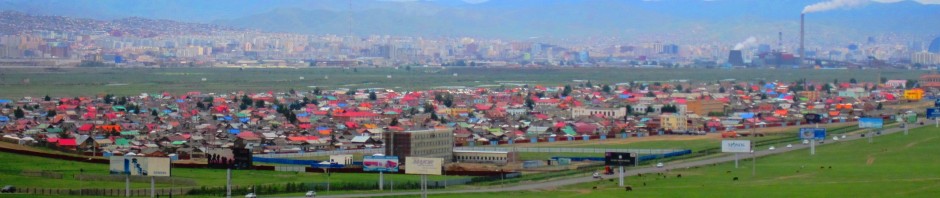
Posted in Business, Canada, Economics, Foreign Investment, Governance, International Relations, JD Mining Governance, Mining, Mongolia and ..., Oyu Tolgoi | Tagged | 7 Comments

Corruption in Mongolia according to Transparency International

Corruption is one of the most prominent features cited in any overview of Mongolian politics, political risk, human development or investment potential. Yet, any hard evidence on the prevalence, extent and mechanisms of corruption are very hard to come by. One of the most internationally visible single piece of evidence in this regard is Transparency International‘s Corruption Perception Index. The 2012 iteration was released on Dec 5, 2012 and below I take a look at Mongolia’s ranking in and of itself and relative to other countries.

Methodological Note

First a few words on the Corruption Perception Index. First of all and very importantly, this is an index of the perception of corruption, not of corruption itself. Presumably this perception correlates highly with actual corruption, but perhaps perception is liable to change more quickly than actual practices, or may lag practices in some circumstances.

Secondly, as the CPI measures perception, it is survey-based and thus subject to the challenges that all surveys face in terms of the recruitment and representativeness of respondents, the translation of words and concepts across languages, etc. These challenges are more severe in a place like Mongolia where we can’t compare any survey data with some general social survey that would give us a better handle on population composition and demographic variables beyond what is offered in the census. This is a challenge that was laid bare in polling in advance of the 2012 parliamentary election, for example.

Importantly, the CPI is a composite index, i.e. it relies on scores/results of a number of other indicators. Beyond that it is actually somewhat difficult to figure out what exactly is going on in the calculation of the Index. The part that I haven’t quite figured out is how much of a judgement by individuals is involved as opposed to a purely mathematical process of aggregating and standardizing other indicators.

One the one hand, TI mentions the involvement of experts in various methodology notes, on the other hand, the Index is clearly described as an “aggregate index, which draws on relevant questions from a number of different data sources that capture business and expert views” (CPI Updated Methodology 2012).

As far as I can figure the methodology notes out, the basis steps in compiling the index are:

  1. selecting data sources according to four criteria: quantifies perception of corruption in public service, valid methodology, credible source, sufficient variation in scores
  2. standardise date sources to 0-100 scale with mean around 45 and SD around 20.
  3. average scores across sources (minimum 3)
  4. report standard error and confidence interval.

According to the Mongolia country page, the sources of information for Mongolia are:

  1. Control of Corruption: WorldBank (2010)
  2. Global Corruption Barometer: TI (2010)
  3. Open Budget Index: International Budget Partnership (2010)
  4. Global Competitiveness Index: IMD (2011-12)
  5. Judicial Independence: World Economic Forum (2011-12)
  6. Human Development Index: UNDP (2011)
  7. Rule of Law: WorldBank (2010)
  8. Press Freedom Index: Reporters Without Borders (2011-12)
  9. Voice & Accountability: WorldBank (2010)

Sources that are not available for Mongolia:

  1. OECD Anti-Bribery Convention [only OECD countries?]
  2. Bribe Payers Index [only “world’s wealthiest and most  economically influential countries”]
  3. Financial Secrecy Index

I am a little puzzled by the listing of sources in that none of the more recent scores (I can’t imagine that 2010 sources are driving the 2012 leap for Mongolia) are particularly positive. Since my conclusion now is that the CPI does not seem to involve any judgements by TI independent of the scores from sources, I’m not sure how this score for Mongolia comes about when I look at the components.

Ranking Mongolia

The biggest news is clearly that Mongolia has jumped from 120th to 94th least corrupt country or, alternatively from 62nd to 80th most corrupt.

TI explicitly warns that the methodology for the 2012 version has changed making year-over-year comparison impossible, though the change was in part motivated by the desire to make such comparisons possible in the future.

Mongolia received a score of 36 out of 100 (100 representing no perception of corruption at all). This compares to an average of just under 44 for all 174 countries ranked. The number of sources used in the calculation of Mongolia compares well with OECD and many other countries.

Among the 28 countries included in the Asia Pacific group, Mongolia ranks right in the middle at 14.

Among all 174 countries, Mongolia has an identical score as Benin, Colombia, Djibouti, Greece, India, Moldova, and Senegal. I know very little about most of these countries, but an identical ranking to an EU member country (Greece) and a gigantic Asian democracy (India) is surely not something to be ashamed of.

If we look at post state-socialist countries in the listing, Mongolia sits right in the middle, below European post-Soviet and Eastern European countries (the Baltics, Poland, Hungary, Czech Republic, Slovakia, Romania, Macedonia, Bosnia and Herzegovina, Bulgaria, Montenegro, Moldova), but ahead of other Asian and some European countries (Armenia, Kosovo, Albania, Belarus, Vietnam, Kazakhstan, Russia, Azerbaijan, Ukraine, Kyrgyzstan, Cambodia, Tajikistan, Laos, Turkmenistan, Uzbekistan. Perhaps most notable is the significantly better score for Mongolia than any of the Central Asian countries even though some of the starting point for development in 1990 may have been comparable (though minus the Soviet Republic status, and plus democracy for Mongolia).

I was also trying to group the TI-ranked countries by those that are significant mining jurisdictions, but found no single listing of such jurisdictions on-line. The challenge would be to come up with a metric that would include a country like Canada with a long-established and large mineral sector, and also Mongolia where the volume is small, but the potential is huge.

In any case, eyeballing some countries with prominent mineral sectors (not oil and gas) would put established producers like Canada, Australia, US, Chile ranked highly, but also Botswana, Namibia, Brazil, South Africa. Mongolia would then be somewhat similar among mining countries to Peru, Mexico and the Philippines, but much less corrupt than Indonesia, Kazakhstan, Russia, Nigeria and Venezuela.

Explaining Mongolia

Let’s assume for the moment (and I am happy to make this assumption having looked at the documentation) that the CPI produces reliable information and that the ranking of countries relative to one another is meaningful. This assumption begs the question of what happened in Mongolia in the past 12 months that would lead to such a significant jump. Fortunately, I had a chance to discuss this with PoliSci PhD student Mendee this morning to get a better sense of likely developments.

Remembering that the CPI is a Corruption Perception Index the best explanation for Mongolia’s jump would be to focus on the momentum (Mendee’s suggestion) that has been building around anti-corruption activities in Mongolia. Corruption has been very much in the news this year with the most internationally visible instances being the arrest and trial of former president Enkhbayar and the current detention of Australian lawyer Sarah Armstrong. But there has been much more than this going on that has been much more visible domestically with investigations of several aimag governors, a tightening of income reporting requirements for public and elected officials, etc.

Public perception of anti-corruption activities given a high level of underlying corruption (this is assumed to be the case for Mongolia where people (Mongolian and non-Mongolian) speak of corruption as “endemic”) could be either, “OMG, what a cesspool, corruption is everywhere” (perception as more corrupt than expected), or “Yes, corruption is everywhere, but things are getting better”. Clearly, the second view must have predominated in the sources used by TI.

What makes this explanation of building momentum plausible is that corruption and related topics like conflict-of-interest have become better defined over the past several years in Mongolia. There has been a fair bit of legislative activity that makes some of the principles behind corruption as well as specific definition clearer to all involved so that discussions now are less about the principle than about specifics.

These legal definitions and some initiatives at enforcement may then be acting in two ways, a) by building awareness, and b) by providing a deterrent to potentially corrupt officials.

News Events that may have contributed to perception of more stringent anti-corruption efforts

Obviously, news events relating to corruption have a great potential to change perceptions. When I exchanged tweets with Enkhbold Z, chairman of the Mongolian parliament, he agreed that “yes, I was expecting some improvement. I think creation of ACA [Anti-Corruption Agency], Elbegdorj election [for president 2009], of course Enkhbayar case contributed to this”. While their impact would be most likely on 2013 or even 2014 surveys, some of the 2012 events might have been:

  • Arrest and trial of former president Enkhbayar. Contrary to the expectations of Doug Schoen and other participants in an international media campaign apparently orchestrated by Enkhbayar, this did not spell the end of Mongolian democracy, but instead signaled the seriousness of anti-corruption efforts. The Anti-Corruption Agency was very visible in this process, though also accused of being political motivated.
  • Tightening and tighter enforcement of election regulations around the June parliamentary election. This included the prosecution of some winning candidates for electoral fraud.
  • New Minister of Justice Temujin has obviously gained some prominence in terms of judicial reforms which is in part an anti-corruption effort as well.
  • While investigations of mining companies, including South Gobi are primarily viewed as being motivated by political/corruption revenge or “resource nationalism” by foreign investors, these may be signalling powerfully to a domestic audience that anti-corruption efforts are being bolstered.

Caveat: A Secular Trend in Rankings of Mongolia

One alternative explanation to this positive sense of building momentum would be that the information used by TI has simply gotten better. This is not implausible in that more attention is being paid to Mongolia from many directions so that more information is becoming available. There may thus be a secular trend in part associated with the status of having the highest GDP growth in 2011 that would lead to a rise in these kind of index scores for Mongolia.

Conclusions

It has been over a year since the Luis Vuitton boutique was established in Ulaanbaatar. It appears to be economically viable. This alone suggests rampant corruption in a country with very few domestic industrial activities (as of yet) and a significant proportion of the country living in poverty. Perhaps this should be an indicator used by TI for their Corruption Perception Index, but maybe not as it would paint as negative a picture of the country as the ownership of the only Rolls Royce by a minister would. The picture suggested by the CPI is more positive.

The bottom line thus could be, corruption is rampant in Mongolia, but anti-corruption efforts have been stepped up significantly, so a decline of corruption can be reasonably expected in coming years.

Posted in Business, Civil Society, Corruption, Foreign Investment, JD Mining Governance, Mongolia and ... | Tagged | 8 Comments

New Book: A History of Land Use in Mongolia: The Thirteenth Century to the Present

Elizabeth Endicott

A History of Land Use in Mongolia: the Thirteenth Century to the Present

Palgrave/Macmillan, November 2012.

While modern Mongolia has attracted much attention from political scientists and economists seeking to explain the rapid changes that have occurred since the end of state socialism (1921-1990) and the advent of the free market democratic era (1990 – present), far less attention has been directed to core issues of land use in a country that supports a pastoral nomadic population.  A History of Land Use in Mongolia: the Thirteenth Century to the Present examines conceptual and practical issues of land use in historical terms.  For instance, to what degree over the centuries have external forms of authority – secular and religious – shaped herders’ relationships to the pasturelands that are crucial to their livelihoods?  What sorts of strategies in dealing with authority – confrontation, avoidance, flexibility – have Mongolia’s pastoral nomadic herders relied upon?  From a historian’s perspective, the current ways in which Mongolia’s herders have adapted to a new economic/political system are best fathomed by understanding how herders have adapted in previous historical regimes dating back to the thirteenth century.

The text of the book is accompanied by several of the author’s photographs.  Among these, for instance, are photos of winter/spring livestock shelters.  These shelters and their surrounding pasturelands represent a key area in which evolving land legislation and local practices intersect in today’s Mongolia.  Since summer and fall pastureland is by law open to common use and unrestricted by any form of land deed, the winter and spring livestock shelters point to new concepts of land leasing and ownership in a countryside largely devoid of fencing.

In the course of the book, Mongolian government policies vis-à-vis pastoral nomadic production are compared with Chinese government policies in ethnically Tibetan and Mongolian regions within the PRC.  Challenges faced by Mongolia’s herding population are also compared and contrasted with those faced by herders in neighboring Kazakhstan.

About the Author

Elizabeth Endicott is a professor emerita of History at Middlebury College in Vermont. She is the author of Mongolian Rule in China: Local Administration in the Yuan Dynasty and Pages from the Past: the 1910 Moscow Trade Expedition to Mongolia.

Posted in Grassland, Nomadism, Publications, Research on Mongolia | Tagged | Leave a comment

2012 Local Election Final Results

The General Election Commission announced today the official results of local elections. In the run-off elections in six capital city districts, the Democratic Party (DP) won in 4 districts and the Mongolian People’s Party (MPP) won in 2 districts. Overall, the DP won in 12 provinces and 5 districts and the MPP won in 9 provinces and 4 districts. Below, the 2012 election results are compared with the corresponding elections in 2008.

Posted in Elections, Politics | Tagged | 1 Comment