Mongolian Foreign Policy: Rapid Growth, Third Neighbours and Moral Authority

Mongolia’s foreign policy has received some attention over the past several years. Most of this attention, especially recently, seems to derive from Mongolia’s current status as the fastest growing economy in the world.

Jean-Frédéric Légaré-Tremblay has provided a very cogent assessment of Mongolia’s place in the world for the Canadian International Council.

In this article, Légaré-Tremblay lists the following aspects:

  • military vulnerability
  • “third neighbour policy”
  • peace-keeping operations
  • North Korea

He ends his overview with the puzzle of Pres. Elbegdorj’ recent visit to Iran.

There are some further elements that make Mongolian foreign policy interesting. Légaré-Tremblay rightly highlights Mongolia’s exceptional status as Asia’s only post-socialist democracy. This status gives the country not only access to some of the high-powered third neighbours it has pursued (note U.S. Sec of State Hilary Clinton’s visit to Mongolia this summer), but also gives it some moral authority. [Note that discussions with Brandon Miliate have shaped many of my views on this moral authority and I have learned from Mendee Jargalsaikhan about foreign policy more generally.] Institutionally, this moral authority is visible in Mongolia’s presidency of the “Community of Democracies“, but it is also associated with the country’s increasing status in other organizational spheres like the UN Office of the High Representative for the Least Developed Countries, Landlocked Developing Countries and Small Island Developing States or the Non-Aligned Movement.

This moral authority surely also in the end made the recognition of Mongolia as a nuclear-weapon free state by the UN Security Council possible in September 2012, a step that the country had been pursuing since its declaration of nuclear-weapon free status in 1992, but that the UN SC had been reluctant to grant due to perceptions of the complications associated with a single-country nuclear weapons-free zone (given that Mongolia’s two neighbours, Russia and China, are both declared nuclear powers). In this forum as well as so many others, Mongolia clearly punches above its weight and its democratic status is a strong factor in this relative visibility.

It is perhaps not surprising that the status of Mongolia’s democracy has been chosen as the avenue of attack of former Mongolian president Enkhbayar especially in the ever-more bizarre writings of a certain Forbes.com blogger. If these writings were to succeed in tainting Mongolia’s democratic reputation (without any particular factual basis, see my article “Mongolian Democracy Crawls, But Moves Ahead” in the Wall Street Journal Asia in July 2012,) this would be a serious blow to Mongolia’s foreign policy. Yet, reasonable and cooler heads will hopefully prevail to reinforce Mongolia’s status in this regard and confirm the Freedom House classification of Mongolia as “free”.

Finally, the matter of Pres. Elbegdorj’ visit to Iran and his “inspection” of the Natanz uranium enrichment plant.  I was initially quite puzzled myself about this visit in the context of the 16th Summit of the Non-Aligned Movement. Why would the Mongolian president – whom no one suspects of harbouring ambitions for nuclear weapons, as confirmed by the recent UN SC recognition of nuclear weapons-free status – visit a facility that is at the root of one of the burning geopolitical challenges at the moment.

There are no particular resource links with Iran, i.e. Mongolia does not appear to be importing any significant quantity of oil from Iran. While there is an ancient Mongolian diaspora in Iran historically associated with the Ilkhanate and the Hazaras, this has been the focus of some initiatives from Mongolia (such as the Mongol Heritage Foundation or the Organization for the Study of Diaspora Mongols), but the fate of diaspora Mongols remains a fringe topic of interest and pan-Mongolism a fringe political movement.

In the end, Pres. Elbegdorj has offered a persuasive explanation that draws on Mongolia’s moral authority as I have also outlined it above. In an interview with CNN’s Christiane Amanpour Pres. Elbegdorj said, “Iran’s nuclear activities should not endanger any independent country’s security. Second, Iran should comply with the UN Security Council’s resolutions. Also, […] Mongolia has nuclear weapon-free zone status. That is a status that is not only important in our region, but it is a status that is important for the rest of the world.”

While the world’s attention to Mongolia over the coming years will be rooted in its economic development and natural resources, its moral authority has been growing on the basis of democratic reforms and an active and openly-engaged foreign policy.

From a Canadian perspective, it is Mongolia’s moral authority that is of great interest in addition to its attempts to lift itself up by its natural resources bootstraps. These twin aspects will surely be something to celebrate in the coming year of the 40th anniversary of Canadian-Mongolian diplomatic relations (2013).

Mongolia Today authors on Mongolia’s foreign policy

Julian Dierkes

Expanding Canada-Mongolia Relations: Resource-Based Democracies in Collaboration“, Canada-Asia Agenda, 7 (April 2010), Asia Pacific Foundation of Canada.

Mongolia’s ‘third neighbour’ policy and its impact on foreign investment” East Asia Forum, February 15, 2011

Mongolian Democracy Crawls, But Moves Ahead“. Wall Street Journal Asia. July 9, 2012: 15.

蒙古 寻求外商投资的多元化” [Mongolia to Seek Foreign Investment Diversification]. 21世纪经济报道 [21st Century Business Herald]. August 28, 2012: 19.

Mendee Jargalsaikhan

Mongolia–Australia relations: a Mongolian perspective” Australian Strategic Policy Institute. Sept 14 2012.

Factoring Mongolia’s Non-Membership in the Shanghai Cooperation Organization Voices From Central Asia, no. 4, July 2012.

Finally a New Era in NATO-Mongolia RelationsVoices From Central Asia, no. 1, June 2012.

Mongolia’s Quest for Third Neighbours: Why the European Union?EUCAM Policy Brief, No.25, July 2012.

Why is Russia Favored by Mongolia and North Korea?PacNet, August 21, 2012.

Brandon Miliate

Sec. Hilary Clinton has finally arrived … in UBMongolia Today July 9 2012.


Posted in Foreign Policy, Mongolia and ... | Tagged | Leave a comment

Why Mongolia’s China Mining Strategy is NOT a Mistake!

In the recent blog of the Wall Street Journal, Drs. Erickson and Collins argued convincingly that resource nationalism and discriminative policies regarding Chinese investors in Mongolia will have a negative impact on Mongolia’s economy. And they downplayed Mongolia’s attempts to extend its railways to reach the Russian Pacific ports. Yes, they are right about the role of geography and importance of Chinese investment and infrastructure for Mongolian mining exports. But, there are other considerations that are missing in their argument.

Before making quick conclusions on either anti-Chinese attitudes or resource nationalism, there are other rationales forcing Mongolian politicians to make a unanimous decision to limit the investment of the foreign state-owned enterprises in key economic projects.  Since 1990, Mongolian citizens have always been able to challenge the government’s key political and economic decisions if it is against their will, livelihood, and future.  This time, Mongolian people did not oppose the parliamentary decision of restricting Chinese investors because they want responsible and sustainable mining.

Arguments made by Erickson and Collin are, of course, shared by a number of Mongolian mining companies that are benefitting from the recent mining boom and the weak mining regulatory policies which could not hold mining investors accountable for responsible mining.  They want to sell more coal to China, but they have little to say about environmental degradation and social-economic consequences caused from extensive, careless mining operations.  Erickson and Collin will be touched if they compare images of the Mongolian southern provinces now and two decades ago just to see the environmental degradation in the world-renown Gobi desert.  Similar heartbreaking images are haunting people living in northern China or the Russian Far East.  Mongolian politicians made attractive, weak mining regulations during the economic downtime in the mid-1990s; as a result, many mining companies showed up and others, including many Chinese companies, secured licenses. The majority of license holders have conducted extensive mining exploration and extractive operations.  The irresponsible, careless mining of both foreign and domestic companies have caused public outrage, with calls to strengthen the mining regulations and make the license-issuance business transparent.  The latest efforts to investigate corruption in the mining regulatory institutions, to suspend the issuance of mining licenses to foreign investors, and to increase Mongolian shares in strategic mines are a few visible responses taken by Mongolian politicians for the public outcry.  Apparently, it also provides the ground for populist politics. The long-term investment agreement with Rio Tinto demonstrated sustainable and reliable mining were the main concerns for Mongolia.  These will be the overriding concerns for all other major projects, including Tavan Tolgoi.  All three neighbors, China, Mongolia, and Russia, are today striving for Western technology and improving the responsibility of mining companies, while keeping in mind each other’s capabilities and mining practices.  But all seem to agree that Western companies have a rather long record of corporate social responsibility.

Like any other nations, reliant on the extractive industries, Mongolians also want to make more value out of their natural resources because they are not renewable.  The establishment of short rail links with Chinese processing factories will benefit only a few mining companies, accelerate extraction process, and increase the Chinese reliance on low-cost coal from Mongolia.  Of course, it will generate short-term revenues from coal exports, but it will not reclaim the virgin lands of the Mongolian Gobi.  On the other hand, Mongolia’s policy to expand its rail links by connecting key mining deposits and extending its reach to Russia’s Pacific Ports have more promises than these short term gains.  First, the major infrastructure projects such as rail road and industrial complex Gobi area will offer employment opportunities for thousands of Mongolians.  Second, it will facilitate future economic interactions with marginalized, poorly developed Mongolia, the Russian Far East and eventually, another route for East Asia.  Third, Mongolians have access to both Russian and Chinese ports to the East Asian market, plus a European link.  The authors might be right at the current time, but the market will change.  One day Mongolia may turn into an importer of coking coal – at which point it would be better to weigh the costs of the two transport options.  Many Mongolians are looking beyond “Mine-golia”, as a new nickname for Mongolia, to build industrial capability for value-added mining products, to diversify its economy by re-investing into crop plantations and animal husbandry, and to improve the responsibility of mining industries. Due to inevitable economic dependence on China (remember, Chinese small and medium mining companies hold far greater number of licenses than other foreign investors), Mongolia does indeed avoid any further increase in economic dependency from any single investor.  This is the concern shared by any nation state.  For instance, Australia prohibited the participation of Huawei in the national network band tender and Mongolia did the same for Chinese ZTE two years ago.  Mongolia’s experience of overdependence on the Russian economy and investment are still haunting Mongolians politicians.  Giving away major tenders to both its neighbors will only consolidate their already influential economic leverage on Ulaanbaatar; therefore, Mongolia must at least attempt to invite others to diversify its economic partners.

Mongolia’s decision to limit the Chinese state-owned enterprises is similar to any state with giant neighbors. The unanimous decision is not a result of anti-Chinese attitudes or over-exaggerated resource nationalism.  It is the reflection of a public outcry against the past two decades of irresponsible mining and their desire of developing their economy by expanding infrastructure, introducing corporate social responsibility, and diversifying its economy. Therefore, the Mongolian mining strategy is not a mistake.

Posted in Business, China, Foreign Investment, Mining, Mongolia and ... | Tagged | 4 Comments

Mongolia-Australia Relation

Mongolia and Australia are marking the 40th anniversary of bilateral relations. In quite similar time frame with Canada, Australia, as another middle power, reached out Mongolia.  Today bilateral relation has been expanded as a result of the Australian well-targeted educational assistant and desire of Australian mining companies.  Here is the recent piece on this.

Posted in Australia, Foreign Policy, Mining | Tagged | Leave a comment

New book: Mapping Mongolia – Situating Mongolia in the World from Geologic Time to the Present

Just adding a review of the book “MAPPING MONGOLIA: Situating Mongolia in the World from Geologic Time to the Present” edited by Paula L.W. Sabloff. It was published in Pacific Affairs, 85(3), September 2012, pp. 656-658(3)

This welcome new book examines the place of Mongolia in the world. The book is a collection of papers originally prepared for the four-day international research symposium on “Mapping Mongolia,” held at the University of Pennsylvania in 2007. The strength of the book is that it is the result of the collaborative efforts of 15 authors from diverse areas of expertise (ecology,
genetics, archeology, history, anthropology and international security). The impetus for writing this book is a widely shared concern among scholars that small countries are marginalized by a configuration of area studies programs and groupings in the Western academia and diplomacy.

Full version of the review PDF

Posted in Mongolia and ..., Publications, Research on Mongolia, Society and Culture | Tagged | Leave a comment

A New Mongolian Government Is Finally Formed

Although the new government formed in Ulaanbaatar, its fate seems to be shaky and fragile.  Unlike earlier governments, Altankhuyag’s government is still trying accomodate interests of various factions and joining coalitions – and even unable to devote more efforts to the actual government work (i.e., the Government’s Action Plan).  President Elbegdorj’s policies over judiciary and security institutions are becoming more similar with his predecessor, Enkhbayar, – to assert the party-affilliated politicians at key posts of the judiciary and security institutions.  Political rhetorics of justice, reform, and equality are well used in Ulaanbaatar, but actions of politicians are telling us something totally different and weakening/politicizing the state institutions at both national and local governments.  Maybe something wrong with the structure….. Just adding a recent piece on the Eurasia Daily Monitor.

Posted in Civil Will Green Party, Democratic Party, Elections, Eurasia Daily Monitor, Ikh Khural 2012, Mongolian People's Party, Mongolian People's Revolutionary Party, Party Politics, Politics | Tagged | Leave a comment

Guest Post: Herders’ Protest in Umnigovi

Guest Post by Sara L. Jackson

Herders Protest the Unpaved Coal Truck Road in Umnigovi

Dozens of herders began a roadblock on September 3, 2012 to protest the impacts of unpaved mining roads in Umnigovi (South Gobi) province. They are blocking the unpaved coal road from Tsogtsetsii to the Chinese border at Tsagaan Khad, but not the Energy Resource and Oyu Tolgoi paved roads to the border.[1] The herders are from Khanbogd, Bayan Ovoo and Tsogtsetsii soums.

Unpaved mining-related roads are major sources of dust and complaint among residents in the area. As hundreds of trucks drive down the roads each day, huge plumes of dust obscure passing vehicles, which causes frequent accidents. The trucks, weighed down with coal and supplies, grind dirt into a fine powder that covers the surrounding pasture. According to herders, the dust sickens their livestock, pollutes the air and water, and ruins the landscape.

From interviews and focus groups I have conducted in Umnigovi and Ulaanbaatar over the last year for my dissertation, I have heard of few plans to improve the public coal road that the herders are currently blocking. A large area of Umnigovi is covered in exploration and exploitation licenses. There has been little government interest or combined effort among mining companies to regulate mining related traffic and infrastructure development. Government representatives argue that the various mining companies need to come together to build a shared paved road. Those working with mining companies argue that the government needs to either build a road or require the companies to come up with a common solution.

Below is a translation of a letter written by the involved NGOs located in Umnigovi and Ulaanbaatar.

NGO Logos:
Gobi Soil, Tsetsii Homeland, OT Watch, Steps without Borders

Respected People –

Upon the request of the herders of the soums of Khan Bogd, Bayan Ovoo, and Tsogttseii in Omnogobi province we are voicing their concerns about the lackof information and irresponsible acts around the road construction work between Tavan Tolgoi deposit and the Gashuun Sukhait, in light of the lack of responsibility and worry for what might happen in the future.  The Gobi Soil and Tsetsii Nutag NGOs have previously written and spoken to the (various ministries), the President, the Prime Minister, and National Human Rights Commission to convey our complaints and requests that something be done about these problems but to date we have not received any answer from any organization or public official, we deeply regret that the law is being neglected in such a manner.

Therefore, at the earliest possible time, we would like to receive information about the road construction work plans, the route, the standards, the building schedule, the implementing building companies, and open and transparent account reports from EIAs, and we urge you to hold a meeting between the residents of the region and the government and company in order to discuss these topics.  Your organization must comply with Mongolian law, and the standards of the United Nations, and the rules and regulations for implementation of projects according to the international financial institution (IFIs) standards.

ENVIRONMENTAL AND SOCIAL IMPACT ASSESSMENT

The “Coal Road,” or the paved and unpaved freight roads and other small roads that run from the mine at Tavan Tolgoi to Tsagaan Khad are affecting every aspect of the lives of the people who live along these routes, from pasture to drinkable water to a lack of clean air; we have seen the end of a safe environment and the advent of unfavorable conditions that have altered our livelihoods, and caused the loss of good health. We feel increasingly and entirely cut off from our ability to improve our livelihoods; our traditional life has become disordered and our long heritage has been rudely trespassed upon and interrupted, for which reason we seek the following:

Law on Environmental Impact Assessment, Articles 2,4-8th requires to evaluate the environmental, social and human health impact from road construction on the community, a process which should include those from the region who are affected, as well as representatives from expert organizations. EIA report should incorporate the opinions of the local community.

Coal Road Social Impact Assessment:

Firstly: Establish negative impact on the pasture because the size, quality and accessibility of pasture has a direct impact on the livestock of the nomadic herders. Based on this finding calculate the impact on the nomadic households’ income and living standards.

Secondly: Determine the effect of the coal road construction and operation activities on the health of people

Thirdly: Determine the effects of the coal road construction and operation on surface water and well water quality, and ascertain the effects of declines in water quality on human and livestock health.

Fourthly: Develop methodology for calculating the effect of above impacts on herding household’s income and health and needed compensation measures.

Fifthly: Based on opinions from expert organizations, establish and abide by methodology for calculating compensation for the negative impact and economic losses.

Sixthly: All parties must adhere to the laws of Mongolia and the IFI performance standards for broad public consultations and inclusion of the opinion of citizens of the impact zones in the design and management of construction and operations of the black-top roads and railroads.

We urge the government and companies to take on the following obligations regarding the negative impacts of their operations:

  1. Prior to granting approval for repairs, quarrying, or any other land use, a social and environmental impact assessment must be conducted, including consideration of the opinions of the regional residents, and in compliance with law. If any party is found breaking the law, approval for activities must be revoked.
  2. Within the zone affected by negative impacts, consider ways to reduce or protect against negative impacts in advance, and in case of negative impacts, create a means to determine compensation.
  3. Put an immediate stop to transport of coal and other goods along the dirt roads.
  4. In consultation with the herders establish the sites where and how many passes to construct for human and\or animal traffic.
  5. In case of road construction and repairs, undertake immediate restoration work, and erect fencing and signage to safeguard people and livestock.
  6. If a company does not carry out adequate restoration work, they will be legally prevented from participation in further projects, tenders, and financing.
  7. The example of inadequate quality culverts built on the Undai River where it had been cut off culverts(see photo), which have been built upon the demand of people who live near the river, shows that there is need to enforce the laws and if standards are not upheld by road building companies or companies awaiting permits, as determined through expert monitoring, then means should be established to terminate contracts.

Herders call for these demands to be upheld in all of their stages, and if they are not we caution that we plan to carry out further protests.

The undersigned represent the delegation of herders, and we await your response at the following addresses:

Etc….


[1] Energy Resources built a paved road from Tavan Tolgoi to the border and the company is currently building a railroad. However, local residents say that the fee for driving on the paved road discourages use and encourages drivers to continue using the free dirt roads. Oyu Tolgoi finished paving their road to the border earlier this summer. The Oyu Tolgoi to Khanbogd road remains unpaved at presents, which makes it an additional source of complaint among residents. However, according to a source at Oyu Tolgoi, there are plans to pave the road in the near future.

About Sara Jackson

Sara has a B.A. in International Studies from the University of Washington and an M.A. in Geography from the University of British Columbia. She began her Ph.D. in Geography at York University in 2009, after lecturing at the Metropolitan State University of Denver and the National University of Mongolia. Her research interests include cultural geographies of resource extraction, environmental displacement, and territory. Sara’s dissertation focuses on infrastructure development of the Oyu Tolgoi gold and copper mine in Mongolia’s Gobi Desert and how natural resources and the nation are re-imagined and materially transformed through the construction of a mining boom. Working with an illustrator, part of her dissertation is a graphic novel that draws from her research experiences to be translated and distributed in Mongolia. The working title of her dissertation is Building a Gold Rush: Imagining New Territories in Mongolia’s South Gobi. A SSHRC doctoral fellowship and a research fellowship with the American Center for Mongolian Studies fund Sara’s research.

Posted in Environment, Environmental Movements, Gobi, Protest, Sara Jackson, Social Issues, Social Movements | Tagged | 1 Comment

Guest Post: Voter Turn-Out

Guest Post By Brian White

Is Migration a Factor in Mongolia’s Recent Steep Decline in Voter Turn Out?

The recent parliamentary election produced a troubling result. Voter turn out dropped to its lowest level in 6 elections in the democratic era from a high of 96% in 1992 to 65% in this election. Turn out has declined in each election since 1992, but this year marked the steepest decline from a previous election with approximately 12% fewer voters going to the polls. I recently examined voter and population data in search of evidence that voter turn out has declined in part due to voters migrating out of registered districts to seek economic or educational opportunities without updating their registration in the new district. I discovered that the decline in voter turn out over the last decade has been strongly associated with an overall increase in the voting age population.

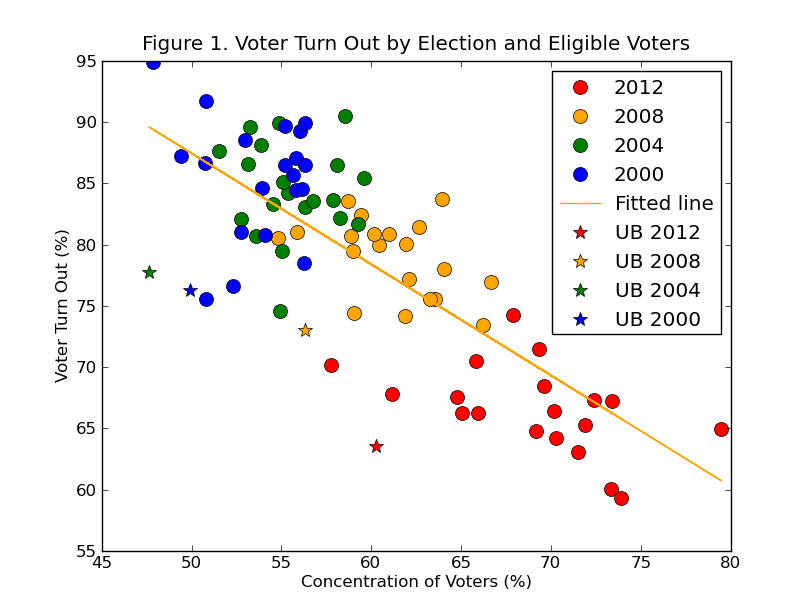
In Figure 1 voter turn out is plotted against the proportion of voting age people within a population area, or “concentration of voters.” In the 2000 and 2004 elections the concentration of voters on average increased only slightly, with the 2004 data points shifting to the right. The shift began to accelerate in 2008, and it basically exploded in 2012. On average there was a 15% increase in voter concentration from 2000 to 2012. As Figure 1 also demonstrates, this increase has coincided with Mongolia’s declining voter turn out.

Voter Turnout by Election and Eligible Voters

There has been great speculation about the causes of this decline from voter confusion over changes to the election laws to growing cynicism about the national political system. Without a direct survey of voters it is difficult to move beyond speculation, but Figure 1 is suggestive of the idea that for some reason new voters chose in large numbers not to participate in the most recent election. As mentioned above, I initially examined voter data with the intent of finding evidence that migration was a significant influence on turn out this year, and given the assumption that the young are more likely to change locations in search of economic or educational opportunities, this and other data are further suggestive of a migration based influence.

This migration hypothesis came from a few personal experiences I had on election day this year. I met two people who had traveled 30km (18mi) to the soum (county) I live in to vote because their official residence is here even though their actual residence is in the provincial capital Dalanzadgad. They moved to Dalanzadgad several years ago for better employment opportunities. Additionally, my neighbor’s daughter who resides in Ulaanbaatar as a recently graduated college student still maintains official residency status here, but unlike the other two voters, decided to not make the 560km (350mi) journey in order to vote. These examples of people having to travel to vote made me start to wonder if they were unusual or reflective of an emerging trend. As people move around seeking employment opportunities far from their hometowns, are they updating their registration to reflect their actual current residences? In other words, on election day did a significant portion of the electorate not vote because they weren’t within an easy distance of their official polling stations?

I compiled voter data from the General Election Commission website for the 2000, 2004, and 2008 elections and voter data for the 2012 elections from media sources, as well as population data from the 2000 and 2010 national censuses, for 22 voting areas in Mongolia, which included 19 provinces and the special administrative areas of Ulaanbaatar, Orkhon, and Darkhan.[1] I constructed a simple formula for annual rate of population change in each area using the census data and estimated the populations in each area during the 2004, 2008, and 2012 elections.

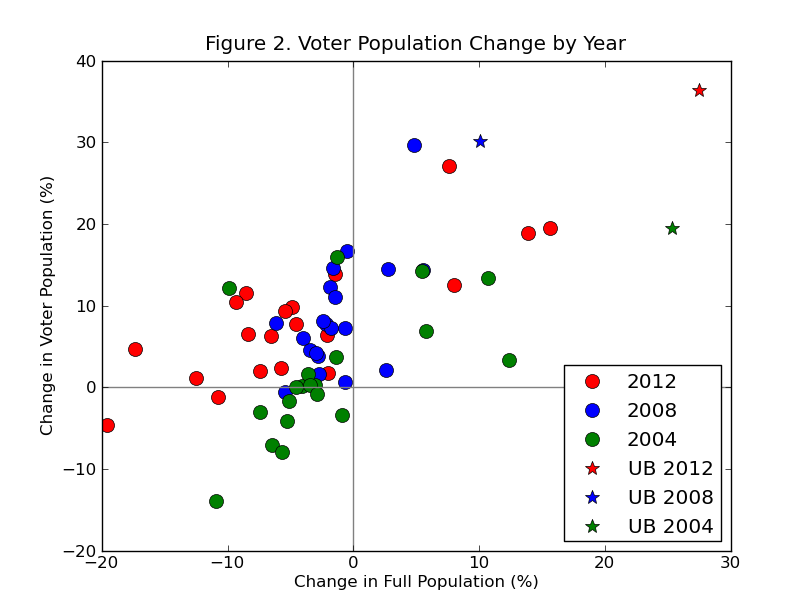
Figure 2, Voter Population Change by Year

The most striking feature of the populations in these areas was the 15 percent decline on average in population in all but five areas in the decade between 2000 and 2010. Not surprisingly the population increases occurred in the economically booming areas of Ulaanbaatar, Orkhon, Darkhan, Umnugovi, and Dornogovi. In spite of this, the majority of areas with declining populations were still able to add to their voting age population in the last two elections. Figure 2 shows this for the 2004, 2008, and 2012 elections with the majority of areas with declines in their full populations from 2008 to 2012 having positive increases in the voting age populations (top left quadrant). This could be explained by more people turning 18 years old than leaving an area either by death or migration each year. Without additional data it’s difficult to calculate the different rates involved to see if the observed pattern is at least consistent with this explanation.

We would also see a similar pattern if people were leaving these areas without deregistering. In such a scenario people would leave the official population at a faster rate than they are leaving the voter registration lists. This would create artificially high voter concentrations in these areas, but it would also conceivably increase the percentage of voters registered but unable to vote due to being in a distant  location on election day. If the association in Figure 1 were to hold true, then if these voters were given the ability to vote, say through an absentee ballot system, and accounted for in the voter concentration of each area, then we’d expect the plotted points for 2008 and 2012 to shift upwards and to the left, increasing average turn out.

There may be more explanations that fit the patterns in the data, but at this point I can at the very least write that the pattern is odd. The concentration of voters in Mongolia has ballooned over the last 12 years, and this by itself seems to account for a significant portion of the decline in voter turnout. A reasonable assumption is that much of this is driven by young voters increasingly not participating in elections, but this may not even be a safe assumption without a better understanding of the composition of the various populations and their respective rates of change, especially if the voter concentration numbers are artificially high due to a divergence in population and voter registration numbers.

An additional piece of anecdotal evidence to support the contention that migration is a significant factor in the decline in voter turn out is that in 2010 the National Statistics Office of Mongolia counted approximately 107,000 Mongolia’s living abroad for the census. Assuming that the concentration of voters in this population is the same as the average concentration for Mongolia (and for simplicity static between 2010 and 2012), this would mean 67,000 people were eligible to vote in the election and were counted on the voting registration lists. This is probably an underestimate, though, because we’d expect the population of Mongolians abroad to be mostly made up of voting age adults and the overall population to have increased in the last two years since the census. In this election for the first time Mongolians abroad were able to vote, but no more than 2,000 did given the availability of polling stations around the world. That leaves roughly 65,000 people who did not vote which represents approximately 3.5% of the 1.8 million registered voters. Unfortunately I do not have data for Mongolians abroad in 2000, so I cannot say if this is more or less than previous elections. However, it is a significant portion of the voting age population, and if it has grown significantly over the last decade, average turn out would have been negatively affected by this change. Domestic migration absolutely dwarfs international migration, so a similar pattern of being unable to vote as a result of being in the wrong polling area on election day could have an even larger effect.

Although speculations on voter turn out that hinge on voter cynicism, confusion, or apathy seem reasonable at first blush, I am left with a gnawing feeling that they may be only part of the story. If migration is having a significant influence on voter turn out, then that actually represents a more serious problem. Without an absentee balloting system, then significant percentages of the population are being inadvertently disenfranchised. I think the trend of declining turn out is here to stay, but it may be happening much faster than it should otherwise due to rapid social and economic change exacerbating a systemic flaw in the election process. A thorough survey of the voting age population would go a long way in establishing the primary causes of this year’s precipitous decline in turn out, and the patterns revealed in Figures 1 and 2 suggest such a survey would potentially yield interesting results.


[1]   National Statistics Office of Mongolia, “Хүн ам, орон сууцны 2010 оны улсын тооллогын үр дүн,” 2010, http://www.toollogo2010.mn/doc/Main%20results_20110615_to%20EZBH_for%20print.pdf, accessed 7/14/2012

General Election Commission of Mongolia, “ УИХ-н Сонгууль – 2000, 2004, 2008 он,” 2000-2008, http://www.gec.gov.mn/parliamentary_election/, accessed 6/15/2012.

Toim.orloo.info, “Сонгогчдын ирц 65.24 хувьтай байлаа,” 2012, http://toim.orloo.info/links.php?weblink=http://politics.time.mn/content/14781.shtml, accessed 7/11/2012.

About Brian White

Brian White has more than 6 years direct experience living and working in Mongolia, having first come to Mongolia in 2002 as a Peace Corps volunteer. He currently resides in Umnugovi Province.

Posted in Brian White, Democracy, Elections, Ikh Khural 2012, Party Politics, Politics, Social Issues | Tagged | 8 Comments

First Mongolian Medal in London

Today, Nyam-Ochir won Bronze in the 73kg judo contest. Congratulations!

Posted in London 2012 | Tagged | 1 Comment

Speculation on a New Government and Factions in the Democratic Party

The Democratic Party (DP) has decided to negotiate with the MPRP-MNDP’s “Justice” coalition on forming a coalition government. However, according to its latest statements, the DP received proposals from the CWGP and independent MPs to join the coalition government. Such a “grand coalition” may reduce the number of noisy oppositions. Also it might be a better option for the DP in terms of the public identity of the new coalition government.

However, before deciding partners for a coalition government, the National Consultative Council of the Democratic Party has approved N.Altankhuyag’s nomination as Prime Minister and Z.Enkhbold’s nomination as the Chair of the State Great Khural. Recalling intra-party convulsions in the past, there was expectation that inter-factional competition within the DP for the distribution of political offices may cause some unexpected political turns. The seemingly smooth process of the nomination of N.Altankhuyag and Z.Enkhbold indicates that influential leaders and major factions of the DP reached a consensus on the distribution of key political offices.

Factions in the DP?

Since the DP was established in 2000 as the coalition of five political parties there has always been rumors about the rivalries among factions. Although most people may know the names of faction leaders, the question of who are the members of these factions and how they actually work has been ambiguous. Unless it is an official statement of one who is in the inner circle of party leaders, any discussions about factions and their relations with each other have always been speculations. However, recently some factions have openly declared their members and objectives. Importantly, an indication of the influence of a faction in the DP is the number of members it has in the National Consultative Council, which makes final decisions on the most important issues in the DP.

After the DP was set to form a coalition government there is a lot of talk going around factional politics, especially about how major factions within the DP such as “Altangadas” (Pole star), “Shonkhor” (Falcon), “MoAH” (Mongolian Democratic Union), “MUDN” (Mongolian National Progress Party), “North East Asia” and “Neg Ardchilal” (One Democracy) would agree on the coalition partner and the distribution of political offices. N.Altankhuyag, the Chairman of the DP, is known as the leader of “Altangadas,” which is regarded as the most influential one among other factions. Z.Enkhbold who is set to be the Chairman of the State Great Khural is the leader of “Shonkhor.” Former Minister of Roads, Transportation, Construction and Urban Development Kh.Battulga who is the leader of “MoAH” has recently been critical of N.Altankhuyag for working merely for the interest of his own faction.

The roots of some of these factions traces back to the 1990s when three opposition parties (the Mongolian Democratic Party, the Mongolian National Progressive Party (MNPP), and the Renaissance Party of Mongolia) merged into the Mongolian National Democratic Party (MNDP) and to 2000 when the MNDP and four other opposition parties including the Mongolian Social Democrat Party merged and established the DP.

Based on available sources, the following is a rough description of some major factions in the DP.

“Altangadas”
In 2002, M.Enkhsaikhan became the chairman of the DP. With a group of DP members who were not included in the inner circle of the DP chairman, N.Altankhuyag, who was the secretary of the MSDP previously and the secretary general of the DP from 2001 to 2003, initiated an association within the DP in 2003. The name of the association was “Altangadas” (Pole star) and it had its own journal www.altangadas.mn. Although it was declared that the association aimed to discuss national policy priorities and reforms, it transformed into an influential faction in the DP, especially after the 2004 parliamentary election. Except Kh.Battulga, most ministers from the DP in the 2008 coalition government were the MPs allegedly affiliated with the “Altangadas” association.

“Shonkhor”
The Democratic Coalition Union (www.dcu.mn), an NGO initiated by Z.Enkhbold and some MPs of the DP in 2010, was the beginning of this faction. In January 2012, the members of the General Council of the DCU, which included MPs such as Z.Enkhbold, S.Erdene, Ts.Gankhuyag, and G.Bayarsaikhan, announced the birth of the “Shonkhor” faction in the DP. According to their statements, Shonkhor or falcon symbolizes the Right or right-wing politics.

“MoAH”
Kh.Battulga, one of the influential leaders of the DP and former Minister of Roads, Transportation, Construction and Urban Development, is the current leader of the Mongolian Democratic Union (MDU). Newly elected MPs such as R.Burmaa and S.Tuvdendorj are members of this faction.

“MUDN”
Mainly former members of the MNPP constitute this faction. Former PM and current MP R.Amarjargal has announced before the election that he was re-forming the “MUDN” faction.

“North East Asia”
Former MPs Batj.Batbayar and Badamdamdin and Baabar are regarded as the founding members. In recent years, MP Lu.Bold leads this faction.

“One Democracy”
Initiated by young MPs of the DP such as Kh.Temuujin and L.Gantumur, “One Democracy” club (www.onedem.mn) seems to be an organization within the DP representing emerging young leaders.

Posted in Democratic Party, Ikh Khural 2012, Politics | Tagged | 1 Comment

Mongolia’s Quest for a Third Neighbor: European Union

Over last two decades, Mongolia is making sustained effort to deepen its ties with the European Union. Just adding a recent piece on Mongolia and EU relations.

Posted in Foreign Policy | Tagged | Leave a comment

Mongolia and Shanghai Cooperation Organization

Mongolia’s non-membership stance towards the Shanghai Cooperation Organization indicates the organization’s incomplete regional representation in Inner Asia. Just adding a recent piece on Mongolia and Shanghai Cooperation Organization: “Factoring Mongolia’s non-Membership In the Shanghai Cooperation OrganizationVoices from Central Asia, No. 3, July 2012, .

Posted in Foreign Policy, SCO | Tagged | Leave a comment

Sec. Hillary Clinton has finally Arrived…in UB

US Secretary of State Hillary Clinton, visited Ulaanbaatar today (July 9th) as part of her Asia tour. Her statements as reported in the Chicago Tribune and The New York Times, present an interesting picture of the visit and point to some important points in the relationship between Mongolia and the United States.

Firstly, China matters. Sec. Clinton made strong statements supporting democracy and political freedoms as steps just as important to economic growth. The news reporters are very much on the right track with pointing out that this is a clear message to China that the US continues to expect political reforms in addition to liberal economic policies. This was explored at length in both articles.

Secondly, Mongolia matters. What was just barely touched on in these articles is that Mongolia’s democratic system is important not just for Mongolian domestic concerns, but also on the international stage. Mongolian democracy stands out in stark contract to it neighbors, Russia and China, as well as when compared across the larger post-communist world. Central Asian authoritarian states, such as Kazakhstan, Uzbekistan, and Turkmenistan stand out in clear contract to Mongolia. Despite all its “robustness/rowdiness” (as terms used in other publications), the Mongolian political system is clearly democratic, though with notable problems that have been explored in this blog already.

Mongolian democracy and continuing commitment to improving its human rights situation is not only a domestic issue, but it also serves as one factor in Mongolia’s foreign policy. Looking at Mongolia’s “Third Neighbors” (India, Japan, South Korea, and the United States- to name the larger players), all are thriving democracies. While much of the attention Mongolia enjoys on the international stage relative to its small economy, is tied to the growth of the mining sector, we should not be too quick to avoid factoring in the good press that Mongolia enjoys as a result of its developing democratic system. Not only is it one country that can prove that democracy is suitable for Asian nations, but it also means that the US and other countries can interact with Mongolia as one democracy to another.

Human rights concerns and pushes for democratic reform complicate US relations with many other countries. This is one complication that Mongolia has managed to avoid, and perhaps this plays a role in US and international interest in the small country.

Posted in China, Democracy, Development, International Relations, Mongolia and ..., United States | Tagged | 1 Comment

Wall Street Journal Asia article on State of Mongolian Democracy

I published an article in the Wall Street Journal Asia, “Mongolian Democracy Crawls, But Moves Ahead“, that offers an assessment of the current, post-election state of democracy in Mongolia.

Posted in Democracy, Elections, Ikh Khural 2012, Media and Press, Politics | Tagged | 2 Comments

East Asia Forum: Electronic Counting but no Trust

We published an article in East Asia Forum that reports on our observations as election monitors and speculates about the lack of trust in political parties that throws a wrench in post-election debates about governments to be formed.

Posted in Democracy, East Asia Forum, Elections, Ikh Khural 2012, Party Politics, Politics | Tagged , | Leave a comment

Steps toward New Government

Contrary to the pattern from previous elections when the various steps following the polls came rather slowly, it appears that the DP is now eager to move ahead much faster.

With run-off elections scheduled for this Sunday, the final results for the election could come as early as this weekend.

The DP then seems to be eager to dissolve parliament and swear in a new parliament before Naadam.

DP leaders also gave a press conference to announce that the DP would be forming a government under party leader Altankhuyag as prime minister. They did not specify which party they would be forming a coalition with to reach the necessary 39 votes in the Ikh Khural to vote in a prime minister. However, DP leaders made an open statement, that they will join with any parties which accepts to the DP platform (campaign policy document). The DP will designate a new ministry for labor to address the unemployment challenges.

While a DP + MPP coalition seems the most natural given their collaboration in the past and the solid majority that they would command jointly, there are persistent rumours of DP discussions with the MPRP. In all likelihood President Elbegdorj would be opposed to that because some DP voters would surely not take kindly to such a coalition and might have this in mind as they cast their votes in next year’s presidential election. Also, Enkhbayar is very likely to be a candidate for president (again) for the MPRP.

Whatever coalition emerges, if it is under the DP’s leadership, this would be the first time that the DP would hold the top three offices in the country (president, prime minister, chairman of the Ikh Khural) and would also control the Ulaanbaatar city council at the same time.

The negotiations over various coalitions will surely involve many personal dynamics and ties, though the DP announcement seems to pre-empt the emergence of an alternative DP candidate for prime minister, a move that Battulga and Z Enkhbold had both rumoured to be planning.

The General Election Commission will submit the election result for the President tomorrow and following the closing ceremony of the current parliament, the new parliament is likely to start its first session.

Posted in Democratic Party, Ikh Khural 2012, Politics | Tagged | 2 Comments