Notes about Accumulation(s)

More (disorganized) notes

———

Accumulation(s) III [the framing frame, why to relate narrative and accumulation]

How much is is enough? 

Is not a question of enough, pal. 

It’s a zero-sum game. Someday wins, someday loses. Money itself isn’t lost or made, it’s simply, uh, transferred from one perception to another, like magic 

Gordon Gekko in Wall Street, 1987

How many stories are enough? Do we ever get tired of more and more narratives? A story and a narrative hardly are different. In a way, storytelling is our adhesion to the world, or addi(c)tion to each other. Stories add us to one another while accumulate in the individual feelings, emotions and, over all, affects. If stories have always been with us, the question about every narrative is not when did we start telling stories to ourselves, but when did stories started moving us to reach disperse, to expand our spheres, to see limits, to expand them, but also to realize that a limit is an affirmation of existence, in its life as immanence. Myth circulated around the Mediterranean, the Tarot did it as a language and as a storytelling-story. Before the Americas, stories circled, crossed mountains but hardly crossed the exodus of the seas. After the first sailors came back from that misnamed land, some came back sick, some rich, some crazy, some astonished, some just destroyed. They brough animals, gold, bodies of all types, but also, their mouths mumbled nonsense stories. One man (Cabeza de Vaca) even proved with his body that he lived among the others, that he met them, that his poverty was useful for the crown. Of course, he later changed his mind. Something broke when he shipwrecked, something grew afterwards and at the same time another thing became more profitable. Somebody had to lose, domination, unlike money, had to be transferred and made.

If there was a Latin American boom before the boom those were the chronicles from Indies. No other texts moved more people before (?). God without knowing it died slowly, because what crusaders did not cross, now sailors were willing to. And years and years passed, sailors and stories changed slowly, but they changed after all. They all cracked-up and became something else. Among the many things that the stories became, novels somehow captured better what those stories had to say. If the chronicles of Indies moved so many bodies in-between seas, the (new)boom moved affects overall. While bodies are things almost ready to be transferred, administered, accumulated more than cumulated, affects are meant to be created. An affect creates as it moves a body. An emotion (re)distributes the body’s affection. While the chronicles of Indies were an invitation to fly off fancy while trying to avoid the territorialization of extraction, of killing, administering and selling for others, the (new)boom was the intervention on the invitation. For the boom realized that once the world was seen as pure form, a body in all its nudity, all places were good burrows for lines of flight to take off. Yet, something cracked-up the boom. The explosion imploded and then again it exploded again. 

As the boom expanded. Somehow national literary spheres crystalized their own explosion. Literature became a machine, something to be exploited and that exploded. Not that this was completely new at all for literature. Literature has always been a sphere of contradiction since the term always has dealt with the hybrid and contradictory concept of representation. It is as Fredric Jameson puts it, “representation is both some vague bourgeois conception of reality and also a specific sign system” (Postmodernism 123). For once, in literature the lettered individuals had their chance to inaugurate their public sphere. But also, more than single individuals articulating freely their stories, a narrator, a writer, and later an author, became a new vessel where sometimes the murmurs of a multitude of stories would gather. For that thing we called literature, the authors, the champions of the lettered city, became addicts to the dictionary (as G. Steiner puts it) but also hoarders. The new authors of the boom accelerated this process but also something was captured, their work was accumulated. However, as their explosions inaugurated a time of change, acceleration and regression (namely postmodernism) they opened up a possibility for creation, for reposing the narrative problems of all times. A narrative is a way of solving narrative problems, but the narration always exceeds, it counts in other means and ends up affecting other fields. 

However, if stories are not a question of enough, would it be that today (and even before) they were about “a zero-sum game”, where “somebody wins, someday loses” (thus their necessity to always solve narrative problems)?  

Notes about Accumulation(s)

More notes

———

Accumulations II [and literature]

Our times are times of the novella. Isn’t it that day by day we question how is it that things have come to this? At the same time reality is coming closer to the durée of “the novel”, since we lived fascinated by the aesthetic contradiction between past and future. If all of this is true, what place would “the novel” hold? For some, like Fredric Jameson, the postmodern is fading away and in its place is now occupied by writing of “itemisation”, the withdrawal (or renouncement) of the attempt to ‘estrange’ “our daily life and see it in new, poetic or nightmarish, ways” (“Itemised”). Karl Ove Knausgaard, Emmanuel Carrère and Valeria Luiselli would be just some items of this list. Valeria Luiselli’s Lost Children Archive (2019) captures in a nutshell what the current status of (Latin-American) fiction in early XXI century is. Yet, one should hesitate to simply take Jameson’s ‘itemisation’ of writing for granted. In a long passage in Luiselli, the main narrator of the novel states that “No one has quite been able to capture what is happening or say why. Perhaps it’s just that we sense an absence of future, because the present has become too overwhelming, so the future has become unimaginable. And without future, time feels like only an accumulation (Lost Children 103). The narration then enlists all of those things accumulated (months, days, natural disasters, television series, terrorist attacks, divorces, mass migrations, birthdays, photographs, sunrises). The digression happens after the main narrator is asked by one of her children about what, how and when to take a photograph. The fact that, to explain the kid when to photograph, the narrator has to enlist both the emptiness of life, and the failure, of photographing in general when capturing or depicting our experience of time and life, illustrates an impossibility that the narration is aware of. The latter would be that “our ways of documenting the world have fallen short” (103) and consequently as much as experiences and other things are accumulated, the future seems unimaginable, undecidable. 

This moment could à la lettre describe what Jameson’s sees in Knausgaard’s sixth book of My Struggle (if not in all the books of the series). Itemisation would be the shift from the aesthetic to the ethical, abandoning the first so that one can as Knausgaard or Luiselli contemplate a “solution to the problem of what to do with [oneself] and [oneself’s] life” (“Itemised”). Hence, for Jameson writing of itemisation is, somehow, the end of the duration of the novel. Since the contemporary novel, as a genre, has to renounce to conjugate the past (what has happened) and l’avenir (what is going to happen), the novel now can merely register a list of items that tentatively would become rereadings, returns to duration. Yet, the novel is hardly a renunciation. In Luiselli, the narration bets for an opening to the future, while hoarding the previous items, “You have to find your own way of understanding space, so that the rest of us can feel less lost in time” (103), tells the mother to the kid so that he would start shooting photographs. There is no duration, but a two folded direction that moves forward in the same direction.

It is not that things have not changed for the novel. Neither it is that the “postmodern” is slowly fading away (if it ever was fully holding sway all over the world). For once, it is true that the novel as “all life is a process of breaking down”, would say Fitzgerald. Something broke in the sphere of the novel, and in the one of the literary. The novel was the genre that better held the hybridity of the new subjects that emerged from the process of so-called primitive accumulation at the dawn of capitalism. While the vogelfrei were attached to their necessity to sell their work in the market, their will was always fugitive. In a same manner the novel was (is) a living contradiction, namely between the writer and their context, the original and the translation, the new and the new. Only the novel knew how to pile together a contradiction. If novellas are cartographies of lines of flight, novels are diagrams of spheres whose functioning lie in opposing semiospheres. To this extend, if the emergence and popularization of novellas (ending of XIX century- and early XX century) marked the shift from industrial accumulation in capitalism and its acceleration, switch and cohabitation to and with algorithm accumulation in the current state of capitalism that we live today, we are not only witnessing the novellation of history, but also the novellation of the novel. If this is true, the contradiction, the main mechanism of the novel, is blurring. The itemisation is not a renouncement, neither the re-disjunction or re-conjunction of duration, “but only a line of flight in the process of being drawn, toward a new acceptance, the opposite of renunciation or resignation —a new happiness?” (Deleuze and Guattari 207), and yet another process of hoarding, a new redirection of accumulation. And still, an opening for heaping history and the novel anew.

Notes on What is World Literature? (2003) by Daniel Damrosch

Daniel Damrosch’s What is World Literature? (2003) departs from J. W. Goethe’s famous formulation about world literature. The term was registered by Johann Peter Eckerman, an author whose entire work is barely know these days. From Eckerman’s works, his conversations with Goethe are an exception since they register the daily live routine of the famous poet and also some moments worth studying, as it is the case of the famous conversation about world literature. As Damrosch registers, Goethe coins the term when discussing poetry as a “universal possession” that is always “revealing itself everywhere” (1). Goethe goes on and states that the “National literature is now a rather unmeaning term; the epoch of world literature is at hand, and everyone must strive to haste its approach” (1). The thing, for Damrosch, is not that Goethe seeks to impose an agenda, or to merely point towards the possibility of a canon, rather world literature should be understood less as “a set of works than a network” (3). Then, world literature is more a system that connects than an accumulation of works. Damrosch takes world literature as something that “encompass all literary works that circulate beyond their culture of origin, either in translation or in their original language” (4). With this in mind, the task of world literature should be to turn visible how “a work only has an effective life as world literature whenever, and wherever it is actively present within a literary system beyond that of its original culture” (4). 

In a way, what Damrosch is looking for is to connect old (and always present) topics in literary studies. Some of these could be the literariness coined by Jakobson —a hundred years ago—, the problem of the canon and, without openly engaging with it, the problem of taste and status championed by Pierre Bourdieau. The book is an ambitious project that is, as it is mentioned later, subject of current studies and reflections. Divided in three parts (circulation, translation and production), each describes three literary works that better exemplifies what is world literature and more importantly how to engage with it. Whether we read about Gilmanesh, Kafka or Rigoberta Menchu, Darmosh displays erudite analysis. Close readings, rhetoric and sociohistorical analysis, biography and philology coexist without any apparent method or problem. Since world literature is only worried about “a mode of circulation and of reading” (5), there is not necessarily a method for reading world literature, but an attitude. This attitude would be that of Goethe himself, namely, “to look about me [oneself] in foreign nations” (1). 

While the readings offered in every chapter are strong and persuasive, one ends with a familiar feeling. This is that reading without the lenses of world literature is basically reading with the lenses of literary criticism in general. However, Damrosch would insist that world literature, as a way of engaging with texts, consists in a particular understanding of what work literature is (281). Irremediably this is a contradiction, for Damrosch himself renounced in the “Introduction” to any definition of the literary since “this is a question that really only has meaning within a given literary system” (14). One can, then, easily say that world literature itself might be “something that really only has meaning within a given literary (or world) system”. 

Despite this contradiction, the three elements that Damrosch depicts as the pillars of world literature, are worth some thought. World literature would be first “an elliptical refraction of national literatures”, secondly, a “writing that gains in translation”, and thirdly “not a set canon of texts but a mode of reading: a form of detached engagement with worlds beyond our own place and time” (281). In way, then, these three characteristics of world literature go back, and are tied up, irremediably with the so called “ontological gap” in comparative literature proposed by René Wellek. While the latter depicted the gap “between the psychology of the author and a work of art, between life and society on the one hand and the aesthetic object” (136), the elliptical refraction that Damrosch is pursuing is that focus that happens when the two focal points of an ellipsis swerve. Namely, these two points would be the national in one side and the worldliness in the other; the literary source and the host; the original and the translation; one world and the other. World literature, then would be something that “goes in two directions at once” (289). Hence, more than a line, or a gap, (world) literature is yet another of the world’s spheres, another expanding bubble, that, as everything alive someday, sometime, has (had) to crack-up. 

Notes about Accumulation(s) I

The following notes are merely a series of thoughts without any particular order but that later (hopefully) could be part of my dissertation project (a very [till today] basic and naive ideas about accumulation as a general movement of history and specially modernity)

———

Accumulation(s) I

In a way, our times could be described as a series of seriated and seriating accumulations. This, of course, not only testifies for capitalism’s endeavour but also for the way the climate catastrophe has heaped in the horizon of history as our further extinction. Yet, to accumulate does not necessarily means to horde valuable items neither to just let catastrophes pile in the horizon of the coming future. In fact, accumulations are closer to disorganized heaps, piles or bodies amassed (and therefore, somewhat to a weird idea of ecology, meaning that even the smallest tossed or dispensed body, would heap somewhere and eventually return to the place where it was thrown away). Etymologically (if this helps to clarify where I’m going), to accumulate is a verb whose first appearance was in the early XIV (1520) century and is composed by two particles, the preposition “ad” (to) and the substantive “cumulus” (a heap). Hence, in the early years of that period commonly called modernity, at the babbling of what centuries later would become a world ordered for capital through capitalism, a direction was forged, and bodies were constantly directed and redirected to it. 

The coincidence between the origins of the word accumulation and the early period (if not the dawn) of modernity signal that history, somehow, could be understood as a way of directing “cumulus” (heaps). It is not only after the works of Ricardo, Adam Smith and later Marx, that accumulation becomes a direction of wealth, for the first and second, and later, for the third, a production of that “ad” that directs the cumulus. When Marx famously described how the whole economic process worked, with the analysis of commodification, fetishization (another word —as accumulation— that was firstly coined in the context of slave trading in the XV-XVI century), capital circulation, value and surplus value, he still found necessary to unveil what started everything. For Marx, it is not that capital is merely understood as a machine, but as something that is triggered, something that needs to be started. Irremediably when understanding the process of accumulation(s) of capital, as Marx puts it, we “turn in a defective circle, out of which we only get by supposing an “original” [primitive]”, an “accumulation that is not the result of capitalistic mode of production, but its starting point”. That starting point, for Marx, “plays in Political Economy the same role that plays the “original sin in theology”. The result of this ironic comparison (and maybe not so ironic) is the famous formulation of the process of “so-called” primitive accumulation: that is the demystifying of an idyllic process of enrichment. From this perspective, the “so-called” primitive accumulation is the systematic repetition of violence, land dispossession, forced migration, law prosecution and bloody legislations necessary to produce an ambivalent subject that both surrenders to the “ad” of accumulation while also seeks for its “cumulation” in a line of flight: the vogelfrei. 

If the process of “so-called” primitive accumulation is needed at every stage of capitalism, where would the “ad” this time be produced when there won’t be no earth to live? Would it be that at best the feverish science fiction fantasies finally have been conquered (as depicted in movies like Ad Astra [after all, another movie about the possibility of starting a new process of accumulation in space)? As much as these questions are necessary, perhaps it should also be thought the possibility of an accumulation without “ad”, or an accumulation without “ad” or “cumulus” but another form of piling. Even more, perhaps that’s the only cynical comfort we have, that of which today accumulation is collapsing, and we are just hoarding history, as new vogelfrei we are tied to our impossibility towards the future and yet with the possibility of take off in a line of flight.

Infrapolitical Passages

There is an odd but (perhaps) not unwelcome tension in Gareth Williams’s new book, Infrapolitical Passages: Global Turmoil, Narco-Accumulation, and the Post-Sovereign State. On the one hand, as even the title announces, this is a far-ranging survey of our contemporary situation (global turmoil!). Moreover, it hardly confines itself even to this broad critique of the present: it opens with an account, drawn from some words of Greta Thunberg’s, of imminent future apocalypse (“extinction,” in Thunberg’s terms, “perishing” in Williams’s) and then, in search of the origins of this catastrophe, proceeds to take us back to Prometheus, via a reading of Shelley. We are in the “epoch of the end of epochality” (121), Williams repeatedly tells us, of “post-katchontic” or “post-sovereign decontainment” (110), and it is clear that Williams has no wish to be restricted in the scope of his reflections or argument.

In short, this is a hugely ambitious work that, what is more, takes issue with many of the major thinkers of our time (Badiou, Agamben), seeks to demolish plenty of sacred cows (politics, hegemony, the subject), and gives short shrift to others, often via endnotes as if they were not even worthy of being dismissed in the body of the text itself. (Full disclosure: I am one of those whose work is despatched this way in the end matter, for “provid[ing] no evaluation of the place of the negative in any conceptual matrix, including [my] own” [210]. But I do not lack company; elsewhere, for instance, another note summarily condemns “humanists, culturalists, hegemony thinkers, decolonials, populists, Marxists, post-Marxists, neocommunists, and antitheory types of all persuasions” [208].) To put this another way: this is a book that often gives the impression that it is endlessly sure of itself, as it seeks from its opening sentence to “clear a way through some of the dominant conceptual determinations and violent symptoms of globalization” (1). Clearing such a path sometimes requires a machete, and the will to wield it.

And yet. On the other hand, there is something quite modest and reticent about Williams’s project. After all, beyond the image of bushwhacking through conceptual thickets, the other metaphor that the book employs to describe its methodology is that of a retreat, for it is “in retreat” that “infrapolitics strives to clear a way” (26); “now the struggle is to find a way to backtrack [. . .]. This backtracking is the basis for the infrapolitical exodus [. . .]” (27-28). Or as Williams puts it, for all the talk of “passages,” by which he hopes to take us (for instance) “from hegemony to posthegemony” and from there to establish or prepare the way for “a renovation or potential turn in our thinking” (96), at best we are ultimately offered “a timorous step toward the possibility of questioning in such a way as to clear away inherited limitations in the realm of thinking and acting” (106). This is a highly qualified ambition indeed! And even that “timorous step” may not be forthcoming. As Williams admits at the outset: “This is a book that makes no progress, and intentionally so” (29). The passage may well end up being a “nonpassage,” and we may not even be able to tell the difference thanks to “a certain indiscernability” between the two (29). As Williams goes on to concede, “Some might feel that this offers in fact the formalization of very little” (29); “and it could very well lead to absolutely or virtually nothing” (32). Alongside the ambition and self-assuredness, in other words, this text also offers us a striking humility, a sort of pre-emptive bet or hedge that it will all end in something like failure, no progress made, nothing to show. Or at least it is prepared to take that risk, which is indeed (perhaps) quite a risk.

This resolute reticence or self-assured uncertainty is not new in Williams’s work. His first book, The Other Side of the Popular (2002) ends with a sustained meditation on the “perhaps,” a word which also becomes a refrain in its final section and closes (without closing, as it opens up) the text: “perhaps. . .” (The Other Side of the Popular 303). As he puts it there, with the same mix of affirmation and doubt, stating and yet taking back at the same time: “One thing appears to be sure, however: being toward becoming worldwide leaves us with the affirmation of perhaps ringing in our ears and suspended on the tips of our tongues. . . perhaps. . .“ (272). A “perhaps” rings, or perhaps it rings, suspended and so not (yet?) fully articulated. This is the “one thing” that is sure, or (perhaps) only appears to be sure for those who have eyes to see what cannot in fact be seen.

But I say all this not to criticize Williams. This unerring hesitation is not a flaw in his project; if anything, it is the project itself. Moreover, the minimalism of the gesture, and the willingness to take the risk that nothing may result, is perhaps its greatest contribution to our thinking about politics. For let there be no doubt: this is a thoroughly political book, which asks the most important, the most essential of political questions. Which is, precisely: What is the smallest difference that may actually make a difference? This is, after all, Lenin’s question (though I am not at all suggesting that Williams is any kind of Leninist): “What is to be done?” Not, note, “What should we do?”–more properly the question of the subject, and of ethics or morality, with which politics is so often confused these days–but, in the passive, what is to be done for some change to come, for a detour or turn to be effected that will not soon enough (or given enough time) be inevitably assimilated or appropriated or turned back such that we find ourselves merely back where we started, or worse. One step forward, two steps back; rather than one step back, two steps forward.

There is a double irony here. The first is that those who are so intent on “being political” or putting politics first, seeking a program or party line to proclaim or to follow, inevitably end up mired only in false pieties and the spectacle of morality (“virtue signalling” and the like) that we see all too insistently wherever we look. The second is that, as Williams (and elsewhere, Alberto Moreiras) shows at length, the one properly political question, the question of the “perhaps,” only arises when we step back from politics, when we try to withdraw from the turmoil, when we hesitate before entering the fray, when we realize that everything is in doubt, and when we acknowledge that “what is to be done” is far from self-evident, being as it is a matter that politics itself can never resolve. Without it, however, there is no politics at all. The very possibility of politics, in other words, as Williams eloquently tells us, depends upon the infrapolitical.

Notes on Fredric Jameson’s Postmodernism, or The Cultural Logic of Late Capitalism (1991)

At the end of Fredric Jameson’s Postmodernism, or The Cultural Logic of Late Capitalism (1991) it is stated, as many times in the book, what a possible definition of postmodernism might be: “The postmodern may well in that sense be little more than a transitional period between two stages of capitalism, in which the earlier forms of the economic are in the process of being restructured on a global scale, including the older forms of labor and its traditional organizational institutions and concepts” (417). From this perspective, postmodernism is also a form of interregnum, since both share a level of uncertainty, at least when it comes to naming what or who is the new ruling name in town. In a way, Jameson’s book offers a continuation of what the Political Unconscious inaugurated, that is, a task of constantly historizing. Not surprisingly, this is precisely what Jameson states in the “Introduction”, since he writes thinking for an age that has forgotten how to think historically (ix). The task, then, for a postmodernism thinking is to realize how much of the past has persisted while at the same time acknowledging that commodity critique became another form of mere consumption. This means, of course, that the ultimate form of capitalism (Jameson’s post-industrial capitalism, aka, third stage of capitalism) is able to melt in the everything, that critique is just another object of consumption in a pure form, since “postmodernism is the consumption of sheer commodification as a process” (x). 

As much as the book seeks to theorize, or, at best, illustrate, what postmodernism might be, it also constantly returns to modernism. If postmodernism is supposed to be understood via historicity, there is no other way than learning the past of that form that could be anywhere. This means that since postmodernism is a “cultural dominant: a conception which allows for the presence and coexistence of a range of very different, yet subordinate features” (4), it hardly is foreseeable whilst also it is always present. Modernism, as an aesthetic form and content, might have challenged the ways and means of production, in the other hand, postmodernism emerges as a form of production that integrates into commodity production the aesthetic. It could be said then that postmodernism is (third stage) capitalism’s craving for the past, present and future, without clearly being able to produce its own historicity. 

Postmodern products (novels, films, buildings and so on) resist interpretation. For instance, about the postmodern novel, Jameson would say that it not only resists interpretation but that it “is organized systematically and formally to short-circuit an older type of social and historical interpretation which it perpetually holds on and withdraws” (23). Without, saying it, Jameson’s suggests that the postmodern is a discourse constantly hesitating, something that needs to cut with the old while sustaining it. Postmodern, in its own expression, has a level of undecidability —as much as Jameson refuses to use the deconstructive term (Cfr. Chp. 7). What is at stake when analyzing postmodern art, is not only its form but the way it also depicts the mode of production that produced it, namely a machine that is obsessed with the process of processes of reproduction. Art no longer holds together a monumental enterprise (if it ever did) but now it “reshuffles the fragments of preexistent texts […] in some new and heightened bricolage: metabooks which cannibalize other books, metatexts which collate hits of other texts” (96). Postmodernism ultimately is the addition of dispersed elements, a summatory of things that are distant in time and yet close to our senses. Living in postmodernism times is living distracted, eternally gone in-between the “wrapping shells” of non-centered spaces that demand our centrality and linearity as subjects of production-distribution-consumption. 

While it could be argued that Jameson too easily totalizes the production of culture in the late capitalism, it could also be said that this is not the project of postmodernism, or at least not the postmodernism that Jameson’s proposes. Jameson is aware that he must avoid auto-reification: “Permanent revolution in intellectual life and culture means both that impossibility and the necessity for a constant reinvention of precautions against what my tradition calls conceptual reification” (401). To this extend, thinking about postmodernism might, at best, open the possibility of reading literature (and history) as a series of movements and strategies. Thus, against reifying postmodernism, it should be thought beyond it. That is, if modernism was the movement and formation of monuments and its attractive force; postmodernism would come to be as an affective movement that brakes and disperses while sustaining what cuts. It might be said, then, that our current times (or even after the 60’s which are the times that Jameson analyzes the most), could be catalogued as a suspension and (another) regression (and return), from the brake of the postmodern and the fascination of the modern. We are not living the times of the “effacement of the traces of production” (314), as in postmodernism times we certainly did, but the times were scars are too visible, when what is effaced still accumulates, when non-subjects still matter and the global suspends the monad. And yet, the suspension (or stasis) of our times replicates more than nothing all that past that was supposed to be meted in the air, but somehow found us via partial summing ups.

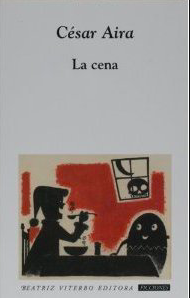
Mitad del cuento, atisbo otro. Notas sobre La cena (2006) de César Aira

La cena (2006) de César Aira pudiera ser corolario de otra de sus novelas. Mientras esto no sorprende, pues lo mismo se podría decir de buena parte de la obra de Aira, sí lo hace el tono sombrío y lacónico del relato. La cena cuenta la historia de un narrador deprimido, lleva ya siete años sin trabajo y se ha mudado al departamento de su madre en Pringles. Aunque la madre no hace sino amarlo, el narrador se siente fracasado. Así que, a miedo de dejar pasar su última oportunidad de alcanzar el éxito, el narrador lleva a su madre a cenar a casa de su único amigo, un tipo solitario pero sociable. Luego de la cena y de que madre y anfitrión entablaran una amable conversación, pues ambos tenían algo en común —la “pasión por los nombres” (pos. 6118)—, el amigo del narrador alarga la velada y les muestra a sus huéspedes una serie de juguetes viejos. La madre del narrador no soporta la exhibición, y es que madre y amigo “sólo se entendían cuando pronunciaban nombres (apellidos) del pueblo; en todo lo demás, ella se retraía enérgicamente” (pos. 6228). Después, el narrador regresa a casa con su madre y se pone a ver por la televisión un programa en vivo en el que se da seguimiento a un evento terrorífico local: cadáveres que se levantan de sus tumbas para succionar las endorfinas del cerebro de los habitantes del pueblo. La desgracia, que no logra sacar al narrador de su depresión y pasmo, dura poco. Finalmente, el narrador, al visitar al día siguiente a su amigo para proponerle formalmente su idea de negocios, se da cuenta de que la desgracia televisada no fue sino un “mal” programa de televisión, un refrito que ahora recibe los elocuentes comentarios de su amigo, para quien ese negocio televisivo debe cambiar, pues “la prosa de los negocios tiene que expresarse en la poesía de la vida” (pos. 7157). 

Mientras que la narración del programa de televisión concentra la mayor parte del relato, el meollo (o uno de los meollos) de la narrativa es la depresión del narrador y su fascinación por los juguetes antiguos que su amigo le mostrara el día de la cena. El narrador queda maravillado cuando ve el primer juguete de su anfitrión. “Era un verdadero milagro de la mecánica de precisión, si se tiene en cuenta que esas manitos de porcelana articulada no medían más de cinco milímetros” (pos. 6202). En cierto sentido, el juguete, como tantos objetos en la obra de Aira tiene un carácter atuorreferencial respecto a la novela en sí. Es decir, como el amigo guarda un montón de objetos inútiles pero “milagros de una mecánica precisa”, así también el mercado literario guarda las novelas de César Aira, obras de precisión milagrosa, pero que a los ojos de otros observadores, como los de la madre del narrador, no son más que objetos inútiles y chatarras, juegos de niños. Los juguetes, como las novelas del autor del relato, son objetos que se presentan en forma precisa y pura, hasta que uno empieza a ver que sucede otra cosa. A cambios de velocidad y fuerza la forma se expresa. Cuando el juguete en cuestión, el de las miguitas imaginarias, termina su funcionamiento, el narrador observa que tal vez “Los autores del juguete debían de haber querido significar la cercanía de la muerte de la anciana. Lo que me hizo pensar que toda la escena estaba representando una historia; hasta ese momento me había limitado a admirar el arte prodigioso de la máquina, sin preguntarme por su significado” (6206). El asunto es que ni la madre ni el anfitrión se esfuerzan en entender la “narración” del juguete, para la primera es una pérdida de tiempo y para el segundo es sólo un derroche de forma. 

El enredo que se teje entre las perspectivas del narrador, su madre y su amigo pone a unos en concordancia y a otros en discordia. La concordancia no puede englobar a las tres partes. Mientras que el amigo y la madre viven fascinados por los nombres (apellidos) que saben, el narrador no comparte esta emoción. Igualmente, a la vez que el narrador y el amigo tienen una fascinación similar por los juguetes y demás objetos lujosos —pero inútiles—, la madre del narrador no puede verle nada de especial a esos cachivaches. Aunado a esto, el narrador queda fuera de cualquier lugar de concordancia, pues ni los remedios del amigo (reformar la forma en que la televisión en Pringles trabaja, para expresar “la prosa de los negocios tiene que expresarse en la poesía de la vida” [pos. [7157]), ni las desconfianzas y preocupaciones de la madre sobre el futuro de su hijo, lo sacan del pasmo y tedio en el que vive.

Si a la mesa de una cena se sentaran arte, estado y mercado, éste último, al menos para nuestros días, sería el anfitrión. Mientras estado y mercado se atragantan de nombres para verificar sus narraciones, el arte no hace sino ver que, como el narrador al escuchar las razones por las que su madre desconfía de su amigo, “los nombres hacían verosímil la historia, aunque sobre mí provocaban más efecto de admiración que de verificación” (6347). El arte puede ver la verdad, pero no verificarla. No es su “deber”, pues la verificación y —en cierto sentido también— la verosimilitud pertenecen a un tiempo muerto, como el de la televisión y el programa que registra la catástrofe de los muertos vivientes y su resolución. Si al día siguiente de la cena, el estado, como la madre, queda con el estómago revuelto, y el mercado con las últimas palabras que no rehabilitan al arte, entonces, no habría más que la estetización de la máquina y el sistema como triunfo de un totalitarismo que sabe del pésimo, pero eficiente, funcionamiento de las viejas formas de narrar la vida cotidiana (como el programa sobre los muertos vivientes). No obstante, si la última palabra la tiene el mercado, su prosa de negocios no es más que una narración mal contada, pues como al amigo del narrador, al mercado “se le mezclaban los episodios, dejaba efectos sin causa, causas sin efecto, se salteaba partes importantes, dejaba un cuento por la mitad” (pos. 6076). En esa mitad que se abre al final de las últimas palabras del mercado, la poesía de la expresión abre camino para otra vida y su trabajo.

Notes on Marxism and Form. Twentieth-Century Dialectical Theories of Literature (1971) by Fredric Jameson

Some of the main ideas of Fredric Jameson’s Political Unconscious (1981), as we are reminded several times by Jameson himself, were already presented in Marxism and Form. Twentieth-Century Dialectical Theories of Literature (1971). To that extend, without Marxism and Form, we hardly would have read in The Political that the task of critique was to unmask “cultural artifacts as socially symbolic acts” (The Political 20). Marxism and Form introduces some of the main critical works of dialectical Marxism on the arts and culture of the XX century. Jameson presents his readings of T.W. Adorno, Walter Benjamin, Herbert Marcuse, Ernst Bloch, Georg (György) Lukács and Jean-Paul Sartre. While Adorno, Lukács and Sartre have chapters on their own, Benjamin, Marcuse (read along Schiller) and Bloch are grouped in a chapter called “Versions of a Marxist Hermeneutic” (Marxism 60). The book finishes with a chapter that could bridge Marxism and Form and The Political Unconscious, “Towards Dialectical Criticism”. In this chapter we read that our “estrangement” or fascination towards literature is an affect related directly to the way art form is worked, since what our senses experience are “but manifestations in aesthetic form and the aesthetic level of the movement of dialectical consciousness as an assault on our conventionalized life patterns […] an implicit critique and restructuration of our habitual consciousness” (374). The Adornean sense of this affirmation is the same frame that will circle the canvas where the political unconscious will seek its task for unveiling myths and to give back, at least, a glimmer to consciousness and the real substratum (the formless of existence) that moves the engines of history. 

Marxism and Form not only presents but also challenges some of the main postulates of the authors reunited in the book. Yet, the challenge is more a comparison. As it is written in the “Preface”, the book intension is to present to the American reader the fact that when analyzing German and French dialectical literature one cannot but “take yet a third national tradition into account, I mean our own: that mixture of political liberalism, empiricism and logical positivism which we know as Anglo-American philosophy” (x). Thus, more than three perspectives we face two, that of the Anglo-American philosophy and that of the Franco-German dialectics. It is not surprising that at the end of the book, Jameson illustrates the importance of a dialectical method for analyzing literature with an analogy of the missile development and atomic research competition between the Soviet Union and the United States. With this example Jameson makes transparent how useful and accurate may a dialectical hermeneutics be. If dialectics is the method that glimpses the dominant categories that trigger the movement of history, in the 70’s what a better way of making a living than to learn how to read the board and the clock of the twilight struggle. 

It is not that Jameson is capturing dialectics and then surrendering it to the “American Imperialism”, but his argument is that dialectics as a tool for understanding reality is already caught up in American Imperialism. If Academia as Jameson pictures it, following C.Wright, is a system who endorses pleasure under capitalism, as something that “is simply the sign of the consumption of an object: it is thus relatively extraneous to the object’s structure or use, since it can attach to any kind of object, and is at the same time gratuitous to the degree that it serves no collective function beyond that of encouraging further consumption and making the system operate at top capacity” (395). Jameson, then, agrees with Adorno that in order to stop/sabotage capitalism’s jouissance dialectics must be “unpleasurable in the commodity sense” (395).  Criticism becomes a task that, as Jameson puts it in the eloquent closing of Marxism and Form, must “compare the inside and the outside, existence and history, to continue to pass judgement on the abstract quality of life in the present, and to keep alive the idea of a concrete future” (416). While in 1971 the idea of a concrete future was still foreseeable, in the following years of that decade that idea melted and both concreteness and future dispersed in the air. Did dialectics did too? That is yet one of the questions to ask.

Notas a Esferas II (2004) de Peter Sloterdijk

Capítulo 3

Si el fuego puede, al menos para Sloterdijk, asegurar la transferencia de solidaridades dentro de un espacio primigenio de inmunidad para las masas —dígase la aldea, la tribu—, el fuego también es vulnerable. Cuando la catástrofe natural aniquila a la aldea, las cenizas no son siquiera resto. La clave para sobrevivir a las desgracias estaría, entonces, en la sublimación del fuego y del agua, del calor y del frío. Un arca, sea la de Noé o la de cualquier mito, es un signo que da inmunidad y cobijo, es la condición de salvación y supervivencia. Para vencer a la catástrofe no hay sino que dejar la esfera primaria y expandirse en la técnica: armar a fuego, sudor y agua un casco protector. Para Sloterdijk, la idea de “arca” tiene una fuerte relación con la aparición de las primeras grandes metrópolis de la antigüedad (Nínive, Babilonia, Ur), pues sólo las arcas están destinadas a ser la prueba de que el suelo del ser puede darse por el ser mismo sin su yo-estar-en-el-mundo. “El arca no es tanto una estructura material cuanto una forma simbólica de cobijo de la vida rescatada, un receptáculo de esperanza” (289). Como los círculos alrededor del fuego inauguran los primeros asentamientos humanos (capítulo 2) luego del crimen originario que sacrifica a lo indeseable del centro (capítulo 1), así también la formación esferológica del arca comienza un nuevo capítulo de la macroesferológica de los seres humanos. 

El dilema de cualquier arca, como el de cualquier ciudad, es el mismo que el de la inclusión. Es decir, “en todos los fantasmas-arca se afirma como una imperiosidad sagrada la selección de los pocos; muchos son los llamados, pocos los que se embarcan” (295). Por consiguiente, se vuelve transparente que a la fiesta del fuego no todos son invitados. Todos sabrán de las danzas alrededor del templo, pero sólo unos pocos verán el desfile de brazos, caderas y pies. Como una ciudad, las arcas manifiestan que su razón de ser radica en una paradoja: “sólo si no entran todos, entran todos; pero si entran todos, no entran todos” (298). Los pocos, los elegidos, los que habrán de salvar, deben excluir para después erigir un milagro. No obstante, ciudades y arcas se diferencian. Mientras las segundas se entregan al impredecible devenir de la catástrofe, las primeras se empecinan obstinadamente a la superficie y también, de cierta manera, a inmunizarse en la llanura de otra imprevisibilidad, sea la del desierto, o la de la estepa. 

Las ciudades antiguas no son testimonios de megalomanías. Ni tampoco sitios de pecado, como las verían aquellos que recién salen de sus arcas. Para Sloterdijk, las ciudades antiguas sólo pueden sentirse “por una angustia especial iniciática” (302), un puente entre lo anterior y lo “de ahora”. Esa angustia es, a su vez, “un éxtasis que produce la sensación de seguridad y cobijo” (302). Habría, entonces, una guerra de afectos frente a los grandes muros de ciudades como las mesopotámicas: 1) asombro y seguridad, para los que viven dentro de los muros; 2) angustia, para los que piensan y saben que fuera del confort no existe nada; 3) recelo y fascinación, para aquellos que deambulan en el desierto y que, aunque saben del confort que hay del otro lado de los muros, no hacen sino pedirle a su dios que castigue a aquellos que se ufanan con alcanzarlo en obras (torres, murallas, estelas). Si el arca es el útero de la madre que nos vuelve a tragar para cargarnos y llevarnos hasta que termine la tormenta, la ciudad será la prostituta, que “está ahí para encandilar miradas, elevar miradas, humillar miradas” (303), un cuerpo que tiene que dejarlo ver todo y a la vez garantizar “el buen ambiente” y “la prosperidad del negocio”, de la mano siempre de una “seguridad con confort”. Mientras la madre sólo nos puede tragar para reconfortarnos, la prostituta promete reparación, como la que tuvo el espíritu del escritor José María Arguedas meses antes de su suicidio.

A diferencia de los círculos alrededor del fuego, las ciudades antiguas ahora se preocuparán por hacer visible y evidente que el calor del centro llega hasta los límites del inmenso poblado. Las grandes murallas no son delirios de paranoia ni nomos de la tierra para la mirada de los enemigos. Antes bien, son cuerpos que “ayudan a los habitantes de la ciudad en su intento de superar la inflamación anímica que les ha causado la asimilación interior del gran espacio” (342). Es decir, si ya todo lo que se puede se quiere y todo lo que se quiere se puede dentro de estas antiguas megalópolis, las murallas se convirtieron en la demostración para las masas de que esos muros son “receptáculos de funciones autorreceptivas” (344). Es decir, cualquiera se podía ver seguro en el sólido muro. La muralla era el retrato de perfil del centro. Con los muros, tanto las masas como los líderes encontraron que era posible “edificar un gran mundo como mundo propio e interior autoincubante” (352). Si el gemelo primigenio, muerto en el parto, nos había dejado solos en el mundo, el proyecto de las viejas megalópolis era hacerle justicia a los abandonados. Por otra parte, estos experimentos morfológicos sólo han cambiado para confundir la megalomanía, la paranoia y la inmunidad que brindan los muros. Hoy, en el mejor de los casos, una muralla es eso, confusión. A su vez, como se vio en estos primeros días del año, con la espectacular y risible alternancia democrática estadounidense, queda más que nunca evidente que los delirios de quienes construyen murallas están dictados para la incubación de lo “superior”. Sólo era posible “Make America Great Again” con muro que incubara, muro que hoy día ya ha sido detenido. Tal vez el loco tenía más de profeta babilónico que de tonto, pues hoy son más quienes aseguran que el mundo está mejor.

Notes on The Political Unconscious. Narrative as a Socially Symbolic Act (1981) by Fredric Jameson

The influential The Political Unconscious. Narrative as a Socially Symbolic Act (1981) by Fredric Jameson in a way brings debates about Marxism during the second half of the 20th century to the North American Academy. It is not surprising to see how the book, as much as it is fighting to offer a post-goldmannian Marxist analysis of narrative (considering Le dieu cache as one of the most ambitious Marxist literary criticism enterprise at the very half of 20thcentury) it also offers a productive discussion with new-criticism ways of interpreting and commenting literature. For Jameson, as it is stated early in the “Preface”, the main duty of any Marxist approach is to “Always historicize!” (9). It is then the task of The Political Unconscious to historicize the ways literature depicts the sublimation of ideologemes, which are the raw material of history and ultimately of literature itself. 

While the book is distributed in six chapters there is not really, necessarily, a progression in this distribution. That is, as much as the book seeks to historicize its historicity is not teleological at all. From this perspective, the first chapter advances most of the topics that would be discussed in the following chapters. The first chapter, “On Interpretation”, while seeking to build the theorical Marxist foundation of the book, also advances the main preoccupation of it: that of pointing out how every attempt of narrativization, and ultimately of history itself, cannot be represented if not by the textuality of a certain structure. This means that while history remains, in Althuserian terms, “a process without telos or a subject”, what is at stake, according to Jameson, is to repudiate any master narrative “and their twin categories of narrative closure (telos) and of character (subject of history)” (29). Consequently, more than denying the Althuserian dictum, Jameson seeks to unveil all metaphorizations and fake problems that hide the political unconscious of social life in general. If Jameson is not interested in denying Althuser, it is because history, more than a process that needs a subject, it is precisely the process that makes the subject conscious of its own subjectivity, hence, history is “inaccessible to us except in textual form, and that our approach to it and to the Real itself necessarily passes through its prior textualization: its narrativization in the political unconscious” (35). While we won’t be able to know what happens to us, by reason and enlightment we can be able to retextualize history as it appears in the unconscious. As a symbolic act, fiction emerges as the field where the social speaks, and so do the ways into history has written its annals in letters of fire and blood. 

At times, the book comes and goes to its introduction. That is, it doesn’t matter (a lot) if we are dealing with Romanticism, the fictions of George Gissing, Honoré de Balzac or Joseph Conrad, what is at stake is to grab the raw materials of these works of fiction and propose a retextualization of them. That is, the tastk of any Marxist approach to literature would be to historicize the class fantasy of every work of art (87) as it is constantly emphasized throughout the book. While the analysis are relevant and in force until today —consider the fact that any literary form is likely just showing a struggle of diverse political unconscious while a leading fantasy attempts to capture and extenuate the potential of the other struggling fantasies—, it could be argued that the syntaxis of Jameson’s analysis (Romanticism, resentment in Gissing, subjecthood in Balzac and reification in Conrad) mystifies the way Romanic studies, or even, literary studies, has appropriated itself a political unconscious of domination over the rest of the world academia. In another front, the book also is more concerned in other challenges of contemporary (80’s) Marxist. For instance, Jameson mentions the problem of the “logic of collective dynamics, with categories that escape the taint of some mere application of terms drawn from individual experience” (294). Therefore, if everything must be rendered political, it is not only necessary to think history as an undecidable thing to be retextualized, but also to speculate the possibility of a politics without subject. This, of course, has been the task of many of the most relevant perspectives after Jameson’s Archimedean knowledge mover in The Political, and yet, these perspectives are more than an attempt to totalize the unconscious of the political, they are in fact the remainder of what Marxism is all about, as Jameson says when concluding his book.